École fauviste française (c.1905) - Le chemin chromatique


07
days
11
hours
01
minute
32
seconds
Current bid
€ 120
Reserve price not met

17 other people are watching this object
 Bidder 9351 Bidder 9351 | €120 | |
|---|---|---|
 Bidder 4329 Bidder 4329 | €99 | |
| Bidder 9351 | €50 |
Catawiki Buyer Protection
Your payment’s safe with us until you receive your object.View details
Trustpilot 4.4 | 122473 reviews
Rated Excellent on Trustpilot.
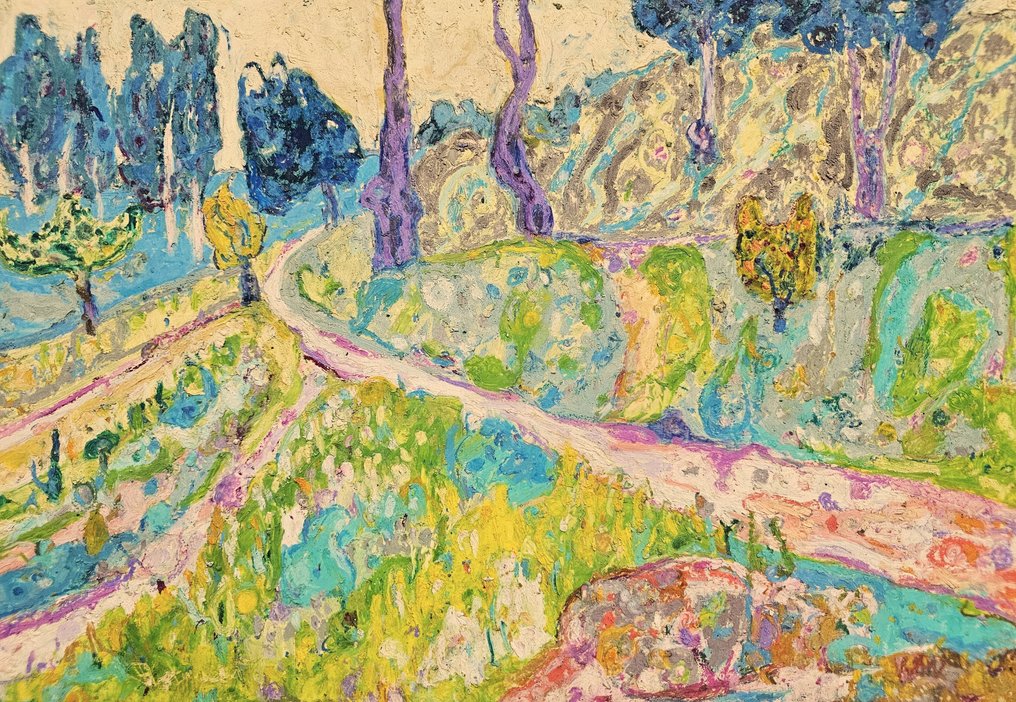
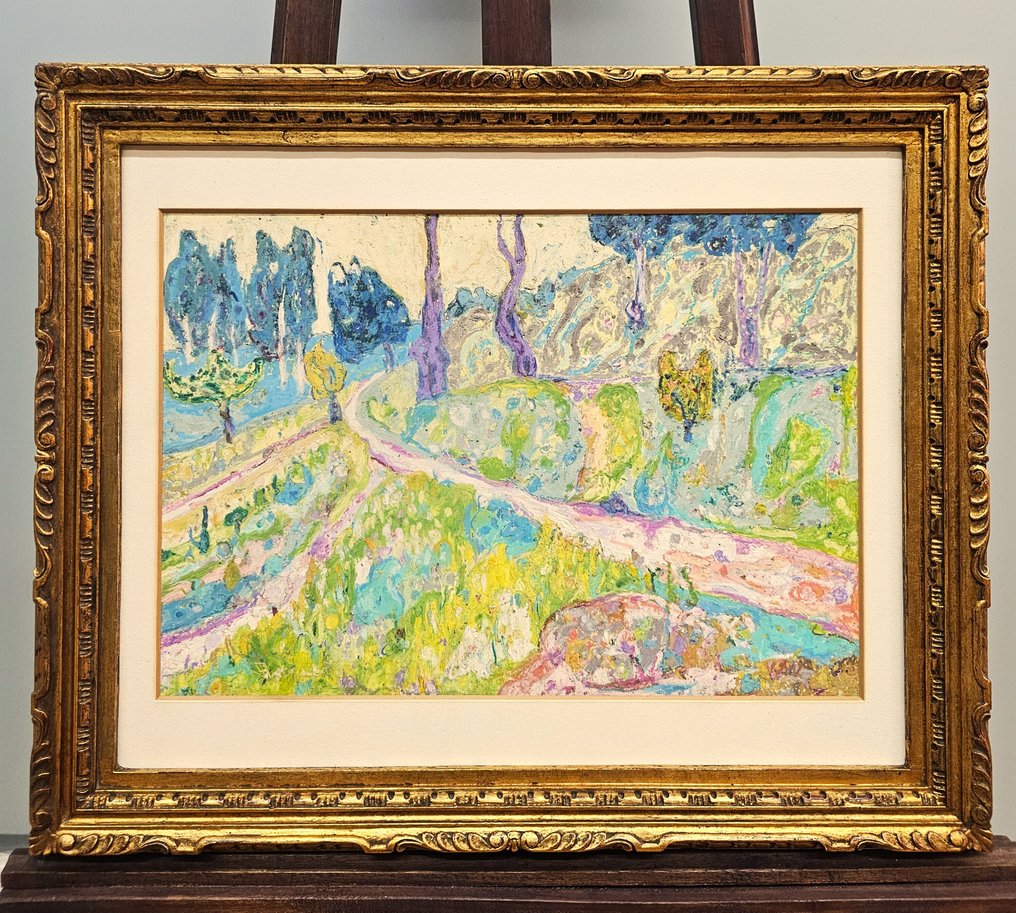
Le chemin chromatique, an original oil painting from 1900–1910, attributed to Pierre Bonnard or his circle in an early Nabi/Fauvist style, origin Peru, 55 × 66 cm with frame, unsigned, in good condition.
AI-assisted summary
Description from the seller
Technical sheet
The Chromatic Trail
Author: Attributed to Pierre Bonnard or his circle (first Nabi period, c. 1900).
School / Style: Intimate Post-Impressionism with early Fauvist drift.
Chronology: circa 1898–1905
Technique: Oil with touches of wax on panel.
Measurements: 55 × 66 cm with frame; 33.5 × 48.8 cm without frame.
Support: Original table with clear preparation, in accordance with Nabis practices.
Sign: lower right margin, partially obscured by the filling.
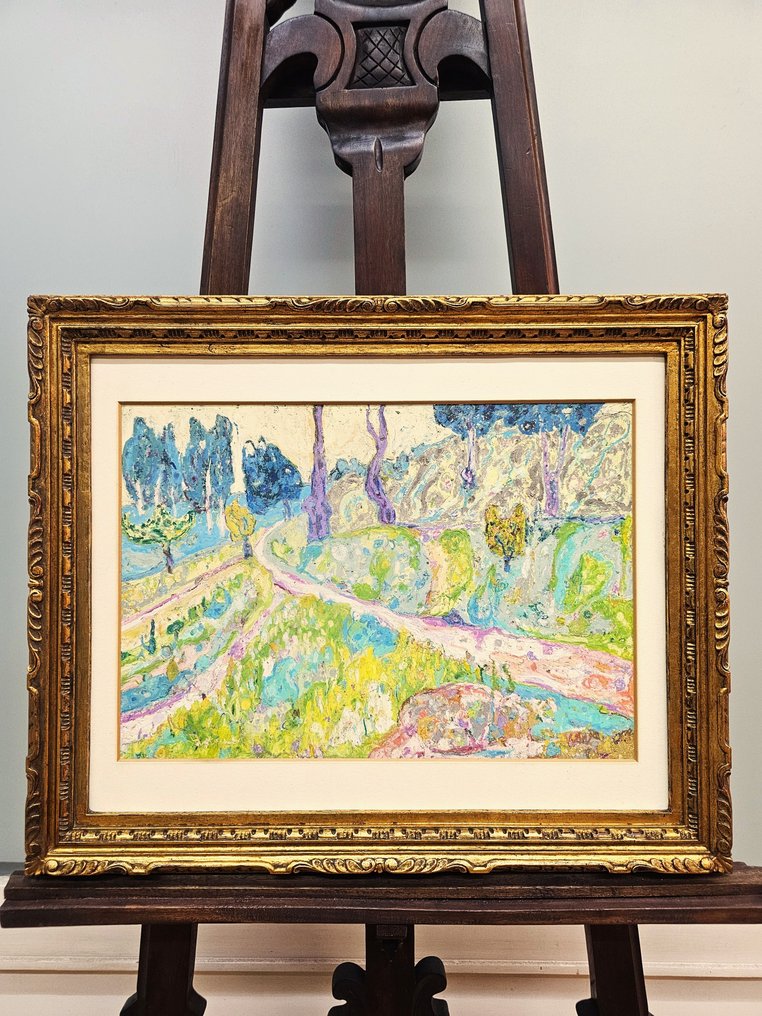
Splendid golden frame, contemporary and historicist, that enhances the pre-Raphaelite aura of the whole.
Condition: Excellent, with a vibrant filling and a very well-preserved surface.
2. Compositional and iconographic description
The landscape unfolds like a sensory stage, more felt than described, where a winding path organizes the scene under the intimate logic of color.
The greenish beds, pearly violets, opaline roses, and distant turquoises surprisingly accurately evoke Bonnard's luminous and domestic palette before his most well-known period in the south of France.
The trees, stylized and almost anthropomorphic, recall Nabi's taste for forms that breathe interiority, while the thick impasto—unusual but not incompatible with certain Bonnard studies—suggests a work of experimentation, perhaps executed en plein air but reworked in the studio.
The image does not seek to represent but to emulsion a memory, something profoundly Bonnardian: the landscape as an affective impression, stained with pure subjectivity.
It is a piece of enigmatic aura, whose chromatic energy sets it apart from academic productions, placing it within the creative orbit of a major artist.
Style, Attribution, and Valuation
The combination of a high palette, the sinuous structure of the path, deliberate absence of contour, and lyrical vibration of color allows for a plausible attribution to Pierre Bonnard's close circle, or even to his own hand in an early phase.
Its similarity to landscape studies by Nabis — such as those carried out by Bonnard in Île-de-France — is striking: the fragmented composition, the sensory perception of the environment, the emotional treatment of the landscape, and the brushstroke that suggests more than it defines.
Due to its rarity, its material power, and its coherent connection with Bonnard pre-1910, this work acquires a highly exclusive and collectible character, making it a piece that can generate great interest both curatorial and market-wise, especially in circles focused on French avant-garde prior to Fauvism.
Seller's Story
At Barcelona Art Gallery, we are a large family of art collectors in Barcelona who have been acquiring all kinds of paintings for 2 centuries.
Headquartered in the Les Corts neighborhood of Barcelona.
We offer part of our private collection for auction: high period and modern paintings that we have been acquiring over time, mainly from art galleries, antique dealers, auctions, private collections and very diverse origins.
Translated by Google TranslateTechnical sheet
The Chromatic Trail
Author: Attributed to Pierre Bonnard or his circle (first Nabi period, c. 1900).
School / Style: Intimate Post-Impressionism with early Fauvist drift.
Chronology: circa 1898–1905
Technique: Oil with touches of wax on panel.
Measurements: 55 × 66 cm with frame; 33.5 × 48.8 cm without frame.
Support: Original table with clear preparation, in accordance with Nabis practices.
Sign: lower right margin, partially obscured by the filling.
Splendid golden frame, contemporary and historicist, that enhances the pre-Raphaelite aura of the whole.
Condition: Excellent, with a vibrant filling and a very well-preserved surface.
2. Compositional and iconographic description
The landscape unfolds like a sensory stage, more felt than described, where a winding path organizes the scene under the intimate logic of color.
The greenish beds, pearly violets, opaline roses, and distant turquoises surprisingly accurately evoke Bonnard's luminous and domestic palette before his most well-known period in the south of France.
The trees, stylized and almost anthropomorphic, recall Nabi's taste for forms that breathe interiority, while the thick impasto—unusual but not incompatible with certain Bonnard studies—suggests a work of experimentation, perhaps executed en plein air but reworked in the studio.
The image does not seek to represent but to emulsion a memory, something profoundly Bonnardian: the landscape as an affective impression, stained with pure subjectivity.
It is a piece of enigmatic aura, whose chromatic energy sets it apart from academic productions, placing it within the creative orbit of a major artist.
Style, Attribution, and Valuation
The combination of a high palette, the sinuous structure of the path, deliberate absence of contour, and lyrical vibration of color allows for a plausible attribution to Pierre Bonnard's close circle, or even to his own hand in an early phase.
Its similarity to landscape studies by Nabis — such as those carried out by Bonnard in Île-de-France — is striking: the fragmented composition, the sensory perception of the environment, the emotional treatment of the landscape, and the brushstroke that suggests more than it defines.
Due to its rarity, its material power, and its coherent connection with Bonnard pre-1910, this work acquires a highly exclusive and collectible character, making it a piece that can generate great interest both curatorial and market-wise, especially in circles focused on French avant-garde prior to Fauvism.
Seller's Story
At Barcelona Art Gallery, we are a large family of art collectors in Barcelona who have been acquiring all kinds of paintings for 2 centuries.
Headquartered in the Les Corts neighborhood of Barcelona.
We offer part of our private collection for auction: high period and modern paintings that we have been acquiring over time, mainly from art galleries, antique dealers, auctions, private collections and very diverse origins.
Translated by Google TranslateDetails
Artist
École fauviste française (c.1905)
Sold with frame
Yes
Sold by
Gallery
Edition
Original
Title of artwork
Le chemin chromatique
Technique
Oil painting
Signature
Not signed
Country of Origin
Peru
Condition
Good condition
Height
55 cm
Width
66 cm
Weight
8 kg
Depiction/Theme
Landscape
Style
Fauvism
Period
1900-1910
Sold by
