Benito Espinos (1748-1818), Circle of - Bouquet baroque dans un vase en pierre




07
days
15
hours
35
minutes
54
seconds
Current bid
€ 120
Reserve price not met

17 other people are watching this object
 Bidder 7357 Bidder 7357 | €120 | |
|---|---|---|
 Bidder 6182 Bidder 6182 | €110 | |
 Bidder 0334 Bidder 0334 | €100 | |
Catawiki Buyer Protection
Your payment’s safe with us until you receive your object.View details
Trustpilot 4.4 | 122473 reviews
Rated Excellent on Trustpilot.
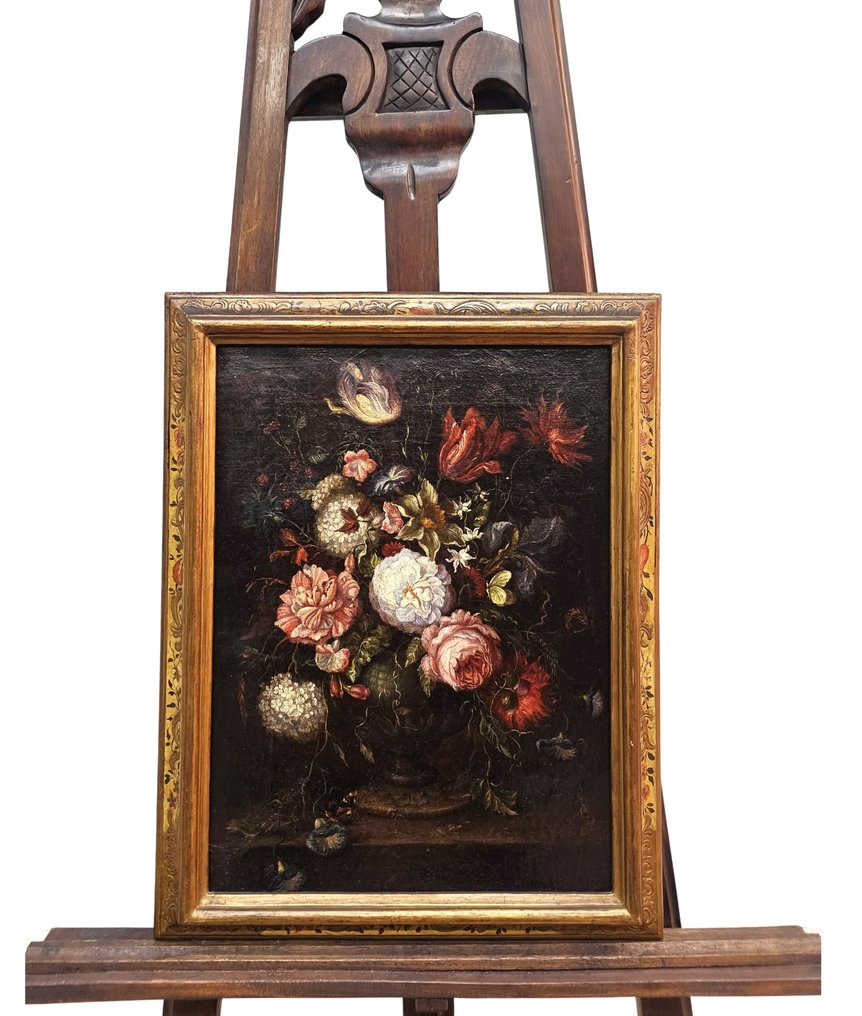
Bouquet baroque dans un vase en pierre, an 18th‑century oil painting from France depicting a floral still life and sold with frame.
AI-assisted summary
Description from the seller
Technical sheet
Baroque bouquet in a stone vase
Author: Anonymous master, Circulo de Benito Espinos (1748-1818)
A Spanish painter active around 1750 with training in late-Baroque Flemish models.
School / Style: Spanish school, floral tradition from the late Baroque with transitioning into Rococo.
Chronology: Circa 1750
Technique: oil on canvas
Measurements: 58 × 46 cm with frame; 50 × 37.5 cm without frame
Support: Antique canvas on original wedge frame.
Marco: An extraordinary handcrafted frame, very old, water-gilded and hand-painted with vegetal scrolls, a unique piece of great decorative value.
Condition: Good for its age; stable crackle, deep patina, and respectful ancient restorations.
2. Compositional and iconographic description
The work presents a luxurious floral arrangement placed in a stone vase, illuminated like a small floral altar against a dark background of great nobility.
Roses, peonies, carnations, and tulips—characteristic of the Hispano-Flamenco repertoire—alternate with wildflowers and small insects, forming a pyramidal composition of remarkable theatricality.
The light falls on the central flowers, revealing a refined work of layers and glazes that enhance the pearly whites and warm pinks, while intense reds and violets add emotional depth.
At its core, fallen petals, butterflies, and withered leaves introduce the baroque symbolism of the passage of time, reminding us that beauty, even when perfect, is ephemeral.
The set conveys an intimate, devotional, and aristocratic atmosphere, typical of Spanish cabinets from the mid-18th century, where the floral still life represented luxury, erudition, and a spiritual sensitivity.
3. Style, plausible attribution, and valuation
The dating around 1750 aligns with the balance between 17th-century Flemish heritage and the chromatic softness that anticipates Spanish Rococo.
Botanical detail, the taste for dense bouquets, and the treatment of the petals with luminous folds allow this work to be related to the Valencian and Madrid environment that revolved around Benito Espinós (1748–1818), one of the great innovators of the floral genre in Spain.
Although Espinós is somewhat later, several masters from his early circle—active around 1740–1760 and linked to the tradition of Juan de Arellano through the trade of prints and Flemish models—show very similar compositions: satinized flowers, deep dark backgrounds, butterflies, and similar lighting qualities.
Affinities are also observed with the language of Bartolomé Pérez in his later followers, especially in the contrasts of light and shadow and the theatricality of the overall composition, but with a style that is now lighter and rococo, typical of the mid-18th century.
The piece stands out for its exclusivity, its magnificent overall condition, and the preservation of an artisanal painted and gilded frame, which increases its historical and museological value.
In summary, a work of great interest within the Spanish floral still life circa 1750, with a plausible attribution to the pre-Spinosian environment that links the Baroque tradition with the floral elegance of the Age of Enlightenment.
Seller's Story
At Barcelona Art Gallery, we are a large family of art collectors in Barcelona who have been acquiring all kinds of paintings for 2 centuries.
Headquartered in the Les Corts neighborhood of Barcelona.
We offer part of our private collection for auction: high period and modern paintings that we have been acquiring over time, mainly from art galleries, antique dealers, auctions, private collections and very diverse origins.
Translated by Google TranslateTechnical sheet
Baroque bouquet in a stone vase
Author: Anonymous master, Circulo de Benito Espinos (1748-1818)
A Spanish painter active around 1750 with training in late-Baroque Flemish models.
School / Style: Spanish school, floral tradition from the late Baroque with transitioning into Rococo.
Chronology: Circa 1750
Technique: oil on canvas
Measurements: 58 × 46 cm with frame; 50 × 37.5 cm without frame
Support: Antique canvas on original wedge frame.
Marco: An extraordinary handcrafted frame, very old, water-gilded and hand-painted with vegetal scrolls, a unique piece of great decorative value.
Condition: Good for its age; stable crackle, deep patina, and respectful ancient restorations.
2. Compositional and iconographic description
The work presents a luxurious floral arrangement placed in a stone vase, illuminated like a small floral altar against a dark background of great nobility.
Roses, peonies, carnations, and tulips—characteristic of the Hispano-Flamenco repertoire—alternate with wildflowers and small insects, forming a pyramidal composition of remarkable theatricality.
The light falls on the central flowers, revealing a refined work of layers and glazes that enhance the pearly whites and warm pinks, while intense reds and violets add emotional depth.
At its core, fallen petals, butterflies, and withered leaves introduce the baroque symbolism of the passage of time, reminding us that beauty, even when perfect, is ephemeral.
The set conveys an intimate, devotional, and aristocratic atmosphere, typical of Spanish cabinets from the mid-18th century, where the floral still life represented luxury, erudition, and a spiritual sensitivity.
3. Style, plausible attribution, and valuation
The dating around 1750 aligns with the balance between 17th-century Flemish heritage and the chromatic softness that anticipates Spanish Rococo.
Botanical detail, the taste for dense bouquets, and the treatment of the petals with luminous folds allow this work to be related to the Valencian and Madrid environment that revolved around Benito Espinós (1748–1818), one of the great innovators of the floral genre in Spain.
Although Espinós is somewhat later, several masters from his early circle—active around 1740–1760 and linked to the tradition of Juan de Arellano through the trade of prints and Flemish models—show very similar compositions: satinized flowers, deep dark backgrounds, butterflies, and similar lighting qualities.
Affinities are also observed with the language of Bartolomé Pérez in his later followers, especially in the contrasts of light and shadow and the theatricality of the overall composition, but with a style that is now lighter and rococo, typical of the mid-18th century.
The piece stands out for its exclusivity, its magnificent overall condition, and the preservation of an artisanal painted and gilded frame, which increases its historical and museological value.
In summary, a work of great interest within the Spanish floral still life circa 1750, with a plausible attribution to the pre-Spinosian environment that links the Baroque tradition with the floral elegance of the Age of Enlightenment.
Seller's Story
At Barcelona Art Gallery, we are a large family of art collectors in Barcelona who have been acquiring all kinds of paintings for 2 centuries.
Headquartered in the Les Corts neighborhood of Barcelona.
We offer part of our private collection for auction: high period and modern paintings that we have been acquiring over time, mainly from art galleries, antique dealers, auctions, private collections and very diverse origins.
Translated by Google TranslateDetails
Artist
Benito Espinos (1748-1818)
Sold with frame
Yes
Attribution
Circle of
Title of artwork
Bouquet baroque dans un vase en pierre
Technique
Oil painting
Signature
Not signed
Country of Origin
France
Condition
Good condition
Height
62 cm
Width
53 cm
Weight
4 kg
Depiction/Theme
Plants and flowers
Style
Rococo
Period
18th century
Sold by
