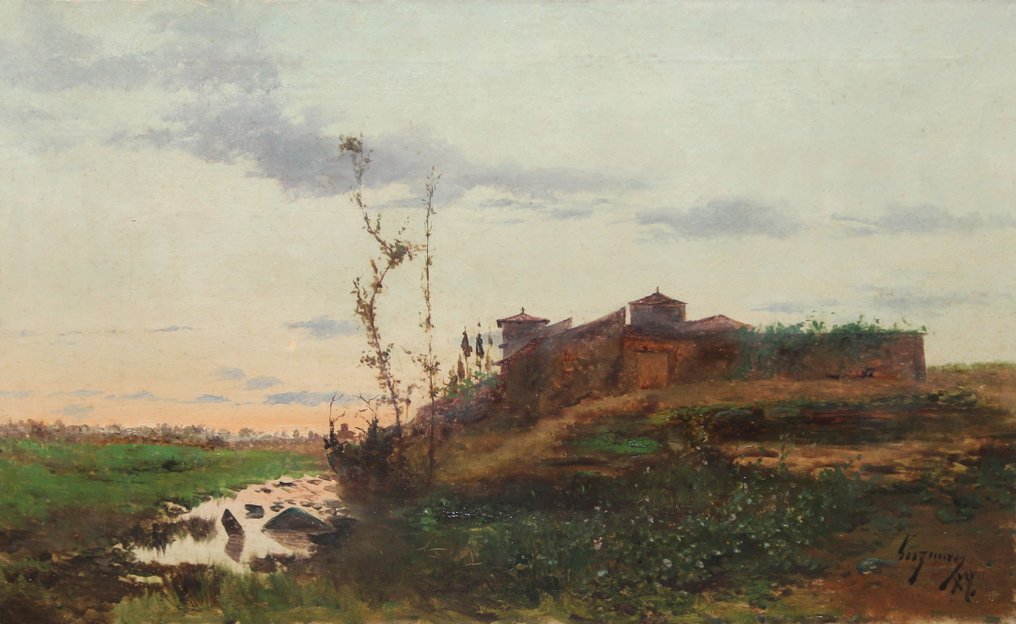
Juan Bautista Guzmán (1850-1898) - Paisaje


04
days
17
hours
46
minutes
49
seconds
Current bid
€ 185
Reserve price not met

5 other people are watching this object
 Bidder 6760 Bidder 6760 | €185 |
|---|
Catawiki Buyer Protection
Your payment’s safe with us until you receive your object.View details
Trustpilot 4.4 | 122630 reviews
Rated Excellent on Trustpilot.
Paisaje, an oil painting from Spain dating to the 19th century (1889).
AI-assisted summary
Description from the seller
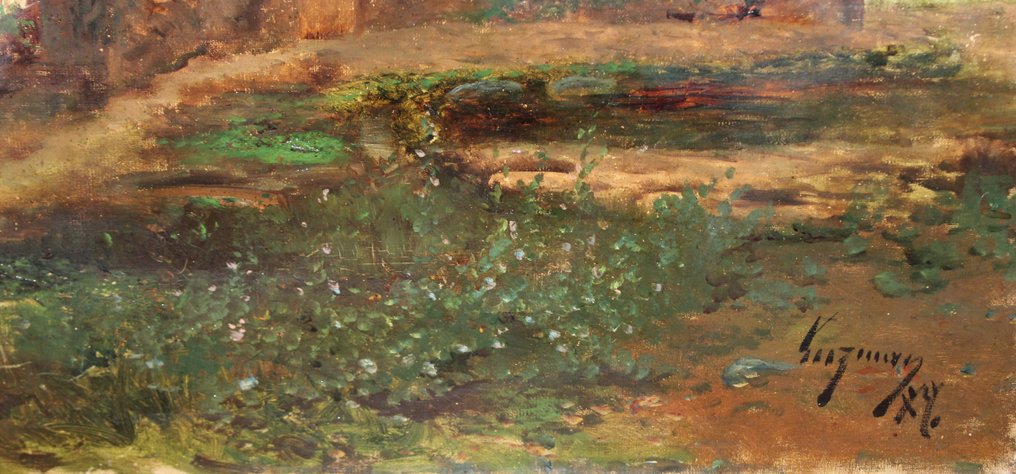
The work is signed by the artist at the bottom and dated 1889.
The work is in an acceptable state of conservation.
The work is presented without a frame.
Work measurements: 51 cm height x 81 cm width.
:::::::::::::::::::::::::::::::::::::::::::::::::::::::::::::::::::::::
Artist biography
Juan Bautista de Guzmán y Orantes (Granada, c. 1850 – Barcelona, September 12, 1898). Although born in Granada, Juan B. de Guzmán was raised in Málaga, a city where he began working as a printing compositor and later as a municipal official.
The Malagan painter Leoncio Talavera (1851 - 1878) instilled his passion for painting. Initially, with little knowledge, he created his first painting, which was a copy of a painting by his friend Talavera, and sold it for 125 pesetas.
After some rapid progress, the Málaga provincial council wanted to grant him a pension but was prevented from doing so, as he was not a native of that province. He then decided to move to Granada, where he dedicated himself entirely to painting. In his first participation in an exhibition, the Granada exhibition of 1876, he won his first prize.
In 1879, he participated in the Cádiz Exhibition, obtaining a silver medal, and in 1881, he displayed his works at the National Exhibition of Madrid.
Later established in Barcelona, he participated with two paintings in the Fine Arts Exhibition of the Catalan capital in 1888 and 1891, with works such as *Garden*, *A Wrong Path* (or *The Open-Air Library*), *A Hungarian Family Begging for Charity*, *Barley to the Dead Donkey*, and *Sensitivity*, as well as in the 1896 edition.
The theme of his paintings recalls the Andalusian characteristic style, set in scenes of taverns and Granada courtyards, featuring peasants, bullfighters, and manolas. When critic García Llansó visited his studio on Barcelona's Balmes street in 1891, he observed that the artist always had the habit of painting several works at once.
In Barcelona, he lived at 31 Balmes Street. He passed away at the Gracia dispensary after suffering an accident while walking along Passeig de Gràcia in the city of the Counts.
The work is signed by the artist at the bottom and dated 1889.
The work is in an acceptable state of conservation.
The work is presented without a frame.
Work measurements: 51 cm height x 81 cm width.
:::::::::::::::::::::::::::::::::::::::::::::::::::::::::::::::::::::::
Artist biography
Juan Bautista de Guzmán y Orantes (Granada, c. 1850 – Barcelona, September 12, 1898). Although born in Granada, Juan B. de Guzmán was raised in Málaga, a city where he began working as a printing compositor and later as a municipal official.
The Malagan painter Leoncio Talavera (1851 - 1878) instilled his passion for painting. Initially, with little knowledge, he created his first painting, which was a copy of a painting by his friend Talavera, and sold it for 125 pesetas.
After some rapid progress, the Málaga provincial council wanted to grant him a pension but was prevented from doing so, as he was not a native of that province. He then decided to move to Granada, where he dedicated himself entirely to painting. In his first participation in an exhibition, the Granada exhibition of 1876, he won his first prize.
In 1879, he participated in the Cádiz Exhibition, obtaining a silver medal, and in 1881, he displayed his works at the National Exhibition of Madrid.
Later established in Barcelona, he participated with two paintings in the Fine Arts Exhibition of the Catalan capital in 1888 and 1891, with works such as *Garden*, *A Wrong Path* (or *The Open-Air Library*), *A Hungarian Family Begging for Charity*, *Barley to the Dead Donkey*, and *Sensitivity*, as well as in the 1896 edition.
The theme of his paintings recalls the Andalusian characteristic style, set in scenes of taverns and Granada courtyards, featuring peasants, bullfighters, and manolas. When critic García Llansó visited his studio on Barcelona's Balmes street in 1891, he observed that the artist always had the habit of painting several works at once.
In Barcelona, he lived at 31 Balmes Street. He passed away at the Gracia dispensary after suffering an accident while walking along Passeig de Gràcia in the city of the Counts.
Details
Artist
Juan Bautista Guzmán (1850-1898)
Sold with frame
No
Title of artwork
Paisaje
Technique
Oil painting
Signature
Hand signed
Country of Origin
Spain
Year
1889
Condition
Fair condition
Height
51 cm
Width
81 cm
Period
19th century
Sold by
