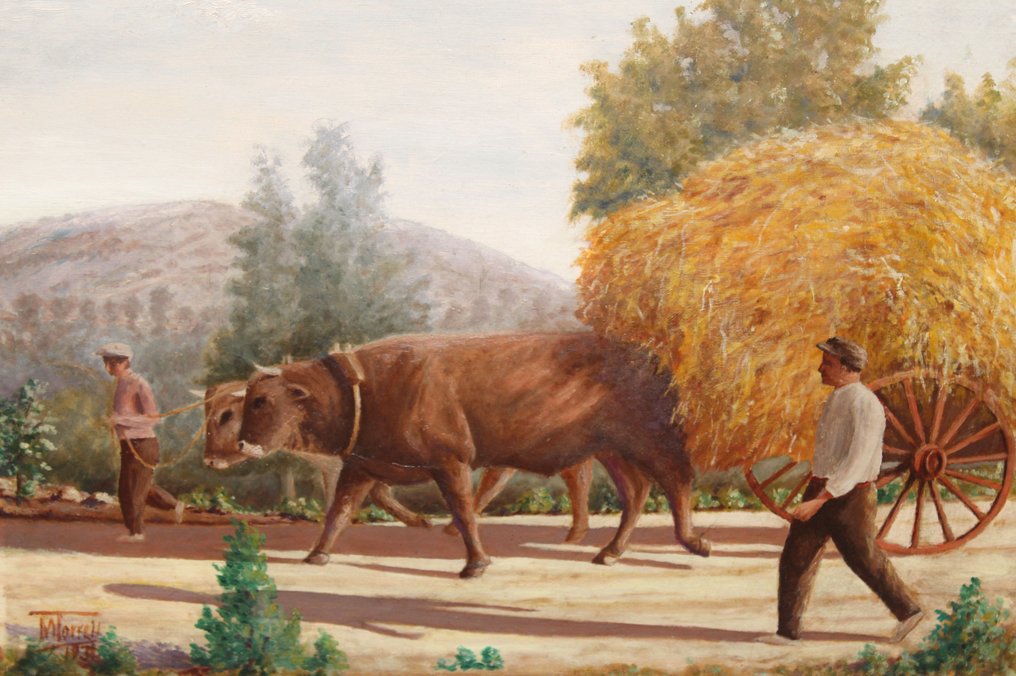
Mariano Torrell (1904-1978) - Regreso de la siega


08
days
23
hours
06
minutes
48
seconds
Starting bid
€ 1
Reserve price not met

No bids placed
Catawiki Buyer Protection
Your payment’s safe with us until you receive your object.View details
Trustpilot 4.4 | 122529 reviews
Rated Excellent on Trustpilot.
Oil painting titled Regreso de la siega (1936) by Mariano Torrell (1904-1978), a 60 × 78 cm original work in España, signed by hand and in acceptable condition, unframed.
AI-assisted summary
Description from the seller
The work is signed at the bottom by the artist and dated 1936.
The condition of the work is acceptable.
Presented without a frame
Work measurements: 60 cm in height x 78 cm in width.
:::::::::::::::::::::::::::::::::::::::::::::::::::::::::::::::::::::::::::::::::::::::::::::::::
Biography of the painter.
Mariano Torrell (Tarragona, 1904 – Barcelona, 1978) was a Catalan painter specializing in rural scenes and landscapes of the interior of Tarragona. His work, marked by a luminist sensitivity and a deep respect for rural life, is part of the artistic tradition of Mediterranean realism.
Son of a small merchant from Tarragonese, Torrell demonstrated from a very young age a remarkable inclination for drawing and color. In 1920, he enrolled at the Escola de Belles Arts de Barcelona, where he studied with teachers such as Francesc Labarta and Josep Mongrell, from whom he learned the value of balanced composition and chromatic clarity. During his formative years, he frequently traveled through Priorat, the Camp de Tarragona, and the Ribera d’Ebre, places that would later become recurring settings in his painting.
Throughout the 1930s and 1940s, he developed a sober yet poetic style focused on rural scenes: peasants working the land, flocks at sunset, farmhouses among vineyards and olive groves, and humble interiors of country houses. His brush leaned towards a warm, earthy palette, influenced by post-impressionism and certain echoes of the Novecento movement.
During the postwar period, Torrell exhibited in small galleries in Reus and Barcelona, and sporadically participated in provincial competitions, where he received several local awards. Although he never achieved great national fame, his work was highly appreciated in regional circles for its plastic honesty and fidelity to the Catalan land.
In the sixties, he partially retired to his workshop in Altafulla, dedicating himself to teaching and small-format painting. He died in Barcelona in 1978, leaving behind a prolific and coherent body of work that is now mainly preserved in private collections in Tarragona and Reus.
The work is signed at the bottom by the artist and dated 1936.
The condition of the work is acceptable.
Presented without a frame
Work measurements: 60 cm in height x 78 cm in width.
:::::::::::::::::::::::::::::::::::::::::::::::::::::::::::::::::::::::::::::::::::::::::::::::::
Biography of the painter.
Mariano Torrell (Tarragona, 1904 – Barcelona, 1978) was a Catalan painter specializing in rural scenes and landscapes of the interior of Tarragona. His work, marked by a luminist sensitivity and a deep respect for rural life, is part of the artistic tradition of Mediterranean realism.
Son of a small merchant from Tarragonese, Torrell demonstrated from a very young age a remarkable inclination for drawing and color. In 1920, he enrolled at the Escola de Belles Arts de Barcelona, where he studied with teachers such as Francesc Labarta and Josep Mongrell, from whom he learned the value of balanced composition and chromatic clarity. During his formative years, he frequently traveled through Priorat, the Camp de Tarragona, and the Ribera d’Ebre, places that would later become recurring settings in his painting.
Throughout the 1930s and 1940s, he developed a sober yet poetic style focused on rural scenes: peasants working the land, flocks at sunset, farmhouses among vineyards and olive groves, and humble interiors of country houses. His brush leaned towards a warm, earthy palette, influenced by post-impressionism and certain echoes of the Novecento movement.
During the postwar period, Torrell exhibited in small galleries in Reus and Barcelona, and sporadically participated in provincial competitions, where he received several local awards. Although he never achieved great national fame, his work was highly appreciated in regional circles for its plastic honesty and fidelity to the Catalan land.
In the sixties, he partially retired to his workshop in Altafulla, dedicating himself to teaching and small-format painting. He died in Barcelona in 1978, leaving behind a prolific and coherent body of work that is now mainly preserved in private collections in Tarragona and Reus.
Details
Artist
Mariano Torrell (1904-1978)
Sold with frame
No
Sold by
Gallery
Edition
Original
Title of artwork
Regreso de la siega
Technique
Oil painting
Signature
Hand signed
Country of Origin
Spain
Year
1936
Condition
Fair condition
Height
60 cm
Width
78 cm
Period
1930-1940
Sold by
