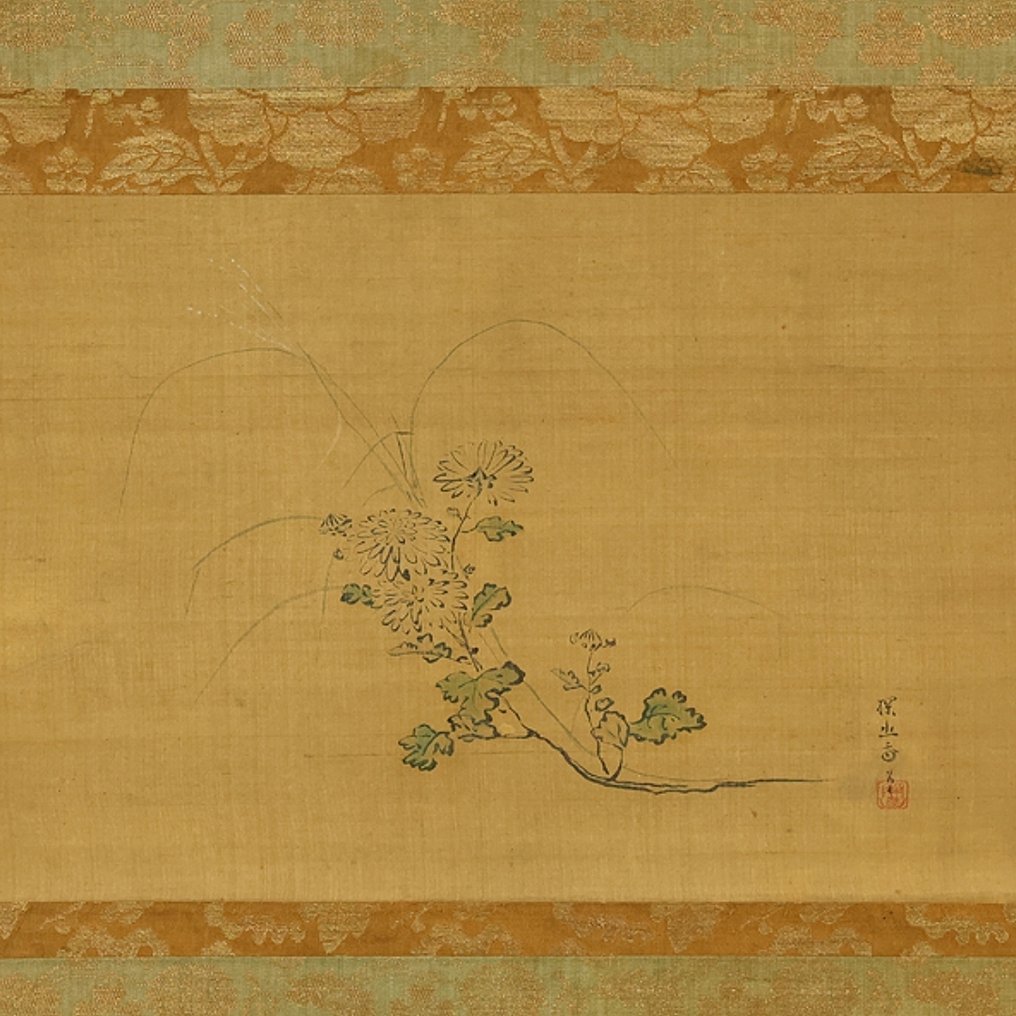
Wild Chrysanthemum - Beauty of Simplicity and Blank with Box - Attributed to Kano Tan'yū 狩野探幽 (1602-1674) - Japan - Vroege Edo periode (Zonder Minimumprijs)


01
dag
20
uren
20
minuten
27
seconden
Huidig bod
€ 140
Geen minimumprijs

Expert
Geselecteerd door Giovanni Bottero
Heeft een masterdiploma in Japanse kunstgeschiedenis en meer dan 10 jaar ervaring.
Geschatte waarde € 400 - € 500
37 andere personen volgen dit object
 Bieder 1281 Bieder 1281 | € 140 | |
|---|---|---|
| Bieder 8175 | € 130 | |
| Bieder 1281 | € 110 | |
Catawiki Kopersbescherming
Je betaling is veilig bij ons totdat je het object hebt ontvangen.Bekijk details
Trustpilot 4.4 | 121899 reviews
Beoordeeld als "Uitstekend" op Trustpilot.
Een verfijnde kakejiku toegeschreven aan Kano Tan’yū uit de zeventiende eeuw met met de hand geschilderde wilde chrysanten en een minimalistische compositie die tot rust leidt.
AI-gegenereerde samenvatting
Beschrijving van de verkoper
狩野探幽 Kano Tanyu (1602-1674)
Painter of the early Edo period and establisher of Edo Kano school. The eldest son of 狩野孝信 Kano Takanobu (1751-1618) and grandson of Kano Eitoku (1543-1590). Founder of the Kajibashi Kano school. He is said to be a precocious genius and is praised as the second coming of Eitoku. His wide range of works includes Sansui landscapes, figures, flowers, and birds. Tanyu's elegant new style, which made use of marginal spaces, was called the Edo Kano style, and it was inherited as the standard of the Kano school thereafter. He was active in the paintings of castles such as Nijo Castle, Osaka Castle, Nagoya Castle, and Edo Castle, as well as in the painting of the inner court. He was also in charge of the decoration of the Tokugawa family mausoleums such as Nikko Toshogu, Zojoji, Kan-eiji, and Edo Castle's Momijiyama.
with signature 'Tanyusai hitsu' 探幽斎筆 and seal 'Tanyu' 探幽
A refined Japanese hanging scroll attributed to Kanō Tan’yū (狩野探幽), a leading master of the early Edo period and one of the most influential painters of the Kanō school. The artwork presents a delicate rendering of wild chrysanthemums (nogiku), executed in subtle ink and color with a minimalist composition. In Japanese aesthetics, wild chrysanthemums symbolize modesty, transience, and seasonal change. Their understated beauty reflects the principles of wabi (quiet elegance) and kanso (simplicity), while the use of blank space (ma) invites contemplation and emotional resonance. Tan’yū’s botanical works are known for their poetic restraint and refined brushwork, capturing nature’s essence with minimal means. The scroll is accompanied by a preservation box. Likely produced in the mid-17th century, it embodies the philosophical depth and visual clarity of classical Japanese painting.
Attributed to 狩野探幽 Kano Tan'yū (1602-1674) Japanese antique art kakejiku kakemono wall hanging scroll / Wild Chrysanthemum - Beauty of Simplicity and Blank with Box
Whole dimensions: 20.3" W x 41.5" H / 51.6cm x 105.5cm
Inside dimensions: 14" W x 8.8" H / 35.6cm x 22.5cm
Material: Silk
Technique: Handpainted
Roller ends: Bone
Weight: 580g including Box
Condition
Antique items have originally crease, stain, damage, and more. I would like you to refer to the listing photos, but please understand that it's difficult to show all conditions by the photos. Special notes: STAIN, CREASE, DAMAGE a little, FOLD, STAIN in the back of the mounting.
Shipping
"FREE SHIPPING" all over the world by Registered Airmail, EMS, or DHL.
De verkoper stelt zich voor
Reiwa Antiques is een officieel erkende antiquair gevestigd in Japan en biedt een scala aan authentiek Japans antiek, waaronder traditionele schilderijen, prachtige kalligrafie en prachtig theegerei. Ons doel is om u een prettige koopervaring te blijven bieden. Als onderdeel daarvan bieden wij gratis verzending aan, om uw BTW- en invoerbelastingdruk zoveel mogelijk te verminderen. Wij houden ons al meer dan 10 jaar bezig met buitenlandse transacties. U kunt er zeker van zijn dat we uw artikelen altijd zorgvuldig verpakken en ons best doen om uw artikelen veilig te bezorgen. De gebruikelijke verzendmethoden zijn geregistreerde luchtpost, EMS (Postal versneld) of DHL. Aarzel niet om mij te laten weten of u vragen heeft of hulp nodig heeft.
Met vriendelijke groet,
Reiwa Antiek
Vertaald door Google Translate狩野探幽 Kano Tanyu (1602-1674)
Painter of the early Edo period and establisher of Edo Kano school. The eldest son of 狩野孝信 Kano Takanobu (1751-1618) and grandson of Kano Eitoku (1543-1590). Founder of the Kajibashi Kano school. He is said to be a precocious genius and is praised as the second coming of Eitoku. His wide range of works includes Sansui landscapes, figures, flowers, and birds. Tanyu's elegant new style, which made use of marginal spaces, was called the Edo Kano style, and it was inherited as the standard of the Kano school thereafter. He was active in the paintings of castles such as Nijo Castle, Osaka Castle, Nagoya Castle, and Edo Castle, as well as in the painting of the inner court. He was also in charge of the decoration of the Tokugawa family mausoleums such as Nikko Toshogu, Zojoji, Kan-eiji, and Edo Castle's Momijiyama.
with signature 'Tanyusai hitsu' 探幽斎筆 and seal 'Tanyu' 探幽
A refined Japanese hanging scroll attributed to Kanō Tan’yū (狩野探幽), a leading master of the early Edo period and one of the most influential painters of the Kanō school. The artwork presents a delicate rendering of wild chrysanthemums (nogiku), executed in subtle ink and color with a minimalist composition. In Japanese aesthetics, wild chrysanthemums symbolize modesty, transience, and seasonal change. Their understated beauty reflects the principles of wabi (quiet elegance) and kanso (simplicity), while the use of blank space (ma) invites contemplation and emotional resonance. Tan’yū’s botanical works are known for their poetic restraint and refined brushwork, capturing nature’s essence with minimal means. The scroll is accompanied by a preservation box. Likely produced in the mid-17th century, it embodies the philosophical depth and visual clarity of classical Japanese painting.
Attributed to 狩野探幽 Kano Tan'yū (1602-1674) Japanese antique art kakejiku kakemono wall hanging scroll / Wild Chrysanthemum - Beauty of Simplicity and Blank with Box
Whole dimensions: 20.3" W x 41.5" H / 51.6cm x 105.5cm
Inside dimensions: 14" W x 8.8" H / 35.6cm x 22.5cm
Material: Silk
Technique: Handpainted
Roller ends: Bone
Weight: 580g including Box
Condition
Antique items have originally crease, stain, damage, and more. I would like you to refer to the listing photos, but please understand that it's difficult to show all conditions by the photos. Special notes: STAIN, CREASE, DAMAGE a little, FOLD, STAIN in the back of the mounting.
Shipping
"FREE SHIPPING" all over the world by Registered Airmail, EMS, or DHL.
De verkoper stelt zich voor
Reiwa Antiques is een officieel erkende antiquair gevestigd in Japan en biedt een scala aan authentiek Japans antiek, waaronder traditionele schilderijen, prachtige kalligrafie en prachtig theegerei. Ons doel is om u een prettige koopervaring te blijven bieden. Als onderdeel daarvan bieden wij gratis verzending aan, om uw BTW- en invoerbelastingdruk zoveel mogelijk te verminderen. Wij houden ons al meer dan 10 jaar bezig met buitenlandse transacties. U kunt er zeker van zijn dat we uw artikelen altijd zorgvuldig verpakken en ons best doen om uw artikelen veilig te bezorgen. De gebruikelijke verzendmethoden zijn geregistreerde luchtpost, EMS (Postal versneld) of DHL. Aarzel niet om mij te laten weten of u vragen heeft of hulp nodig heeft.
Met vriendelijke groet,
Reiwa Antiek
Vertaald door Google TranslateDetails
Kunstenaar
Attributed to Kano Tan'yū 狩野探幽 (1602-1674)
Toeschrijving
Toegeschreven aan
Titel van kunstwerk
Wild Chrysanthemum - Beauty of Simplicity and Blank with Box
Signatuur
Handgesigneerd
Land van herkomst
Japan
Staat
In goede staat
Hoogte
105,5 cm
Breedte
51,6 cm
Gewicht
580 g
Afbeelding/Thema
Planten en bloemen
Stijl
Klassiek
Periode
17e eeuw
Dynastieke stijl/periode
Vroege Edo periode
Herkomst
Galeriehouder / Antiekhandelaar
Verkocht door
