Nr 100082296

Sprzedane
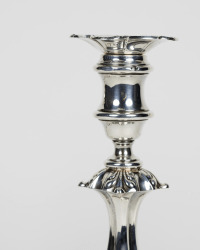
Henri Clavel - Paris, Meaux - Miseczka z uchwytem - French Sterling - 1784 Louis XVI miska
Ostateczna oferta
€ 2.000
1 tydzień temu

Henri Clavel - Paris, Meaux - Miseczka z uchwytem - French Sterling - 1784 Louis XVI miska

A Fine Louis XVI Period French Silver Écuelle (Covered Porringer), dated 1784 This elegant silver écuelle, or covered two-handled porringer, dates to 1784 during the reign of Louis XVI (1774–1792). It exemplifies the refined neoclassical taste of late 18th-century France, just before the Revolution. Design and Craftsmanship The circular bowl rests on a short foot, with a domed cover topped by a finely modeled rosebud finial—a charming naturalistic motif popular in the Louis XVI era, symbolizing delicacy and the influence of rococo lingering into neoclassicism. The body, lid, and everted rim feature lavish repoussé and chased decoration: swirling acanthus leaves, clusters of berries, blooming roses, and scrolling foliage create a rich, textured surface that catches the light beautifully. The two opposed handles take stylized leaf or shell forms, enhancing the organic, flowing aesthetic typical of the period. The restrained gadrooning at the base adds subtle texture without overpowering the floral motifs. Écuelles served primarily for consuming broth or bouillon, often at bedside for invalids, new mothers, or during morning levees in aristocratic households. They formed part of elite toilette or breakfast services, reflecting the opulence of pre-Revolutionary French silver. Hallmarks and Provenance The piece bears characteristic Ancien Régime hallmarks: Silver Hallmarks from 1784 France. Paris, Province Meaux From Left (Monogram) Henri Clavel - source A Guide to Old French Plate, Louis Carre, 1931 page 38 (Makers Mark) Poinçon de garantie province- Meaux, MCX, couronné, Meaux.— Wardens' marks : the date-letter, crowned, the letters M and X, and a cat. New mark adopted in 1784 : a cat, and the date. The work of the goldsmiths of Coulommiers, Ferte-sous-Jouarre and Lagny-surMarne was marked at Meaux. Makers' marks at the end of the seventeenth century : the initials of the maker, the letter M, crowned, and two allowance grains. - source A Guide to Old French Plate, Louis Carre, 1931 page 72 (Date Mark) P for 1784 year, Paris These marks place the écuelle firmly in Paris, 1784, under the fermiers généraux system. Surviving pre-1789 French silver remains exceptionally rare, as vast quantities were melted down during royal edicts, wartime shortages, and the Revolution itself. Condition and Weight The piece shows honest age and use—polishing wear, minor dings, and a warm patina that enhances its historical character—while remaining in very good overall condition. It weighs approximately 298 grams (as photographed on a scale), consistent with high-quality 18th-century French silver of .950 or .925 standard. This écuelle stands as a superb and scarce survivor of Louis XVI silver, combining masterful chasing, evocative naturalistic design, and documented provenance to a pivotal year in French history. It would grace any collection of 18th-century European silver or decorative arts. Diameter 13cm without handles, 20cm with handles Height 12cm Henri Clavel (also spelled Henry Clavel in some sources) was a prominent Fermier Général (General Farmer/Tax Farmer) in late 18th-century France, specifically responsible for overseeing the collection of duties (taxes) on precious metals, including gold and silver, in Paris and certain other areas during the Ancien Régime. His Role and Period He served as the Fermier Général for the Paris assay office (and related jurisdictions) from July 13, 1780, until around 1789 (with some sources noting his direct regime ending in 1784–1786, transitioning to successors like Jean-François Kalendrin just before the French Revolution). Fermiers Généraux were wealthy financiers who "farmed" (leased) the right to collect indirect taxes on behalf of the Crown. This system was highly lucrative but unpopular, as it was seen as exploitative. In the context of silver and gold work, Clavel's administration introduced specific charge marks (tax incoming) and discharge marks (tax outgoing/export) on precious metal objects. These included symbols like crowned letters (e.g., crowned A, crowned P), interlaced letters (e.g., double Ls), animal heads (e.g., parrot head, eagle's head), or other devices, varying by year and type of object (large vs. small works, gold vs. silver). Significance for Silver Hallmarks Silver pieces made in Paris during his tenure (1780–1789) often bear his associated marks, confirming high purity (typically .950/.958 for large silver items, .916 for gold). Examples include: Crowned "A" or "P" as date/warden letters. Parrot head or soldier's head as discharge marks (from 1786 onward under his regime). These marks appear on luxurious Louis XVI-era items like candelabras, salt cellars, and gold boxes. A famous artifact is a silvered copper plaque listing all the hallmarks used under Clavel's Régie de Paris (1780–1784), preserved and occasionally auctioned.

Nr 100082296

Sprzedane
Henri Clavel - Paris, Meaux - Miseczka z uchwytem - French Sterling - 1784 Louis XVI miska

Henri Clavel - Paris, Meaux - Miseczka z uchwytem - French Sterling - 1784 Louis XVI miska

A Fine Louis XVI Period French Silver Écuelle (Covered Porringer), dated 1784
This elegant silver écuelle, or covered two-handled porringer, dates to 1784 during the reign of Louis XVI (1774–1792). It exemplifies the refined neoclassical taste of late 18th-century France, just before the Revolution.
Design and Craftsmanship
The circular bowl rests on a short foot, with a domed cover topped by a finely modeled rosebud finial—a charming naturalistic motif popular in the Louis XVI era, symbolizing delicacy and the influence of rococo lingering into neoclassicism. The body, lid, and everted rim feature lavish repoussé and chased decoration: swirling acanthus leaves, clusters of berries, blooming roses, and scrolling foliage create a rich, textured surface that catches the light beautifully. The two opposed handles take stylized leaf or shell forms, enhancing the organic, flowing aesthetic typical of the period. The restrained gadrooning at the base adds subtle texture without overpowering the floral motifs.
Écuelles served primarily for consuming broth or bouillon, often at bedside for invalids, new mothers, or during morning levees in aristocratic households. They formed part of elite toilette or breakfast services, reflecting the opulence of pre-Revolutionary French silver.

Hallmarks and Provenance
The piece bears characteristic Ancien Régime hallmarks:
Silver Hallmarks from 1784 France. Paris, Province Meaux
From Left
(Monogram) Henri Clavel - source A Guide to Old French Plate, Louis Carre, 1931 page 38
(Makers Mark) Poinçon de garantie province- Meaux, MCX, couronné, Meaux.— Wardens' marks : the date-letter, crowned, the letters M and X, and a cat. New mark adopted in 1784 : a cat, and the date.
The work of the goldsmiths of Coulommiers, Ferte-sous-Jouarre and Lagny-surMarne was marked at Meaux.
Makers' marks at the end of the seventeenth century : the initials of the maker, the letter M, crowned, and two allowance grains. - source A Guide to Old French Plate, Louis Carre, 1931 page 72
(Date Mark) P for 1784 year, Paris
These marks place the écuelle firmly in Paris, 1784, under the fermiers généraux system. Surviving pre-1789 French silver remains exceptionally rare, as vast quantities were melted down during royal edicts, wartime shortages, and the Revolution itself.

Condition and Weight
The piece shows honest age and use—polishing wear, minor dings, and a warm patina that enhances its historical character—while remaining in very good overall condition. It weighs approximately 298 grams (as photographed on a scale), consistent with high-quality 18th-century French silver of .950 or .925 standard.
This écuelle stands as a superb and scarce survivor of Louis XVI silver, combining masterful chasing, evocative naturalistic design, and documented provenance to a pivotal year in French history. It would grace any collection of 18th-century European silver or decorative arts.

Diameter 13cm without handles, 20cm with handles
Height 12cm

Henri Clavel (also spelled Henry Clavel in some sources) was a prominent Fermier Général (General Farmer/Tax Farmer) in late 18th-century France, specifically responsible for overseeing the collection of duties (taxes) on precious metals, including gold and silver, in Paris and certain other areas during the Ancien Régime.
His Role and Period

He served as the Fermier Général for the Paris assay office (and related jurisdictions) from July 13, 1780, until around 1789 (with some sources noting his direct regime ending in 1784–1786, transitioning to successors like Jean-François Kalendrin just before the French Revolution).
Fermiers Généraux were wealthy financiers who "farmed" (leased) the right to collect indirect taxes on behalf of the Crown. This system was highly lucrative but unpopular, as it was seen as exploitative.
In the context of silver and gold work, Clavel's administration introduced specific charge marks (tax incoming) and discharge marks (tax outgoing/export) on precious metal objects. These included symbols like crowned letters (e.g., crowned A, crowned P), interlaced letters (e.g., double Ls), animal heads (e.g., parrot head, eagle's head), or other devices, varying by year and type of object (large vs. small works, gold vs. silver).

Significance for Silver Hallmarks

Silver pieces made in Paris during his tenure (1780–1789) often bear his associated marks, confirming high purity (typically .950/.958 for large silver items, .916 for gold).
Examples include:
Crowned "A" or "P" as date/warden letters.
Parrot head or soldier's head as discharge marks (from 1786 onward under his regime).
These marks appear on luxurious Louis XVI-era items like candelabras, salt cellars, and gold boxes.

A famous artifact is a silvered copper plaque listing all the hallmarks used under Clavel's Régie de Paris (1780–1784), preserved and occasionally auctioned.

Ostateczna oferta
€ 2.000
Inés Fernández
Ekspert
Oszacuj cenę  € 2.500 - € 2.800

Podobne przedmioty

Dla Ciebie w

Srebrne i złote dekoracje

Ustaw alert wyszukiwania
Ustaw alert wyszukiwania, aby otrzymywać powiadomienia o nowych dopasowaniach.

Ten przedmiot został zaprezentowany w


Jak kupować w serwisie Catawiki

Dowiedz się więcej o naszej ochronie nabywców

      1. Odkryj coś wyjątkowego

      Przeglądaj tysiące wyjątkowych przedmiotów wybranych przez ekspertów. Zobacz zdjęcia, szczegóły i wartość szacunkową każdego wyjątkowego przedmiotu. 

      2. Złóż najwyższą ofertę

      Znajdź coś, co Ci się podoba i złóż najwyższą ofertę. Możesz śledzić aukcję do końca lub pozwolić naszemu systemowi licytować za Ciebie. Wszystko, co musisz zrobić, to ustawić ofertę na maksymalną kwotę, którą planujesz wydać. 

      3. Dokonaj bezpiecznej płatności

      Zapłać za swój wyjątkowy przedmiot, a my zabezpieczymy Twoją płatność, dopóki Twój przedmiot nie dotrze bezpiecznie do Ciebie. Używamy zaufanego systemu płatności do obsługi wszystkich transakcji. 

Masz coś podobnego do sprzedania?

Niezależnie od tego, czy dopiero zaczynasz przygodę z aukcjami internetowymi, czy sprzedajesz już profesjonalnie, możemy pomóc Ci sprzedać Twoje wyjątkowe przedmioty za wyższe kwoty, tak abyś mógł zarobić więcej.

Sprzedaj swój przedmiot