
Nr 108341920

Sprzedane
Cabassutius - Juris Canonici Theoria et Praxis - 1709
Ostateczna oferta
€ 224
Bez ceny minimalnej
2 dni temu

Cabassutius - Juris Canonici Theoria et Praxis - 1709

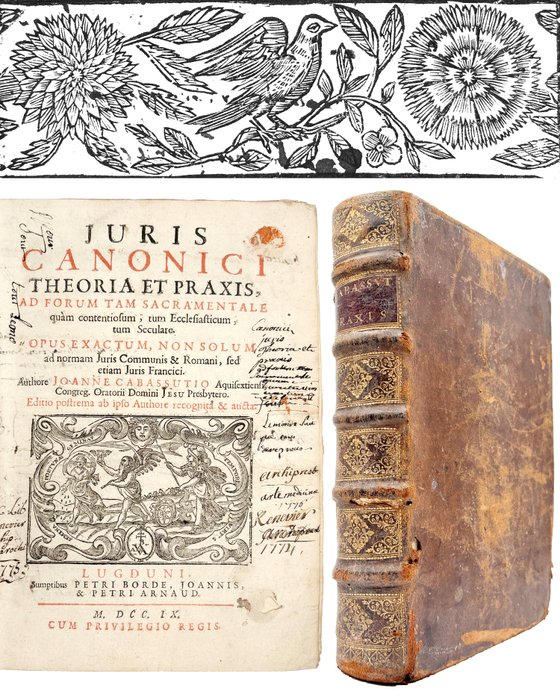
[CANON LAW – CHURCH COURTS – SACRAMENTS – ECCLESIASTICAL JURISPRUDENCE – MANUSCRIPT PROVENANCE] Very fine copy of the standard handbook of canon law from the Lyon press, 1709 – with eighteenth-century manuscript inscriptions from a French archpriest’s library “Juris Canonici Theoria et Praxis ad Forum Tam Sacramentale quàm contentiosum, tum Ecclesiasticum, tum Seculare.” Jean Cabassut (Joannes Cabassutius, 1604–1685) Lugduni (Lyon), Petrus Borde, 1709 25.5 x 19.5 cm. Title page + 5 pp. (dedication to Hieronymo Grimaldo) + 8 pp. (Ad Lectorem) + 4 pp. (Epistola) + 5 pp. (Synopsis Librorum et Capitum) + 600 pp. + 70 pp. (Index Rerum Omnium Notabilium). Contemporary leather binding. Jean Cabassut was born at Aix-en-Provence and entered the Congregation of the Oratory at the age of twenty-one, devoting himself thereafter to theology and canon law. He taught canon law at Avignon and accompanied Cardinal Grimaldi, Archbishop of Aix, to Rome; on his return to Aix he spent the remainder of his life in scholarship, producing works on church history and canon law that were read across Catholic Europe. The present volume is dedicated to his patron Grimaldi. The book appeared at a moment when canon law stood at the centre of European legal life, shaping the proceedings of ecclesiastical and secular courts alike. Cabassut set out to give a systematic account of the subject uniting theory with practice, and the structure of the work reflects that aim: it treats both the forum sacramentale – the law governing the sacraments, confession and ecclesiastical discipline – and the forum contentiosum, the law of contested proceedings, extending to disputes within the church hierarchy and between the church and secular authorities. Cabassut expounds the canonical principles, interprets papal decrees and conciliar decisions, and offers practical guidance on applying them. What distinguished his approach, and secured the book’s long life as a working reference for clergy, theologians and jurists, was his combination of theological, historical and juridical perspectives within a single framework. It was read in Rome and in the other great centres of canon law throughout Europe, and went through numerous editions – of which this Lyon printing of 1709, from the press of Petrus Borde, is one. Provenance and manuscript inscriptions. This copy carries an appealing record of its clerical ownership. The title page bears the inscription “Ex lib. Renevier archip. et parochi 1775” – “from the books of Renevier, archpriest and parish priest, 1775” – together with a further dated entry of 1770. A facing leaf carries a longer handwritten text in a mixture of Latin and French, liturgical in character: it opens with a formula recalling the doxology (“Cum Sancto Spiritu in Gloria”), repeats the solemn phrase “cum ipso et in nomine” (“with him and in his name”), and includes the line “Hoc opus commisit Juste Joannes Baptista”. Taken together the inscriptions give a vivid sense of the book’s life in the hands of a working French parish clergyman in the decades before the Revolution. (Please see the photographs; the transcription and reading of the manuscript are offered in good faith but without warranty.) Condition: Contemporary leather binding. Very good condition overall. Please see the photographs. Pages: 693 pp. in all (title + 5 + 8 + 4 + 5 + 600 + 70 pp.) This listing was created with the help of AI.

Nr 108341920

Sprzedane
Cabassutius - Juris Canonici Theoria et Praxis - 1709

Cabassutius - Juris Canonici Theoria et Praxis - 1709

[CANON LAW – CHURCH COURTS – SACRAMENTS – ECCLESIASTICAL JURISPRUDENCE – MANUSCRIPT PROVENANCE]

Very fine copy of the standard handbook of canon law from the Lyon press, 1709 – with eighteenth-century manuscript inscriptions from a French archpriest’s library

“Juris Canonici Theoria et Praxis ad Forum Tam Sacramentale quàm contentiosum, tum Ecclesiasticum, tum Seculare.”

Jean Cabassut (Joannes Cabassutius, 1604–1685)
Lugduni (Lyon), Petrus Borde, 1709

25.5 x 19.5 cm. Title page + 5 pp. (dedication to Hieronymo Grimaldo) + 8 pp. (Ad Lectorem) + 4 pp. (Epistola) + 5 pp. (Synopsis Librorum et Capitum) + 600 pp. + 70 pp. (Index Rerum Omnium Notabilium). Contemporary leather binding.

Jean Cabassut was born at Aix-en-Provence and entered the Congregation of the Oratory at the age of twenty-one, devoting himself thereafter to theology and canon law. He taught canon law at Avignon and accompanied Cardinal Grimaldi, Archbishop of Aix, to Rome; on his return to Aix he spent the remainder of his life in scholarship, producing works on church history and canon law that were read across Catholic Europe. The present volume is dedicated to his patron Grimaldi.

The book appeared at a moment when canon law stood at the centre of European legal life, shaping the proceedings of ecclesiastical and secular courts alike. Cabassut set out to give a systematic account of the subject uniting theory with practice, and the structure of the work reflects that aim: it treats both the forum sacramentale – the law governing the sacraments, confession and ecclesiastical discipline – and the forum contentiosum, the law of contested proceedings, extending to disputes within the church hierarchy and between the church and secular authorities. Cabassut expounds the canonical principles, interprets papal decrees and conciliar decisions, and offers practical guidance on applying them. What distinguished his approach, and secured the book’s long life as a working reference for clergy, theologians and jurists, was his combination of theological, historical and juridical perspectives within a single framework. It was read in Rome and in the other great centres of canon law throughout Europe, and went through numerous editions – of which this Lyon printing of 1709, from the press of Petrus Borde, is one.

Provenance and manuscript inscriptions. This copy carries an appealing record of its clerical ownership. The title page bears the inscription “Ex lib. Renevier archip. et parochi 1775” – “from the books of Renevier, archpriest and parish priest, 1775” – together with a further dated entry of 1770. A facing leaf carries a longer handwritten text in a mixture of Latin and French, liturgical in character: it opens with a formula recalling the doxology (“Cum Sancto Spiritu in Gloria”), repeats the solemn phrase “cum ipso et in nomine” (“with him and in his name”), and includes the line “Hoc opus commisit Juste Joannes Baptista”. Taken together the inscriptions give a vivid sense of the book’s life in the hands of a working French parish clergyman in the decades before the Revolution. (Please see the photographs; the transcription and reading of the manuscript are offered in good faith but without warranty.)

Condition: Contemporary leather binding. Very good condition overall. Please see the photographs.

Pages: 693 pp. in all (title + 5 + 8 + 4 + 5 + 600 + 70 pp.)

This listing was created with the help of AI.

Ostateczna oferta
€ 224
Bez ceny minimalnej
Volker Riepenhausen
Ekspert
Estymacja  € 330 - € 400

Podobne przedmioty

  • ​
    ​
    ​
  • ​
    ​
    ​
  • ​
    ​
    ​
  • ​
    ​
    ​
  • ​
    ​
    ​
  • ​
    ​
    ​
  • ​
    ​
    ​
  • ​
    ​
    ​
  • ​
    ​
    ​
  • ​
    ​
    ​

Dla Ciebie w

Książki

  • ​
    ​
    ​
  • ​
    ​
    ​
  • ​
    ​
    ​
  • ​
    ​
    ​
  • ​
    ​
    ​
  • ​
    ​
    ​
  • ​
    ​
    ​
  • ​
    ​
    ​
  • ​
    ​
    ​
  • ​
    ​
    ​
Ustaw alert wyszukiwania
Ustaw alert wyszukiwania, aby otrzymywać powiadomienia o nowych dopasowaniach.

Ten przedmiot został zaprezentowany w


Jak kupować w serwisie Catawiki

Dowiedz się więcej o naszej ochronie nabywców

      1. Odkryj coś wyjątkowego

      Przeglądaj tysiące wyjątkowych przedmiotów wybranych przez ekspertów. Zobacz zdjęcia, szczegóły i wartość szacunkową każdego wyjątkowego przedmiotu. 

      2. Złóż najwyższą ofertę

      Znajdź coś, co Ci się podoba i złóż najwyższą ofertę. Możesz śledzić aukcję do końca lub pozwolić naszemu systemowi licytować za Ciebie. Wszystko, co musisz zrobić, to ustawić ofertę na maksymalną kwotę, którą planujesz wydać. 

      3. Dokonaj bezpiecznej płatności

      Zapłać za swój wyjątkowy przedmiot, a my zabezpieczymy Twoją płatność, dopóki Twój przedmiot nie dotrze bezpiecznie do Ciebie. Używamy zaufanego systemu płatności do obsługi wszystkich transakcji. 

Masz coś podobnego do sprzedania?

Niezależnie od tego, czy dopiero zaczynasz przygodę z aukcjami internetowymi, czy sprzedajesz już profesjonalnie, możemy pomóc Ci sprzedać Twoje wyjątkowe przedmioty za wyższe kwoty, tak abyś mógł zarobić więcej.

Sprzedaj swój przedmiot
