Mark Rothko (1903-1970) (after) - "Untitled, 1960-61"


Abre amanhã
Licitação inicial
€ 1
Adicione aos seus favoritos para receber um alerta quando o leilão começar.

Especialista
Selecionado por Justus Heutink
Detém amplo conhecimento em ícones religiosos e seis anos de experiência em colecionismo.
Estimativa € 140 - € 170
Proteção do comprador da Catawiki
O seu pagamento está seguro connosco até receber o seu objeto.Ver detalhes
Trustpilot 4.4 | 132849 avaliações
Classificada como Excelente na Trustpilot.
Descrição fornecida pelo vendedor
- Mark Rothko (após).
Authorized offset on heavyweight smooth satin paper (approx. 250gsm, refers to paper thickness/density).
- Copyright 2005 Christopher Rothko & Kate Rothko Prizel.
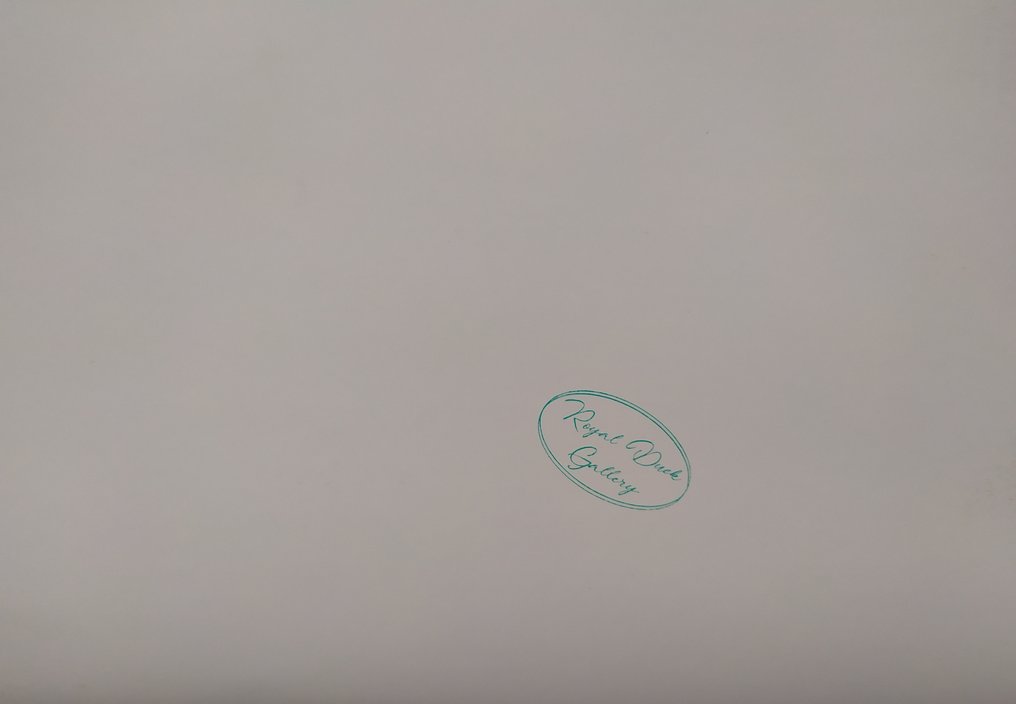
- Stamp on verso.
- Size: 60 x 80cm.
- Condition: excellent. Never framed, never exposed.
- Mark Rothko (1903–1970) is one of the most important figures of Abstract Expressionism and a central name in the history of modern and contemporary art, often mentioned alongside Jackson Pollock, Barnett Newman, Willem de Kooning, and Clyfford Still as a pioneer of Color Field painting. His works from the late 1950s and early 1960s, including Untitled (1960–1961), represent the mature period of his career, when he developed his iconic compositions based on large floating rectangles of color that create a powerful emotional and meditative experience.
In this composition, Rothko uses a luminous pink field contrasted with a deep violet-black form, creating a subtle yet intense dialogue between light and darkness. Rather than depicting objects, Rothko sought to express universal human emotions through color, scale, and atmosphere. This approach places his work in direct relation to the spiritual abstraction of Wassily Kandinsky, the chromatic sensitivity of Paul Klee, and the later minimalist investigations of artists such as Ellsworth Kelly and Donald Judd.
Works from this period are especially valued because they reflect Rothko’s fully developed visual language, where the boundaries between forms dissolve into soft, vibrating edges. The apparent simplicity of the composition hides a complex layering of pigment that produces depth, luminosity, and a sense of silence, qualities that made Rothko one of the most influential artists of the 20th century and a key reference for later generations including Gerhard Richter, Yves Klein and Shepard Fairey.
Those interested in modern abstraction often associate Rothko with major names such as Pablo Picasso, Joan Miró, Andy Warhol, and Claude Monet, whose works transformed the language of painting and continue to dominate the international art market.
Works from the 1960–1961 period are particularly desirable because they belong to the artist’s most iconic phase, combining historical importance, aesthetic purity, and extraordinary decorative power, making them among the most recognizable and sought-after images in modern art.
Artists of similar importance: Miró, Hockney, Lichtenstein, Warhol, Banksy, Brainwash, Delaunay, Nara, Soulages, Lagasse, Ramos, Coa, Lautrec, Klimt, Hirst, Chagall, Koons, Haring, Indiana, Mondrian, Groening, Richter, Monroe, Herrera, Laurent, Klein, Kusama, Murakami, Testa, Villemot, Oldenburg, Hopper, Ripolles, Wesselmann, Magritte, Jenk, Orlinski, Wille, Rizzi, Manara, Kaws, Valentino, Cappiello, Rothko, Dalí, among others.
Mais sobre o vendedor
Vendedor na Catawiki há mais de sete anos.
Convido você a visitar meu perfil, onde você encontrará uma lista completa dos diferentes lotes que estão sendo leiloados atualmente. Clique em "Yuke".
Boa sorte nos leilões!
Traduzido pelo Google Tradutor- Mark Rothko (após).
Authorized offset on heavyweight smooth satin paper (approx. 250gsm, refers to paper thickness/density).
- Copyright 2005 Christopher Rothko & Kate Rothko Prizel.
- Stamp on verso.
- Size: 60 x 80cm.
- Condition: excellent. Never framed, never exposed.
- Mark Rothko (1903–1970) is one of the most important figures of Abstract Expressionism and a central name in the history of modern and contemporary art, often mentioned alongside Jackson Pollock, Barnett Newman, Willem de Kooning, and Clyfford Still as a pioneer of Color Field painting. His works from the late 1950s and early 1960s, including Untitled (1960–1961), represent the mature period of his career, when he developed his iconic compositions based on large floating rectangles of color that create a powerful emotional and meditative experience.
In this composition, Rothko uses a luminous pink field contrasted with a deep violet-black form, creating a subtle yet intense dialogue between light and darkness. Rather than depicting objects, Rothko sought to express universal human emotions through color, scale, and atmosphere. This approach places his work in direct relation to the spiritual abstraction of Wassily Kandinsky, the chromatic sensitivity of Paul Klee, and the later minimalist investigations of artists such as Ellsworth Kelly and Donald Judd.
Works from this period are especially valued because they reflect Rothko’s fully developed visual language, where the boundaries between forms dissolve into soft, vibrating edges. The apparent simplicity of the composition hides a complex layering of pigment that produces depth, luminosity, and a sense of silence, qualities that made Rothko one of the most influential artists of the 20th century and a key reference for later generations including Gerhard Richter, Yves Klein and Shepard Fairey.
Those interested in modern abstraction often associate Rothko with major names such as Pablo Picasso, Joan Miró, Andy Warhol, and Claude Monet, whose works transformed the language of painting and continue to dominate the international art market.
Works from the 1960–1961 period are particularly desirable because they belong to the artist’s most iconic phase, combining historical importance, aesthetic purity, and extraordinary decorative power, making them among the most recognizable and sought-after images in modern art.
Artists of similar importance: Miró, Hockney, Lichtenstein, Warhol, Banksy, Brainwash, Delaunay, Nara, Soulages, Lagasse, Ramos, Coa, Lautrec, Klimt, Hirst, Chagall, Koons, Haring, Indiana, Mondrian, Groening, Richter, Monroe, Herrera, Laurent, Klein, Kusama, Murakami, Testa, Villemot, Oldenburg, Hopper, Ripolles, Wesselmann, Magritte, Jenk, Orlinski, Wille, Rizzi, Manara, Kaws, Valentino, Cappiello, Rothko, Dalí, among others.
Mais sobre o vendedor
Vendedor na Catawiki há mais de sete anos.
Convido você a visitar meu perfil, onde você encontrará uma lista completa dos diferentes lotes que estão sendo leiloados atualmente. Clique em "Yuke".
Boa sorte nos leilões!
Traduzido pelo Google TradutorDados
Artista
Mark Rothko (1903-1970) (after)
Vendido por
Proprietário ou revendedor
Edição
Original
Título da obra de arte
"Untitled, 1960-61"
Técnica
Impressão offset
Assinatura
Não assinado
País de origem
Bélgica
Estado
Excelente estado
Altura
80 cm
Largura
60 cm
Estilo
Expressionismo Abstrato
Período
2000-2010
Vendido com moldura
Não
Vendido por