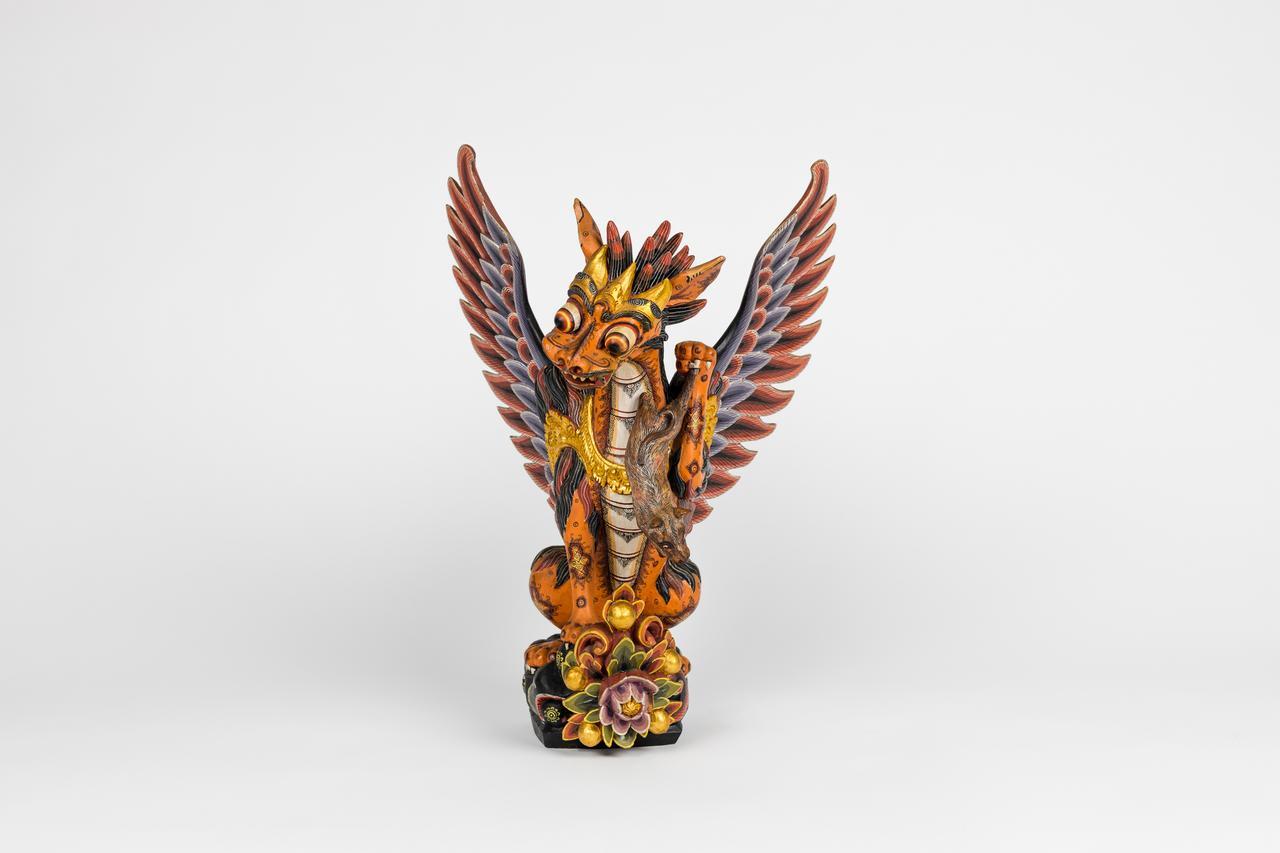
Marionettdocka balinesiska - vattenbuffelskinn


02
dagar
21
timmar
16
minuter
21
sekunder

 | 2 € |
|---|
Catawikis köparskydd
Din betalning är säker hos oss tills du får ditt objekt.Se detaljer
Trustpilot 4.4 | 141736 omdömen
Betygsatt utmärkt på Trustpilot.
Wayang Kulit-skuggefigur från Bali, Indonesien, tillverkad av härdad vattenbuffelhud, 52 cm hög, 19 cm bred, 1 cm djup, vikt 70 g, avsedd som en högt uppsatt balinesisk krigarsprins; vänsterarm lossnar vid axelleden och de tunna manipulationsstavarna saknas.
AI-assisterad sammanfattning
Beskrivning från säljaren
Originating from the sacred theatrical traditions of Bali, this evocative wayang kulit figure represents a vigorous, high-ranking persona - likely a warrior prince or fierce courtly archetype drawn from the Hindu-Javanese adaptations of the Mahabharata or Ramayana epics. Within the context of Balinese wayang parwa, such shadow figures serve not merely as theatrical instruments, but as metaphysical conduits animated by the dalang (puppet master) in ritual dramas that negotiate harmony between the physical world and the unseen realm (sekala and niskala). The figure displays the characteristic stylistic traits of the Balinese tradition, distinguished by more anatomical grounding and kinetic posture than its Central Javanese counterparts, featuring an intensely expressive profile with wide, open eyes, a prominent arched nose, and a pronounced jawline adorned with royal regalia and elaborate headdress adornments.
The puppet is meticulously fashioned from cured water buffalo hide, incised with intricate pierced openwork that defines the cascading drapery of the patterned lower wrap, ornate armlets, and sweeping headdress. Traces of traditional polychrome decoration—dominated by mineral and organic pigments of cinnabar red, earthen ochre, malachite green, and indigo blue—remain visible across both surfaces, creating a layered, translucent silhouette when backlit against the kelir screen. The body is mounted along an intact central bamboo support rod, bound along the spine to stabilize the figure during handling.
The piece presents an authentic antiquarian state with an honest, smoke-darkened patina consistent with historical use near traditional coconut-oil performance lamps (damar). Significant surface rubbing, pigment craquelure, and localized pigment losses are evident throughout, accentuating the parchment’s natural grain and age. Structurally, the proper left arm is detached at the shoulder joint; the small upper fragment remains fixed at the pivot point, allowing the limb to rest in position for display, though it is physically separated from the main torso. The secondary thin manipulation rods for the hands are no longer present. The resulting object carries the dignified presence of a genuine ritual artifact shaped by performance history.
PROVENANCE
Private collection, Germany (field-collected in Bali, 1994).
Thence by descent to the present owner.
Originating from the sacred theatrical traditions of Bali, this evocative wayang kulit figure represents a vigorous, high-ranking persona - likely a warrior prince or fierce courtly archetype drawn from the Hindu-Javanese adaptations of the Mahabharata or Ramayana epics. Within the context of Balinese wayang parwa, such shadow figures serve not merely as theatrical instruments, but as metaphysical conduits animated by the dalang (puppet master) in ritual dramas that negotiate harmony between the physical world and the unseen realm (sekala and niskala). The figure displays the characteristic stylistic traits of the Balinese tradition, distinguished by more anatomical grounding and kinetic posture than its Central Javanese counterparts, featuring an intensely expressive profile with wide, open eyes, a prominent arched nose, and a pronounced jawline adorned with royal regalia and elaborate headdress adornments.
The puppet is meticulously fashioned from cured water buffalo hide, incised with intricate pierced openwork that defines the cascading drapery of the patterned lower wrap, ornate armlets, and sweeping headdress. Traces of traditional polychrome decoration—dominated by mineral and organic pigments of cinnabar red, earthen ochre, malachite green, and indigo blue—remain visible across both surfaces, creating a layered, translucent silhouette when backlit against the kelir screen. The body is mounted along an intact central bamboo support rod, bound along the spine to stabilize the figure during handling.
The piece presents an authentic antiquarian state with an honest, smoke-darkened patina consistent with historical use near traditional coconut-oil performance lamps (damar). Significant surface rubbing, pigment craquelure, and localized pigment losses are evident throughout, accentuating the parchment’s natural grain and age. Structurally, the proper left arm is detached at the shoulder joint; the small upper fragment remains fixed at the pivot point, allowing the limb to rest in position for display, though it is physically separated from the main torso. The secondary thin manipulation rods for the hands are no longer present. The resulting object carries the dignified presence of a genuine ritual artifact shaped by performance history.
PROVENANCE
Private collection, Germany (field-collected in Bali, 1994).
Thence by descent to the present owner.
Uppgifter
Era
1900-2000
Vikt
70 g
Titel på konstverket
Wayang Kulit Shadow Puppet
Ursprungsland
Indonesien
Material
Water buffalo hide
Etnisk grupp / kultur
Balinese
Inhemskt objektnamn
Wayang kulit
Sold with stand
Nej
Skick
Rimligt - kraftigt använt och med eventuellt mindre delar som saknas
Höjd
52 cm
Bredd
19 cm
Djup
1 cm
Såldes av