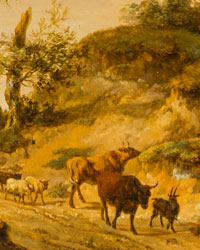
Alfonso Papi (1931) - Buttero


10
days
17
hours
08
minutes
06
seconds
Starting bid
€ 1
Reserve price not met

Expert
Selected by Caterina Maffeis
Master in early Renaissance Italian painting with internship at Sotheby’s and 15 years' experience.
Estimate € 400 - € 500
No bids placed
Catawiki Buyer Protection
Your payment’s safe with us until you receive your object.View details
Trustpilot 4.4 | 133362 reviews
Rated Excellent on Trustpilot.
Buttero, oil on masonite by Alfonso Papi (born 1931), from the 1960s to 1970s, in green, beige, yellow and brown tones, depicting a daytime scene of a buttero in Tuscany; 50 × 70 cm without frame, framed 69 × 88 cm, signed in the lower right, original edition, in good condition, sold with frame, Italy.
AI-assisted summary
Description from the seller
Alfonso Papi (Castellina Marittima, Pisa, 1931)
Buttero
Oil on Masonite, 50 x 70 cm
Dimensions with frame: 69 x 88 cm
Signed bottom right.
In the Tuscan countryside, in Maremma in particular, a buttero—the traditional cattle herder of Maremma, the countryside of Rome and the Pontine Plain—returns to his tent at the end of the workday. In the center, in the background, a green bush emerges from the peaceful pinkish sky.
Splotches of color sketch in the foreground the pasture, while—less agitated—they delineate more clearly the protagonist of the scene, in the saddle of his sturdy Maremma horse.
Born in 1931 in Castellina Marittima (Pisa), Alfonso Papi has lived and worked in Livorno for years, where he also trained artistically. A student of Voltolino Fontani, he studied at the Libera Accademia d'Arte Trossi-Uberti.
His style is strongly influenced by the ways of the Gruppo Labronico.
Gruppo Labronico is a circle of painters still active, founded in Livorno on July 15, 1920 at Gino Romiti’s studio with the aim of continuing the pictorial experiences developed in Tuscany—and, in particular, right in Livorno—during the preceding years.
The members of the Group aimed to follow in the footsteps of the great master Giovanni Fattori and were classified within the Post-Macchiaioli current.
Voltolino Fontani himself became a member in 1951 and gave the Group an innovative impulse.
Papi has thus absorbed a style based on blotching, which he has managed to reinterpret according to his own landscape poetics.
His painting is immediate, outlining objects with a few spots of color. His interest focuses on Tuscan inland landscapes, and the chosen color range is characterized by bright, emotionally charged hues.
Provenance: private Italian collection.
Frame included.
Alfonso Papi (Castellina Marittima, Pisa, 1931)
Buttero
Oil on Masonite, 50 x 70 cm
Dimensions with frame: 69 x 88 cm
Signed bottom right.
In the Tuscan countryside, in Maremma in particular, a buttero—the traditional cattle herder of Maremma, the countryside of Rome and the Pontine Plain—returns to his tent at the end of the workday. In the center, in the background, a green bush emerges from the peaceful pinkish sky.
Splotches of color sketch in the foreground the pasture, while—less agitated—they delineate more clearly the protagonist of the scene, in the saddle of his sturdy Maremma horse.
Born in 1931 in Castellina Marittima (Pisa), Alfonso Papi has lived and worked in Livorno for years, where he also trained artistically. A student of Voltolino Fontani, he studied at the Libera Accademia d'Arte Trossi-Uberti.
His style is strongly influenced by the ways of the Gruppo Labronico.
Gruppo Labronico is a circle of painters still active, founded in Livorno on July 15, 1920 at Gino Romiti’s studio with the aim of continuing the pictorial experiences developed in Tuscany—and, in particular, right in Livorno—during the preceding years.
The members of the Group aimed to follow in the footsteps of the great master Giovanni Fattori and were classified within the Post-Macchiaioli current.
Voltolino Fontani himself became a member in 1951 and gave the Group an innovative impulse.
Papi has thus absorbed a style based on blotching, which he has managed to reinterpret according to his own landscape poetics.
His painting is immediate, outlining objects with a few spots of color. His interest focuses on Tuscan inland landscapes, and the chosen color range is characterized by bright, emotionally charged hues.
Provenance: private Italian collection.
Frame included.
Details
Artist
Alfonso Papi (1931)
Sold with frame
Yes
Sold by
Owner or reseller
Edition
Original
Title of artwork
Buttero
Technique
Oil painting
Signature
Signed
Country of origin
Italy
Condition
Good condition
Colour
Beige, Brown, Green, Yellow
Height
50 cm
Width
70 cm
Depiction/theme
Day scene
Period
1960-1970
Sold by