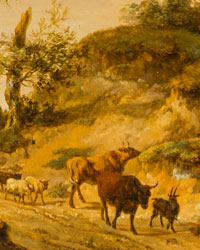
Miguel Couce Vidal (1904 - 1995) - Esperando


10
days
10
hours
32
minutes
44
seconds
Starting bid
€ 1
Reserve price not met

No bids placed
Catawiki Buyer Protection
Your payment’s safe with us until you receive your object.View details
Trustpilot 4.4 | 135253 reviews
Rated Excellent on Trustpilot.
Esperando, an oil painting by Miguel Couce Vidal (Spain), from the 1970s period, dated 1978, depicting animals, original edition, hand-signed, in good condition, framed, frame size 58 x 48 cm.
AI-assisted summary
Description from the seller
The work is signed by the artist at the bottom.
On the back it is again signed, dated in the year 1978 and titled "Esperando".
The painting is presented framed.
Dimensions of the work: 34 cm x 43 cm.
Frame dimensions: 48 cm x 58 cm.
The condition of the work is good.
:::::::::::::::::::::::::::::::::::::::::::::::::::::
Artist biography:
He was born in Bilbao, Spain on January 5, 1904, and died in New York on October 1, 1995. He arrived in Argentina in 1910 and became a citizen in 1930. In 1921 he entered the National Academy of Fine Arts, where his teachers were Gervasio Trezzini, Enrique Fabbri, and Alberto María Rossi. He resided in Brazil between 1935 and 1945 and in Massachusetts in the late 20th century. Upon his return from Brazil, he took part in group exhibitions and held solo shows in Buenos Aires, Mendoza, San Juan, Salta, and Rosario. He held solo exhibitions at Galería Müller in 1945, Casa de Mendoza in Buenos Aires in 1952, Plaza Hotel in Mendoza in 1953, Casa de España in Mendoza in 1953, the Museum of Fine Arts in Rio de Janeiro, Brazil in 1952, and at Galería Dantes in Belo Horizonte, Brazil in 1953, among others. He participated in the Painting and Sculpture Salon of the Mutual Society of Fine Arts Students and Graduates in 1924, the National Salons of Brazil in 1938 and from 1940 to 1943; Rio Grande do Sul in 1940; Fluminense in 1943; Pelotas in 1940. He received an Honorable Mention at the National Salon of Brazil in 1940, a Bronze Medal at the National Salon of Brazil in 1941, and an Honorable Mention at the Rio Grande do Sul Salon in 1940. “An artist of the La Boca group, inspired by its landscapes he depicted scenes of the Riachuelo, of the ports and of the boquense hamlets with a personal picturesque quality in the contrasts of light and the play of color, based on a firm drawing and good mattering of material,” said Carlos Foglia. In his final period he moved toward figurative abstraction.
The work is signed by the artist at the bottom.
On the back it is again signed, dated in the year 1978 and titled "Esperando".
The painting is presented framed.
Dimensions of the work: 34 cm x 43 cm.
Frame dimensions: 48 cm x 58 cm.
The condition of the work is good.
:::::::::::::::::::::::::::::::::::::::::::::::::::::
Artist biography:
He was born in Bilbao, Spain on January 5, 1904, and died in New York on October 1, 1995. He arrived in Argentina in 1910 and became a citizen in 1930. In 1921 he entered the National Academy of Fine Arts, where his teachers were Gervasio Trezzini, Enrique Fabbri, and Alberto María Rossi. He resided in Brazil between 1935 and 1945 and in Massachusetts in the late 20th century. Upon his return from Brazil, he took part in group exhibitions and held solo shows in Buenos Aires, Mendoza, San Juan, Salta, and Rosario. He held solo exhibitions at Galería Müller in 1945, Casa de Mendoza in Buenos Aires in 1952, Plaza Hotel in Mendoza in 1953, Casa de España in Mendoza in 1953, the Museum of Fine Arts in Rio de Janeiro, Brazil in 1952, and at Galería Dantes in Belo Horizonte, Brazil in 1953, among others. He participated in the Painting and Sculpture Salon of the Mutual Society of Fine Arts Students and Graduates in 1924, the National Salons of Brazil in 1938 and from 1940 to 1943; Rio Grande do Sul in 1940; Fluminense in 1943; Pelotas in 1940. He received an Honorable Mention at the National Salon of Brazil in 1940, a Bronze Medal at the National Salon of Brazil in 1941, and an Honorable Mention at the Rio Grande do Sul Salon in 1940. “An artist of the La Boca group, inspired by its landscapes he depicted scenes of the Riachuelo, of the ports and of the boquense hamlets with a personal picturesque quality in the contrasts of light and the play of color, based on a firm drawing and good mattering of material,” said Carlos Foglia. In his final period he moved toward figurative abstraction.
Details
Artist
Miguel Couce Vidal (1904 - 1995)
Sold with frame
Yes
Sold by
Gallery
Edition
Original
Title of artwork
Esperando
Technique
Oil painting
Signature
Hand signed
Country of origin
Spain
Year
1978
Condition
Good condition
Height
48 cm
Width
58 cm
Depiction/theme
Animals
Period
1970-1980
Sold by