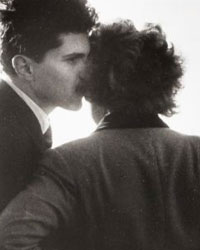
Xesus Vázquez - Diego (De la serie “La frontera del Edén”), 1989


05
days
18
hours
11
minutes
32
seconds
Current bid
€ 60
Reserve price not met

Expert
Selected by Elena Vaninetti
Has over ten years of experience in art, specialising in post-war photography and contemporary art.
Estimate € 500 - € 600
 | €60 | |
|---|---|---|
 | €1 |
Catawiki Buyer Protection
Your payment’s safe with us until you receive your object.View details
Trustpilot 4.4 | 141948 reviews
Rated Excellent on Trustpilot.
Xesus Vázquez created the unique print Diego (from the series The Edge of Eden), 1989, a rayogram on Ilford Multigrade paper, dated 1989, 23.5 × 30 cm, hand-signed, in exceptionally well-preserved condition.
AI-assisted summary
Description from the seller
Author: Xesus Vázquez (Pentes, Orense, 1946; nationality: Spanish)
Title: Diego (From the series “The Border of Eden,” 1989-1990)
Technique and support: Rayogram on Ilford Multigrade paper
Date: 1989
Signed and dated in pencil, on the mat, in the lower right area: “x vazquez 89”
Framed with a mat. The framing has been done by the artist himself and is part of the work
Dimensions: 23.5 x 30 cm. (Image dimensions, not including the mat)
Presentation in original folder
The attached photos form part of the description
Impeccable condition
This work has always been kept in a dark archival environment with acid-free protective paper
Express courier shipping to the buyer’s country can be arranged safely
Artist highly valued today and included in the most prestigious public Spanish collections (See attached photos)
TECHNICAL ASPECTS OF THE WORK:
. RAYOGRAM (or Photogram): A photographic process made without a camera. It consists of placing objects directly on a light-sensitive surface (in this case, paper) and exposing them to light. When developing the paper, the covered areas stay white, the exposed areas turn black, and the edges create a grayscale scale that silhouettes the objects in a ghostly or abstract way.
. ILFORD MULTIGRADE PAPER: A type of black-and-white photographic paper with variable contrast widely used in traditional laboratories. When used for rayograms, it allows the artist to play very precisely with the depth of blacks and the delicacy of grays depending on the light filters used in the enlarger. This type of piece reflects Vázquez’s most experimental and abstract facet, where chance, direct light, and the material imprint replace the traditional brush, maintaining the conceptual dialogue characteristic of the exhibitions hosted by Galería Juana de Aizpuru.
Born in Pentes (Orense) in 1946, Xesus Vázquez began his career in the 1960s. Gradually he created cycles such as the 'Atalayas', with Goethe, and the 'Caverns', as well as the series of paintings with titles of the great battles, which he gathered under the name 'Memory is a Starry Night' (Banco Zaragozano, 1991). He also cultivates abstraction in his 'tableautins', more than a hundred experimental small-format works with figurative faces and geometric abstractions, forming part of the 'La internacional' cycle. If initially he looked toward American abstraction, in the 1980s his gaze returned to Europe, with Kiefer, Schnabel, and Polke as references, also incorporating Ezra Pound’s literary traces. He has exhibited in numerous galleries (especially 'Siboney' in Santander and 'Juana de Aizpuru' in Madrid), spaces, and museums, up to the great retrospective commissioned by CGAC in Santiago de Compostela in 2005. Xesus Vázquez has also ventured into photography and printmaking, as well as graphic design. Poetry has been another modality developed by Vázquez, whose poem 'Mitad del gozne' was published by 'Caballo de Troya' in 1990 and reissued in 1997. He has also contributed to journals such as 'Comercial de la pintura' and 'La ortiga'.
Author: Xesus Vázquez (Pentes, Orense, 1946; nationality: Spanish)
Title: Diego (From the series “The Border of Eden,” 1989-1990)
Technique and support: Rayogram on Ilford Multigrade paper
Date: 1989
Signed and dated in pencil, on the mat, in the lower right area: “x vazquez 89”
Framed with a mat. The framing has been done by the artist himself and is part of the work
Dimensions: 23.5 x 30 cm. (Image dimensions, not including the mat)
Presentation in original folder
The attached photos form part of the description
Impeccable condition
This work has always been kept in a dark archival environment with acid-free protective paper
Express courier shipping to the buyer’s country can be arranged safely
Artist highly valued today and included in the most prestigious public Spanish collections (See attached photos)
TECHNICAL ASPECTS OF THE WORK:
. RAYOGRAM (or Photogram): A photographic process made without a camera. It consists of placing objects directly on a light-sensitive surface (in this case, paper) and exposing them to light. When developing the paper, the covered areas stay white, the exposed areas turn black, and the edges create a grayscale scale that silhouettes the objects in a ghostly or abstract way.
. ILFORD MULTIGRADE PAPER: A type of black-and-white photographic paper with variable contrast widely used in traditional laboratories. When used for rayograms, it allows the artist to play very precisely with the depth of blacks and the delicacy of grays depending on the light filters used in the enlarger. This type of piece reflects Vázquez’s most experimental and abstract facet, where chance, direct light, and the material imprint replace the traditional brush, maintaining the conceptual dialogue characteristic of the exhibitions hosted by Galería Juana de Aizpuru.
Born in Pentes (Orense) in 1946, Xesus Vázquez began his career in the 1960s. Gradually he created cycles such as the 'Atalayas', with Goethe, and the 'Caverns', as well as the series of paintings with titles of the great battles, which he gathered under the name 'Memory is a Starry Night' (Banco Zaragozano, 1991). He also cultivates abstraction in his 'tableautins', more than a hundred experimental small-format works with figurative faces and geometric abstractions, forming part of the 'La internacional' cycle. If initially he looked toward American abstraction, in the 1980s his gaze returned to Europe, with Kiefer, Schnabel, and Polke as references, also incorporating Ezra Pound’s literary traces. He has exhibited in numerous galleries (especially 'Siboney' in Santander and 'Juana de Aizpuru' in Madrid), spaces, and museums, up to the great retrospective commissioned by CGAC in Santiago de Compostela in 2005. Xesus Vázquez has also ventured into photography and printmaking, as well as graphic design. Poetry has been another modality developed by Vázquez, whose poem 'Mitad del gozne' was published by 'Caballo de Troya' in 1990 and reissued in 1997. He has also contributed to journals such as 'Comercial de la pintura' and 'La ortiga'.
Details
Date of print
1989
Artist
Xesus Vázquez
Sold by
Direct from the artist
Title of artwork
Diego (De la serie “La frontera del Edén”), 1989
Condition
Extremely fine
Technique
Other
Height
23.5 cm
Edition
One-of-a-kind work
Width
30 cm
Signature
Hand signed
Genre
Nature
Sold by