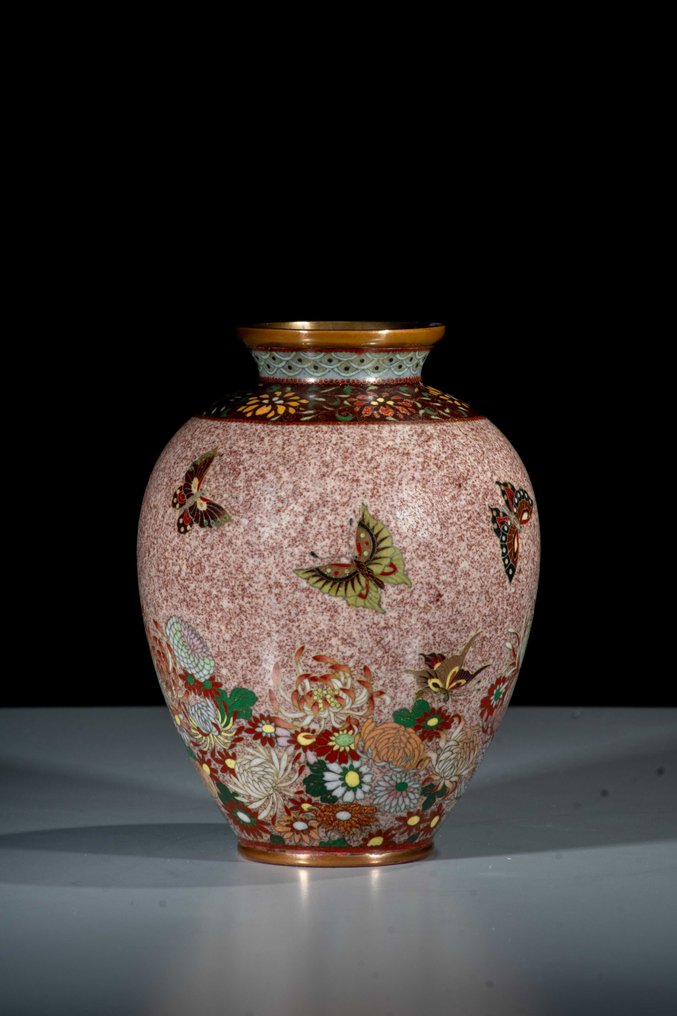
Vase - Enamel, A silver-wire cloisonné vase with butterflies and chrysanthemums - Japan - Meiji period (late 19th century)



02
days
16
hours
28
minutes
44
seconds
Current bid
€ 160
Reserve price not met

Expert
Selected by Giovanni Bottero
Holds a master’s in Japanese art history with over 10 years’ expertise in Asian art.
Estimate € 950 - € 1,100
 | €160 | |
|---|---|---|
 | €150 | |
| €8 | |
Catawiki Buyer Protection
Your payment’s safe with us until you receive your object.View details
Trustpilot 4.4 | 142120 reviews
Rated Excellent on Trustpilot.
Japanese Meiji period cloisonné vase with a silver-wire technique, featuring butterflies and chrysanthemums, in very good condition, dimensions 9.5 x 12.5 x 9.5 cm, with certificate of authenticity.
AI-assisted summary
Description from the seller
A globular cloisonné vase decorated with numerous butterflies in flight within a lush garden of chrysanthemums in various colours and forms, executed in polychrome enamels on a speckled reddish-brown ground and finished with precise silver wirework.
The neck is decorated with a band of stylised flowers on a brown ground, bordered by a geometric motif.
The marbled ground enhances the details of the decoration and the vibrancy of the colours.
Japanese cloisonné is one of the most refined forms of decorative art. Originally adopted from China, the technique was perfected by Japanese artisans during the Meiji period. The technique involves the use of vibrant polychrome enamels that create a metallic, glossy effect.
---The vase is in very good condition. Please refer to the pictures for further details.
The item will be carefully packed and shipped via DHL or FedEx, accompanied by the original certificate of authenticity issued by Mastromauro Japanese art gallery based in Milan, Italy.
293
Seller's Story
Mastromauro Arte Giapponese, based in Milan, specializes in Japanese art, with particular attention to the Edo (1603–1868) and Meiji (1868–1912) periods, while also maintaining an open perspective on more contemporary works.
Here on Catawiki, they offer a part of their collection in every weekly auction.
Translated by Google TranslateA globular cloisonné vase decorated with numerous butterflies in flight within a lush garden of chrysanthemums in various colours and forms, executed in polychrome enamels on a speckled reddish-brown ground and finished with precise silver wirework.
The neck is decorated with a band of stylised flowers on a brown ground, bordered by a geometric motif.
The marbled ground enhances the details of the decoration and the vibrancy of the colours.
Japanese cloisonné is one of the most refined forms of decorative art. Originally adopted from China, the technique was perfected by Japanese artisans during the Meiji period. The technique involves the use of vibrant polychrome enamels that create a metallic, glossy effect.
---The vase is in very good condition. Please refer to the pictures for further details.
The item will be carefully packed and shipped via DHL or FedEx, accompanied by the original certificate of authenticity issued by Mastromauro Japanese art gallery based in Milan, Italy.
293
Seller's Story
Mastromauro Arte Giapponese, based in Milan, specializes in Japanese art, with particular attention to the Edo (1603–1868) and Meiji (1868–1912) periods, while also maintaining an open perspective on more contemporary works.
Here on Catawiki, they offer a part of their collection in every weekly auction.
Translated by Google TranslateDetails
Era
1400-1900
Country of origin
Japan
Material
A silver-wire cloisonné vase with butterflies and chrysanthemums, Enamel
Dynastic style/period
Meiji period (late 19th century)
Condition
Excellent condition: barely used with minimal signs of wear
Height
12.5 cm
Width
9.5 cm
Depth
9.5 cm
Estimated period
1850-1900
Sold by
