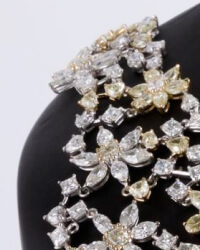
No reserve price - Necklace - 18 kt. Yellow gold - 50.10ct. tw. Tanzanite


01
day
19
hours
07
minutes
56
seconds
Current bid
€ 20
No reserve price

Expert
Selected by Chumeng Weng
Holds a master’s in contemporary jewellery design and certified pearl specialist.
Retail Estimate € 250 - € 300
 | €20 | |
|---|---|---|
| €15 | |
| €10 | |
Catawiki Buyer Protection
Your payment’s safe with us until you receive your object.View details
Trustpilot 4.4 | 142824 reviews
Rated Excellent on Trustpilot.
An 18 karat yellow gold necklace featuring natural faceted Tanzanite totaling 50.10 ct with 150 main stones and an Akoya pearl, presented without a laboratory report.
AI-assisted summary
Description from the seller
Refined necklace composed of natural faceted tanzanite, characterized by a delicate lilac/purple shade and selected for uniformity and brightness.
Tanzanite, a variety of zoisite among the most fascinating and sought-after gems, is appreciated for its unique hues and its distinctive elegance, making this jewelry a refined choice with great impact.
The stones, cut in a faceted cut, enhance brilliance and give color depth to the composition, maximizing the lilac-toned shades.
A central element of particular value is the Akoya pearl “Pinctada Martensii,” known for its fine surface and high luster, which adds further elegance and balance to the set.
The structure is completed by 18 kt yellow gold components, which give harmony and value to the jewelry.
The contrast between the lilac/purple tones of the tanzanite and the pearl’s brightness creates a sophisticated and distinctive balance, ideal for collectors or anyone seeking a unique jewel.
The necklace comes with a gemological certificate attesting its authenticity and characteristics.
⸻
Features:
• Gold: 18 kt yellow gold (clasp and components)
• Estimated gold weight: about 1 g
• Main stone: Natural tanzanite (zoisite)
• Cut: Faceted
• Color: Lilac/purple
• Stone weight: about 50.10 ct
• Dimensions: about 3.60 – 4.50 mm
• Origin: Africa
• Treatment: Thermal (TE)
• Pearl: Cultured Akoya (about 6.20 mm)
• Total weight: 11.28 g
• Conditions: New
Seller's Story
MIREIA – Jewelry and precious stones | mireia.it
Mireia specializes in the selection and sale of jewelry and precious objects.
We primarily offer 18 kt gold jewelry, natural coral, and gemstones, chosen with particular attention to the quality and characteristics of each individual piece.
Each lot is carefully inspected and described in the most transparent possible way, with detailed photographs that allow buyers to assess conditions, materials and details.
All items are packaged with care and shipped via secure and traceable shipping.
Our objective is to offer authentic, high-quality jewelry, accompanied by a serious, reliable and professional service, to ensure a safe and satisfactory purchasing experience on Catawiki.
Translated by Google TranslateRefined necklace composed of natural faceted tanzanite, characterized by a delicate lilac/purple shade and selected for uniformity and brightness.
Tanzanite, a variety of zoisite among the most fascinating and sought-after gems, is appreciated for its unique hues and its distinctive elegance, making this jewelry a refined choice with great impact.
The stones, cut in a faceted cut, enhance brilliance and give color depth to the composition, maximizing the lilac-toned shades.
A central element of particular value is the Akoya pearl “Pinctada Martensii,” known for its fine surface and high luster, which adds further elegance and balance to the set.
The structure is completed by 18 kt yellow gold components, which give harmony and value to the jewelry.
The contrast between the lilac/purple tones of the tanzanite and the pearl’s brightness creates a sophisticated and distinctive balance, ideal for collectors or anyone seeking a unique jewel.
The necklace comes with a gemological certificate attesting its authenticity and characteristics.
⸻
Features:
• Gold: 18 kt yellow gold (clasp and components)
• Estimated gold weight: about 1 g
• Main stone: Natural tanzanite (zoisite)
• Cut: Faceted
• Color: Lilac/purple
• Stone weight: about 50.10 ct
• Dimensions: about 3.60 – 4.50 mm
• Origin: Africa
• Treatment: Thermal (TE)
• Pearl: Cultured Akoya (about 6.20 mm)
• Total weight: 11.28 g
• Conditions: New
Seller's Story
MIREIA – Jewelry and precious stones | mireia.it
Mireia specializes in the selection and sale of jewelry and precious objects.
We primarily offer 18 kt gold jewelry, natural coral, and gemstones, chosen with particular attention to the quality and characteristics of each individual piece.
Each lot is carefully inspected and described in the most transparent possible way, with detailed photographs that allow buyers to assess conditions, materials and details.
All items are packaged with care and shipped via secure and traceable shipping.
Our objective is to offer authentic, high-quality jewelry, accompanied by a serious, reliable and professional service, to ensure a safe and satisfactory purchasing experience on Catawiki.
Translated by Google TranslateDetails
Era
After 2000
Laboratory report
No laboratory report
No. of main gemstones
150
Total carat weight of all stones
50.10
Metal
Yellow gold
Total carat weight of main stone(s)
50.00
Brand jewellery
No
Fineness
18 kt.
Main stone
Tanzanite
Total weight
11 g
Condition
New
Gender
Women
Disclaimer
Catawiki always aims to offer you the best possible buying experience. Our experts virtually review and select every object in line with our submission guidelines. While we strive to provide a detailed description and photographs of each jewellery object, discrepancies or inaccuracies may occur. It is your responsibility to review all of the information provided about an object, including the condition and description, before placing an order. Sellers are responsible for the information, pictures and description provided, including the quality, quantity and nature of the jewelry supplied. A small imperfection that cannot be seen in the photo but is included in the description is not a non-conformity. A Lab Report is not a guarantee, valuation or appraisal regarding the articles described therein. A Lab Report contains only the characteristics of an article described after it has been graded, tested, examined, and analyzed using the techniques and equipment used at the time of the examination from that specific Lab. The results of any other examination performed on the article may differ depending when, how, by whom and with which grading standard the article is examined. In addition, any changes and improvements in techniques and equipment that may have occurred which may enable the examiner to detect, among other things, the use of processes for altering the characteristics of an article which use was previously undetectable, does not automatically mean the object does not conform to its description.
Catawiki always aims to offer you the best possible buying experience. Our experts virtually review and select every object in line with our submission guidelines. While we strive to provide a detailed description and photographs of each jewellery object, discrepancies or inaccuracies may occur. It is your responsibility to review all of the information provided about an object, including the condition and description, before placing an order. Sellers are responsible for the information, pictures and description provided, including the quality, quantity and nature of the jewelry supplied. A small imperfection that cannot be seen in the photo but is included in the description is not a non-conformity. A Lab Report is not a guarantee, valuation or appraisal regarding the articles described therein. A Lab Report contains only the characteristics of an article described after it has been graded, tested, examined, and analyzed using the techniques and equipment used at the time of the examination from that specific Lab. The results of any other examination performed on the article may differ depending when, how, by whom and with which grading standard the article is examined. In addition, any changes and improvements in techniques and equipment that may have occurred which may enable the examiner to detect, among other things, the use of processes for altering the characteristics of an article which use was previously undetectable, does not automatically mean the object does not conform to its description.