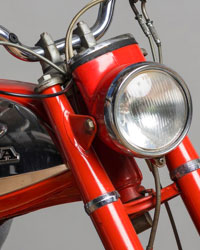
Piaggio - Vespa - VGL1 - 150 cc - 1958


07
days
00
hours
23
minutes
40
seconds
Current bid
€ 2,012
Reserve price not met

Expert
Selected by Davide Marelli
With 15 years' trade experience, he has written extensively for moped magazines.
Estimate € 8,000 - € 8,800
 | €2,012 | |
|---|---|---|
| €1,912 | |
| €1,812 | |
Catawiki Buyer Protection
Your payment’s safe with us until you receive your object.View details
Trustpilot 4.4 | 144916 reviews
Rated Excellent on Trustpilot.
This Vespa VGL1 GL 150 Touring was first registered in 1958, has its original VGL1M engine, has covered 15,921 km and comes with Swedish registration papers.
AI-assisted summary
Description from the seller
Rarely seen Wideframe GL 150 Touring.
The assembly was carried out at the Messerschmitt works.
All originals – extremely rare add-on parts – are present.
Year 1958
Frame VGL1T Wideframe corrugated frame.
Engine VGL1M (original engine installed)
Total production numbers for 1957 and 1958 were only 2110 units.
Produced only in red or blue.
It has very special and valuable add-on parts such as:
VDO speedometer
Chrome side bars
Ulma 10-inch wheel covers
Scarlet headlight
Hella horn
Original handles
Wideframe taillight
I.m.p.e.a. C.E.V. Genova rectifier
Ulma swingarm cover
Rare “oxeye” lenses on the side cheeks
Passenger seat with folding backrest.
It starts and runs very well.
Very nice visual condition with some patina.
Things to be checked: taillight not working, horn not working, ignition not working.
Complete Swedish papers available.
Delivery within DE €200
NL, AT, BE €250
IT, DNK, PL €300
Worldwide shipping available on request
Wikipedia:
The transitional model produced for the export market was assembled from Italian body parts of the VGL1T together with the typical add-on parts of the Messerschmitt-Vespa VD2T (T/3) in the Pontedera frame.
Characteristics of this model:
- Burgundy red paint
- Hella electrical system
- silver wiring harnesses according to the Messerschmitt VD2T circuit diagram
- Hella horn
- steering head with rectangular VDO speedometer up to 120 km/h
- Hella ignition lock
- round Hella or scarlet headlight
- center stand with bent feet
- typical German exhaust silencer
- Boge shock absorbers
- chrome front wheel fork
- Italian VGL1T drum brakes with burgundy-painted steel rims
- the Germany-standard hollow-embossed Vespa script on adhesive mounts
- Vespa script on rubber parts such as handlebar grips or stand feet and Bauer screws for mounting connections
- The Italian sheet metal frames had a holder for I.M.P.E.A. rectifier, which were also used during Vespa assembly, as well as the Italian SIEM taillight with separate brake light bulb. The cheeks also came from Italy and had the common mounting hole patterns there. The model was equipped with Vigano brakes and a bumper on the fender for export of this VGL1T to the markets of the intended countries.
Frame and engine numbers were issued at the Pontedera plant; the German numbers and type plates were not used for this model since licensing had already ended and negotiations for the future were still open at the start of VGL1T production. The model series was exported to the Swedish market and was sold under the designation “Touring”, later in Sweden also as “Tysk Touring” (German Touring) after its origin. Together with the export series, Messerschmitt spare parts catalogs were delivered to the Swedish importer COMO M. & T. Bjerke AB in Stockholm.
The earliest German Touring Vespa models for the Swedish market had frame numbers around ☆010200 and these frames of the series were produced in Pontedera from late 1957 to early 1958. In early March 1958, the first German Touring Vespas for the Swedish market were registered for road use. The total production of VGL1T frames in Pontedera stood:
1957 from frame number VGL1T ☆001001 to ☆010842 and
1958 from frame number VGL1T ☆010843 to ☆016610.
Details
Brand
Piaggio
Model Type
Vespa - VGL1
Engine size (in cc)
150
Year of first registration
1958
Condition
Very good
Registration papers
with Swedish registration
Mileage
15921 km
Frame number
VGL1T
Engine number
VGL1M
Located in country
Germany
Vehicle registration
We can help buyers register their vehicle through our trusted external partner. The process is straightforward and can be completed after purchase. Vehicle registration remains the buyer's responsibility.
Sold by
Disclaimer
Catawiki always aims to offer you the best possible buying experience. Our experts virtually review and select every vehicle in line with our submission guidelines and we require our sellers to provide the most accurate description of the vehicle. However, providing a fully detailed analysis of the vehicle is extremely difficult, and close to impossible. To guide you, we ask our sellers to provide information about the vehicle’s condition. Please consider that most vehicles for sale are classic vehicles and they often already have a whole life behind them, meaning that even a condition 1 or 2 vehicle might need maintenance to be ready for the road. It is advised to carefully read our submission guidelines that further describe details about the condition grades and types to manage your expectations. Cars are sold “as is”, meaning as described and in the condition they are in at the time of the sale and without any representation, warranty or assumption of liability of any kind as to the condition by Catawiki or by the seller. The condition of this item is the opinion of the seller and may differ from yours, your local garage, or the dealer’s opinion. This does not automatically mean the car does not conform to its description. Before bidding, please check your local legislation regarding vehicle registration. Neither the seller nor Catawiki is responsible for the registration of the vehicle in your country and will not accept a cancellation for your failure to register the vehicle. We also recommend that, if possible, you arrange a viewing with the seller before placing a bid.
Catawiki always aims to offer you the best possible buying experience. Our experts virtually review and select every vehicle in line with our submission guidelines and we require our sellers to provide the most accurate description of the vehicle. However, providing a fully detailed analysis of the vehicle is extremely difficult, and close to impossible. To guide you, we ask our sellers to provide information about the vehicle’s condition. Please consider that most vehicles for sale are classic vehicles and they often already have a whole life behind them, meaning that even a condition 1 or 2 vehicle might need maintenance to be ready for the road. It is advised to carefully read our submission guidelines that further describe details about the condition grades and types to manage your expectations. Cars are sold “as is”, meaning as described and in the condition they are in at the time of the sale and without any representation, warranty or assumption of liability of any kind as to the condition by Catawiki or by the seller. The condition of this item is the opinion of the seller and may differ from yours, your local garage, or the dealer’s opinion. This does not automatically mean the car does not conform to its description. Before bidding, please check your local legislation regarding vehicle registration. Neither the seller nor Catawiki is responsible for the registration of the vehicle in your country and will not accept a cancellation for your failure to register the vehicle. We also recommend that, if possible, you arrange a viewing with the seller before placing a bid.