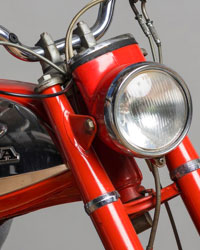
Piaggio - Vespa - VGL1 - 150 cc - 1958


16
days
03
hours
23
minutes
44
seconds
Starting bid
€ 1
Reserve price not met

Expert
Selected by Davide Marelli
With 15 years' trade experience, he has written extensively for moped magazines.
Estimate € 8,000 - € 8,800
No bids placed
Catawiki Buyer Protection
Your payment’s safe with us until you receive your object.View details
Trustpilot 4.4 | 146353 reviews
Rated Excellent on Trustpilot.
Description from the seller
Rare Wideframe GL 150 Touring.
Assembled at the Messerschmitt factory.
All original—and extremely rare—accessories are present.
Year: 1958
Frame: VGL1T Wideframe ribbed frame.
Engine: VGL1M (original engine fitted)
Total production in 1957 and 1958 was only 2,110 units.
Produced only in red or blue.
It has some very special and valuable accessories, including:
VDO speedometer
Chrome side bars
Ulma 10-inch wheel covers
Scharlach headlight
Hella horn
Original hand grips
Wideframe taillight
I.m.p.e.a C.E.V. Genova rectifier
Ulma swingarm cover
Rare “ox-eye” turn signals on the side panels
Passenger seat with folding backrest.
It starts and runs very well.
Very nice cosmetic condition with some patina.
Items that need attention: the taillight does not work, the horn does not work, and the ignition will not switch off.
Complete Swedish papers included.
Delivery within Germany: €200
NL, AT, BE: €250
IT, DNK, PL: €300
Worldwide shipping on request
Wikipedia:
This model, produced temporarily for export markets, was assembled from Italian VGL1T body parts together with the characteristic accessories of the Messerschmitt Vespa VD2T (T/3), using an Italian frame from Pontedera.
The model was characterized by:
Burgundy-red paintwork,
Hella electrical components,
silver wiring looms following the Messerschmitt VD2T wiring diagram,
Hella horn,
a steering head with a rectangular VDO speedometer reading up to 120 km/h,
Hella ignition switch,
a round Hella or Scharlach headlight,
a center stand with offset feet,
a typically German-style exhaust silencer,
Boge shock absorbers,
a chrome-plated front suspension spring,
Italian VGL1T drum brakes with burgundy-red painted steel rims,
the embossed, adhesive-mounted Vespa script commonly used in Germany,
Vespa logos on rubber parts, such as the handlebar grips or stand feet, and Bauer screws for assembly joints.
The Italian sheet-steel frames had a bracket for I.M.P.E.A. rectifiers, which were also used during Vespa assembly, as was the Italian SIEM taillight with a separate brake-light bulb. The side panels also came from Italy and had the mounting brackets and hole pattern customary there. This model was fitted with Vigano side-panel trim and a bumper on the front fender for export of this VGL1T to its intended markets.
Frame and engine numbers were assigned at the Pontedera factory. German numbers and type plates were not used on this model, as the license had already expired and negotiations for the future were still ongoing when production of the VGL1T began. The model series was exported to the Swedish market and sold under the name “Touring”; later in Sweden it was also called “Tysk Touring” (= German Touring), referring to its manufacturing origin. Messerschmitt spare-parts catalogs were shipped along with the export series to the Swedish importer COMO M. & T. Bjerke AB in Stockholm.
The earliest German Touring Vespas for the Swedish market had frame numbers around ☆010200, and the frames in this series were produced in Pontedera from late 1957 to early 1958. In early March 1958, the first German Touring Vespas were registered for road use in the Swedish market. Total production of VGL1T frames in Pontedera ran as follows:
1957, frame numbers VGL1T ☆001001 to ☆010842, and
1958, frame numbers VGL1T ☆010843 to ☆016610.
Details
Brand
Piaggio
Model Type
Vespa - VGL1
Engine size (in cc)
150
Year of first registration
1958
Condition
Very good
Registration papers
with Swedish registration
Mileage
15921 km
Frame number
VGL1T
Engine number
VGL1M
Located in country
Germany
Vehicle registration
We can help buyers register their vehicle through our trusted external partner. The process is straightforward and can be completed after purchase. Vehicle registration remains the buyer's responsibility.
Sold by
Disclaimer
Catawiki always aims to offer you the best possible buying experience. Our experts virtually review and select every vehicle in line with our submission guidelines and we require our sellers to provide the most accurate description of the vehicle. However, providing a fully detailed analysis of the vehicle is extremely difficult, and close to impossible. To guide you, we ask our sellers to provide information about the vehicle’s condition. Please consider that most vehicles for sale are classic vehicles and they often already have a whole life behind them, meaning that even a condition 1 or 2 vehicle might need maintenance to be ready for the road. It is advised to carefully read our submission guidelines that further describe details about the condition grades and types to manage your expectations. Cars are sold “as is”, meaning as described and in the condition they are in at the time of the sale and without any representation, warranty or assumption of liability of any kind as to the condition by Catawiki or by the seller. The condition of this item is the opinion of the seller and may differ from yours, your local garage, or the dealer’s opinion. This does not automatically mean the car does not conform to its description. Before bidding, please check your local legislation regarding vehicle registration. Neither the seller nor Catawiki is responsible for the registration of the vehicle in your country and will not accept a cancellation for your failure to register the vehicle. We also recommend that, if possible, you arrange a viewing with the seller before placing a bid.
Catawiki always aims to offer you the best possible buying experience. Our experts virtually review and select every vehicle in line with our submission guidelines and we require our sellers to provide the most accurate description of the vehicle. However, providing a fully detailed analysis of the vehicle is extremely difficult, and close to impossible. To guide you, we ask our sellers to provide information about the vehicle’s condition. Please consider that most vehicles for sale are classic vehicles and they often already have a whole life behind them, meaning that even a condition 1 or 2 vehicle might need maintenance to be ready for the road. It is advised to carefully read our submission guidelines that further describe details about the condition grades and types to manage your expectations. Cars are sold “as is”, meaning as described and in the condition they are in at the time of the sale and without any representation, warranty or assumption of liability of any kind as to the condition by Catawiki or by the seller. The condition of this item is the opinion of the seller and may differ from yours, your local garage, or the dealer’s opinion. This does not automatically mean the car does not conform to its description. Before bidding, please check your local legislation regarding vehicle registration. Neither the seller nor Catawiki is responsible for the registration of the vehicle in your country and will not accept a cancellation for your failure to register the vehicle. We also recommend that, if possible, you arrange a viewing with the seller before placing a bid.