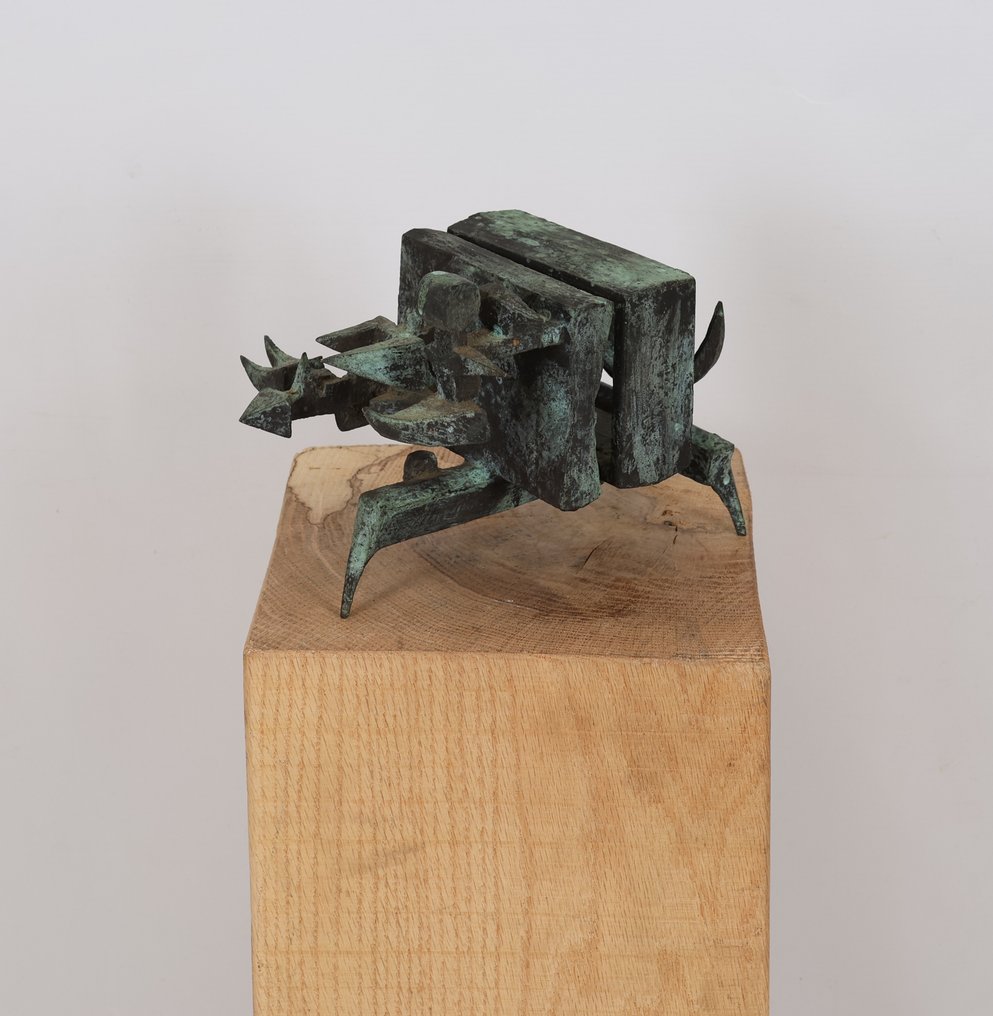
Jerzy Jarnuszkiewicz (1919–2005) - Sculpture, Untitled - 16 cm - Bronze


02
days
11
hours
42
minutes
38
seconds
Current bid
€ 2
Reserve price not met

Expert
Selected by Silvia Possanza
Held senior specialist role at Finarte for 12 years, specialising in modern prints.
Estimate € 500 - € 600
18 other people are watching this object
| Bidder 0214 | €2 | |
|---|---|---|
| Bidder 0214 | €1 |
Catawiki Buyer Protection
Your payment’s safe with us until you receive your object.View details
Trustpilot 4.4 | 121798 reviews
Rated Excellent on Trustpilot.
Bronze Untitled sculpture by Jerzy Jarnuszkiewicz (1919–2005), signed and measuring 16×21×16 cm.
AI-assisted summary
Description from the seller
A great piece by sculptor Jerzy Jarnuszkiewicz (1919–2005). 16x21x16 cm
Jerzy Jarnuszkiewicz (1919–2005) is considered "one of the greatest educators in the history of the Academy of Fine Arts in Warsaw." In his studio, overlooking Krakowskie Przedmieście Street, he developed the so-called "education of partnership" and practiced an "open didactic method," striving to "extract creative individual elements" from each of his students. Future eminent sculptors and pedagogues, including Krzysztof M. Bednarski, Barbara Falender, Grzegorz Kowalski, and Henryk Morel, studied in his studio. Jarnuszkiewicz sensitized his students to events affecting their own lives in terms of macro- and micro-history. Like himself, they created various types of commemorative forms—from monumental statues to statuettes and medals. They participated in competitions (often winning them) to commemorate individual people as well as social or historical events, including the extermination of the Jews during World War II.
Jarnuszkiewicz had the appropriate background to do this. He belonged to Oskar Hansen's team, which in late 1958 won the competition for the Oświęcim monument, commemorating the victims of the Auschwitz-Birkenau concentration and extermination camp. A proposal by Hansen’s team titled *Road* was presumably the most avant-garde monument project in postwar Poland. Sometime in 1961 or 1962, Jarnuszkiewicz himself created
Seller's Story
Over Art Dumay
Art Dumay in Nuenen is much more than just a gallery. It is a versatile art enterprise that brings together modern and classical art under one roof. From our gallery for contemporary painting and our art dealership with classical works, we are engaged in evaluating, purchasing, and selling art. We do this both directly and through carefully organized art auctions for modern and classical art.
Our selection is broad and varied — from modern Dutch artists to renowned masters from the past.
With more than 25 years of experience, we successfully guide purchase and sale processes for individuals, companies, governments, and institutions.
Art Dumay has an extensive regional, national, and international network of buyers and collectors.
In addition to our sales activities, we also provide professional appraisals, restorations, and repair work in-house. Thanks to our effective auction methodology, we are able to reach a large international audience, while our art collections are safely stored and insured in our 1,000 m² building in Nuenen.
At Art Dumay, expertise, a passion for art, and personal attention are at the core — each day again.
Translated by Google TranslateA great piece by sculptor Jerzy Jarnuszkiewicz (1919–2005). 16x21x16 cm
Jerzy Jarnuszkiewicz (1919–2005) is considered "one of the greatest educators in the history of the Academy of Fine Arts in Warsaw." In his studio, overlooking Krakowskie Przedmieście Street, he developed the so-called "education of partnership" and practiced an "open didactic method," striving to "extract creative individual elements" from each of his students. Future eminent sculptors and pedagogues, including Krzysztof M. Bednarski, Barbara Falender, Grzegorz Kowalski, and Henryk Morel, studied in his studio. Jarnuszkiewicz sensitized his students to events affecting their own lives in terms of macro- and micro-history. Like himself, they created various types of commemorative forms—from monumental statues to statuettes and medals. They participated in competitions (often winning them) to commemorate individual people as well as social or historical events, including the extermination of the Jews during World War II.
Jarnuszkiewicz had the appropriate background to do this. He belonged to Oskar Hansen's team, which in late 1958 won the competition for the Oświęcim monument, commemorating the victims of the Auschwitz-Birkenau concentration and extermination camp. A proposal by Hansen’s team titled *Road* was presumably the most avant-garde monument project in postwar Poland. Sometime in 1961 or 1962, Jarnuszkiewicz himself created
Seller's Story
Over Art Dumay
Art Dumay in Nuenen is much more than just a gallery. It is a versatile art enterprise that brings together modern and classical art under one roof. From our gallery for contemporary painting and our art dealership with classical works, we are engaged in evaluating, purchasing, and selling art. We do this both directly and through carefully organized art auctions for modern and classical art.
Our selection is broad and varied — from modern Dutch artists to renowned masters from the past.
With more than 25 years of experience, we successfully guide purchase and sale processes for individuals, companies, governments, and institutions.
Art Dumay has an extensive regional, national, and international network of buyers and collectors.
In addition to our sales activities, we also provide professional appraisals, restorations, and repair work in-house. Thanks to our effective auction methodology, we are able to reach a large international audience, while our art collections are safely stored and insured in our 1,000 m² building in Nuenen.
At Art Dumay, expertise, a passion for art, and personal attention are at the core — each day again.
Translated by Google TranslateDetails
Era
1900-2000
Country of Origin
Poland
Material
Bronze
Artist
Jerzy Jarnuszkiewicz (1919–2005)
Title of artwork
Untitled
Signature
Signed
Condition
Good condition
Height
16 cm
Width
21 cm
Depth
16 cm