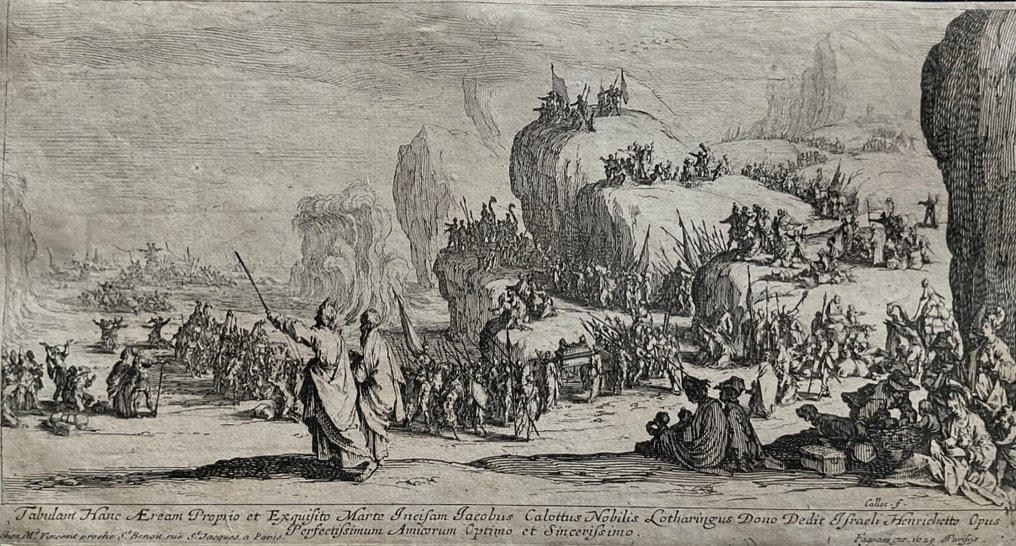
Jacques Callot (1592-1635) - "Traversata del Mar Rosso"- Originale rara


04
days
19
hours
57
minutes
55
seconds
Current bid
€ 1
No reserve price

Expert
Selected by David Elberg
Spent five years as a Classic Art Expert and three years as a commissaire-priseur.
Estimate € 150 - € 200
7 other people are watching this object
 Bidder 4835 Bidder 4835 | €1 |
|---|
Catawiki Buyer Protection
Your payment’s safe with us until you receive your object.View details
Trustpilot 4.4 | 122813 reviews
Rated Excellent on Trustpilot.
Jacques Callot, 'Traversata del Mar Rosso'—Original rare impression of 1629, an etching on plate, 127 × 235 mm, Baroque historical scene depicting the Exodus with Moses and Aaron and the Ark, signed lower right Callot f., produced in France.
AI-assisted summary
Description from the seller
Rare impression
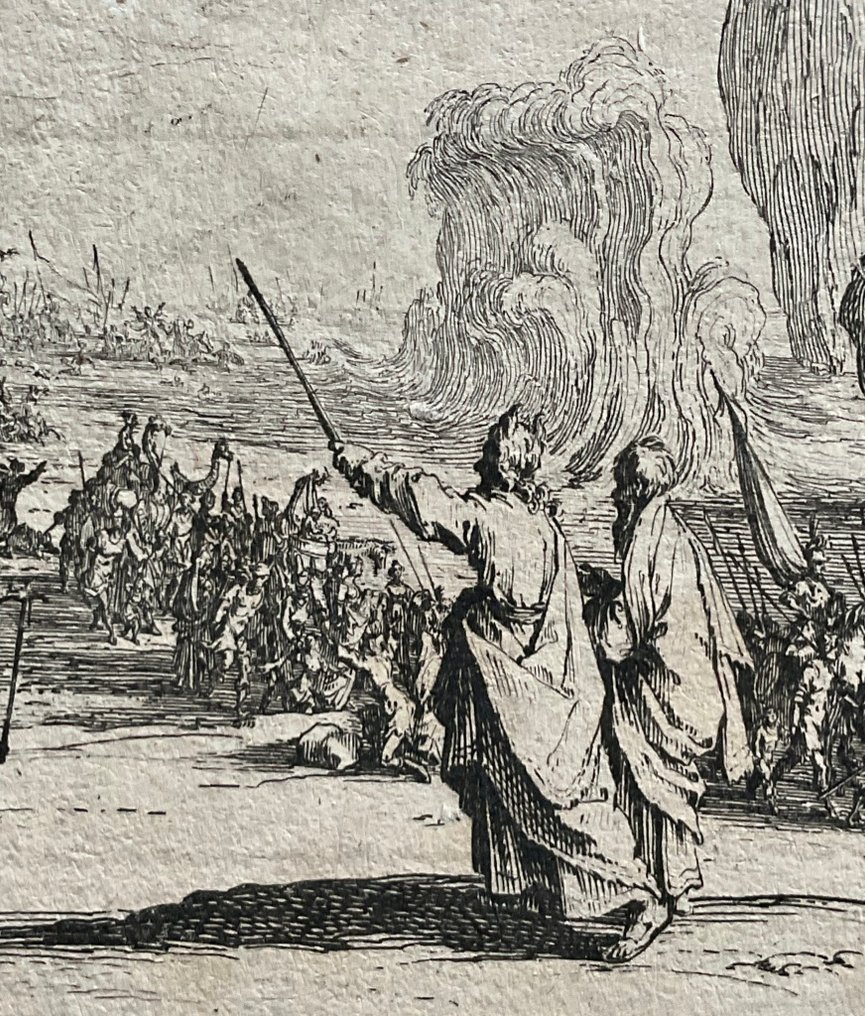
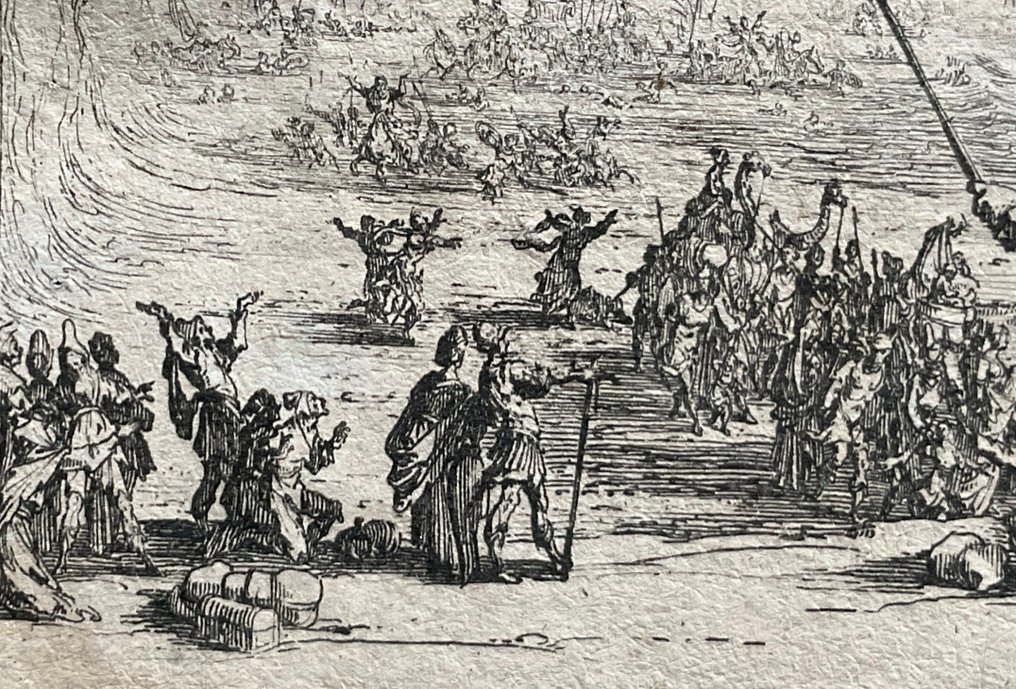
Crossing of the Red Sea; in the foreground, Moses and Aaron, with the former brandishing his staff; in the center, a procession of people emerging from the corridor formed by the divided sea, carrying the Ark of the Covenant; in the distance, the Pharaoh and his army swallowed by the sea; with another wave alteration at the center.
The Crossing of the Red Sea (also known as The Passage of the Mer Rouge), 1629, with a Latin dedication by Callot to Israël Henriet (c. 1590–1661), originally published by Israël Henriet and subsequently by Jacques Fagnani (1699–1730) in 1712/3, and finally by the publisher Vincent (c. 1775–1800).
This table, carved from precious wood by his own exquisite skill, Jacob Calottus, noble Lotharingian, gave as a gift to Israeli Henrichetto. A most perfect work from the best and sincerest of friends.
Fagnani exc. 1629 Paris.
State IV (of V) with the publisher's address, Vincent 'at Md, Vincent near St. Benoît, rue St. Jacques, in Paris,' at the bottom left.
Conditions: sharp and well-printed impression showing signs of wear on the printing plate, trimmed with a small margin around the edge of the image. The print is in good condition (i.e., it does not have tears, holes, creases, abrasions, stains, or significant foxing). On the back, there are old attachments in the corners.
Signed at the bottom right: Callot. f.
Bibliographic references:
Lieure 1927 / Jacques Callot (665.VII.)
Meaume 1860 / Research on the life and works of Jacques Callot 1860 (1.V)
From private collection
Also preserved in the collections of the British Museum and the Rijksmuseum.
Callot, the master of burin (a tool that allows engravers to create lines similar to those made by engravers themselves), and the technique of 'stopping out,' which enables engravers to create lighter lines in the distance (as seen here).
Visually striking engraving depicting a miraculous episode from the biblical story, 'Exodus,' showing Moses with his staff raised as he commands the waters of the Red Sea to part, allowing the Israelites to escape the pursuing Egyptian army by crossing the water passage with the Ark of the Covenant.
Rare impression
Crossing of the Red Sea; in the foreground, Moses and Aaron, with the former brandishing his staff; in the center, a procession of people emerging from the corridor formed by the divided sea, carrying the Ark of the Covenant; in the distance, the Pharaoh and his army swallowed by the sea; with another wave alteration at the center.
The Crossing of the Red Sea (also known as The Passage of the Mer Rouge), 1629, with a Latin dedication by Callot to Israël Henriet (c. 1590–1661), originally published by Israël Henriet and subsequently by Jacques Fagnani (1699–1730) in 1712/3, and finally by the publisher Vincent (c. 1775–1800).
This table, carved from precious wood by his own exquisite skill, Jacob Calottus, noble Lotharingian, gave as a gift to Israeli Henrichetto. A most perfect work from the best and sincerest of friends.
Fagnani exc. 1629 Paris.
State IV (of V) with the publisher's address, Vincent 'at Md, Vincent near St. Benoît, rue St. Jacques, in Paris,' at the bottom left.
Conditions: sharp and well-printed impression showing signs of wear on the printing plate, trimmed with a small margin around the edge of the image. The print is in good condition (i.e., it does not have tears, holes, creases, abrasions, stains, or significant foxing). On the back, there are old attachments in the corners.
Signed at the bottom right: Callot. f.
Bibliographic references:
Lieure 1927 / Jacques Callot (665.VII.)
Meaume 1860 / Research on the life and works of Jacques Callot 1860 (1.V)
From private collection
Also preserved in the collections of the British Museum and the Rijksmuseum.
Callot, the master of burin (a tool that allows engravers to create lines similar to those made by engravers themselves), and the technique of 'stopping out,' which enables engravers to create lighter lines in the distance (as seen here).
Visually striking engraving depicting a miraculous episode from the biblical story, 'Exodus,' showing Moses with his staff raised as he commands the waters of the Red Sea to part, allowing the Israelites to escape the pursuing Egyptian army by crossing the water passage with the Ark of the Covenant.
Details
Artist
Jacques Callot (1592-1635)
Title of artwork
"Traversata del Mar Rosso"- Originale rara
Technique
Engraving
Signature
Plate signed
Country of Origin
France
Year
1629
Condition
Good condition
Height
127 mm
Width
235 mm
Depiction/Theme
Historical scene
Style
Baroque
Period
17th century
Sold with frame
No
Sold by