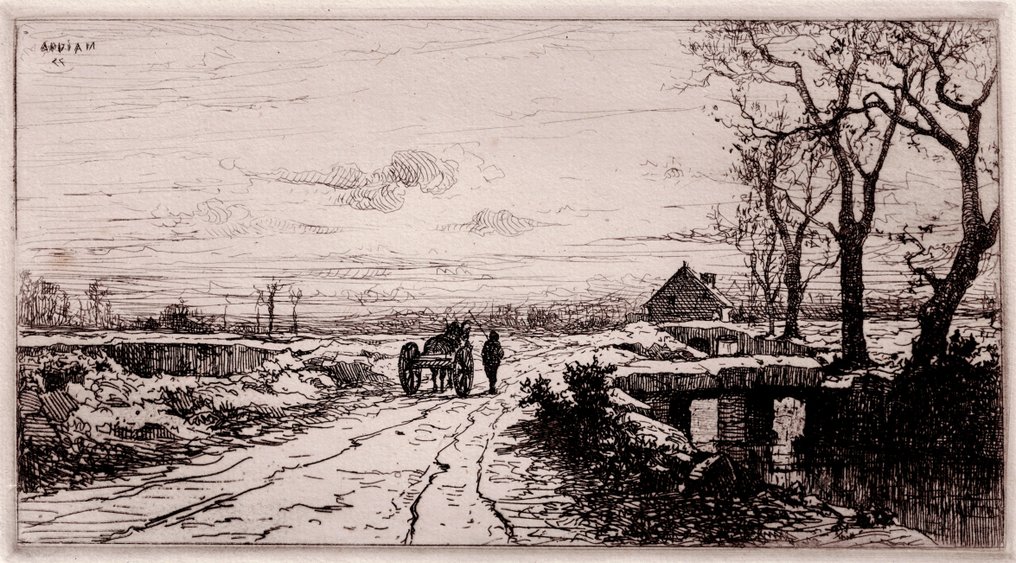
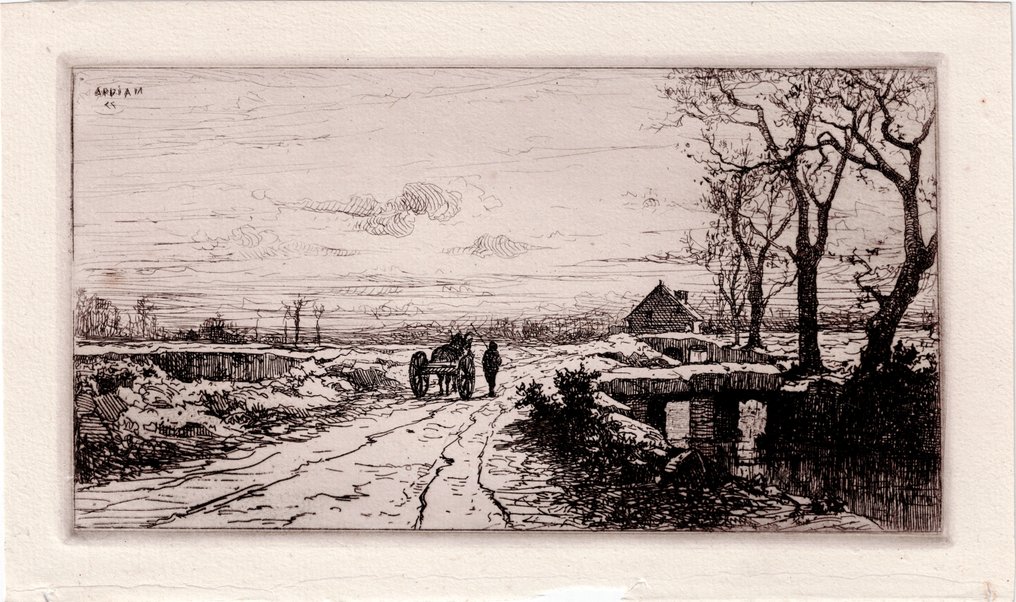
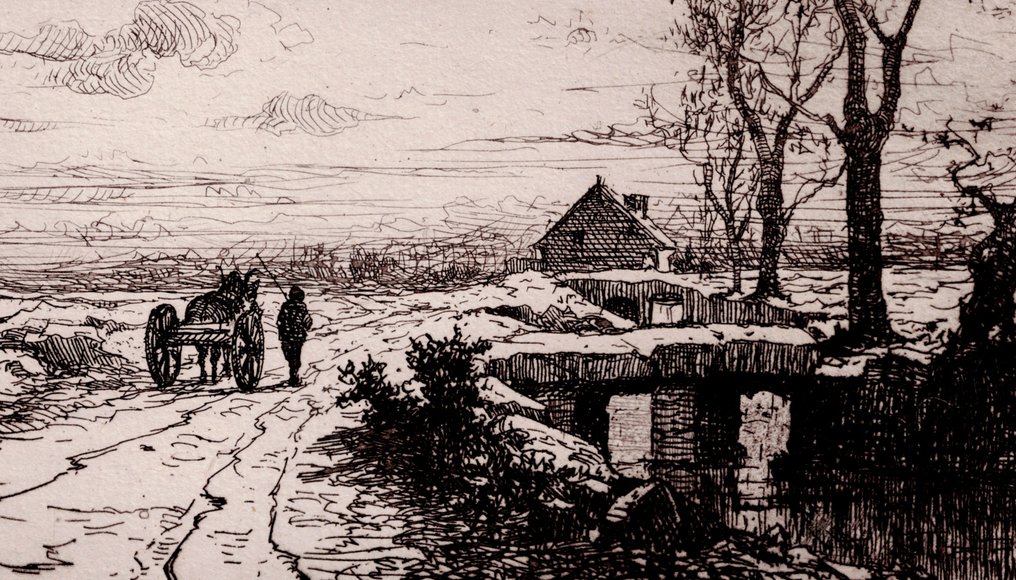
Adolphe Appian (1818-1898) - Chemin de l'étang de Frignon, Isere - 1877
06
days
08
hours
59
minutes
04
seconds
Starting bid
€ 1
No reserve price

Expert
Selected by David Elberg
Spent five years as a Classic Art Expert and three years as a commissaire-priseur.
Estimate € 150 - € 200
No bids placed
Catawiki Buyer Protection
Your payment’s safe with us until you receive your object.View details
Trustpilot 4.4 | 122630 reviews
Rated Excellent on Trustpilot.
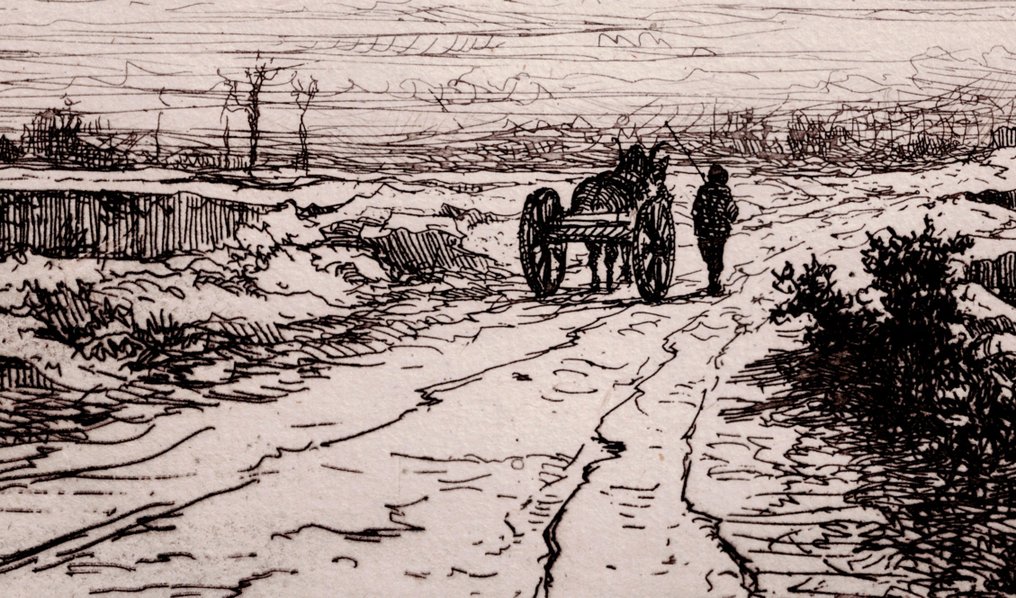
An 1877 etching by Adolphe Appian, titled Chemin de l'étang de Frignon, Isere, with plate signature, offers a refined Barbizon winter mood and historical printmaking significance.
AI-assisted summary
Description from the seller
Description:
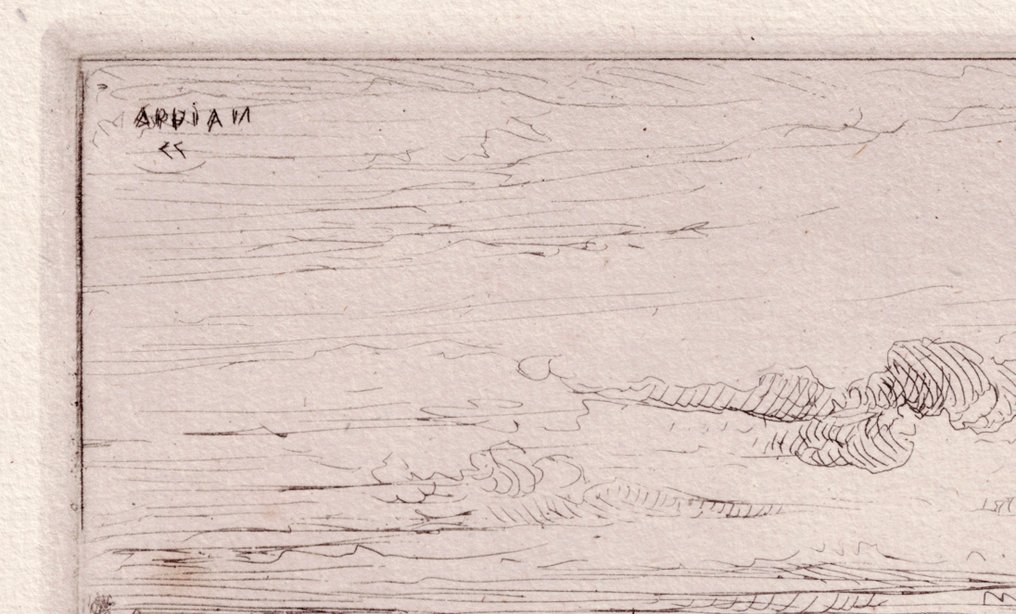
CHEMIN DE L'ETANG DE FRIGNON (ISERE) 1877 ( J.40, P.45 ). A winter scene. Signed Appian 77 in top right corner.
Dimensions:
10,80 x 19,80 cm
Literature:
Curtis & Prouté 1968 / Adolphe Appian, son oeuvre gravé et lithography (45) --- Jennings.40 ---- Appian was one of the outstanding landscape painters of the 19th century in Lyon. He was also an excellent etcher who was extremely sensitive to light and atmosphere. He was able to create a mood with line and by carefully leaving a fine layer of ink on the surface of the copper plate which prints as pale tone. Adolphe Appian studied at the École de Dessin et Beaux-Arts in Lyon, where he was taught by Jean-Michel Grobon (1770-1853). In 1851 he debuted at the Salon of Lyon with three paintings. In 1852 he moved to Crémieu, where he painted the region. He befriended Corot and Daubigny and they influenced his work. 1854 he made his first excursion to the forest of Fontainebleau, In 1861 Appian settled in Creys, located twenty-five kilometers from Crémieu and ten kilometers from Morestel. In 1863 he became an active member of the new Société des Aquafortistes founded by Alfred Cadart in 1862.F. In 1866 the two works he exhibited in Paris were bought by Napoleon III and by princess Mathilde. From 1871 until the early nineties he often visited the Mediterranean coast.Appian is one of the regional artists who showed their territory with love and grace. Besides his paintings he made 76 etchings and 4 litho. Appian was one of the artists closely followed by the publisher Cadart who's merit it was to publish their genius graphical work. Appian was responsible together with Corot and Daubigny for the renewal of the etching in the middle of the 19th century. The great esteem for his work was boosted by Atherton Curtis for Paul Prouté who published his catalogue raisonné in 1968.He based his catalogue on that one of H. Jennings published in the Print Collector's Quarterly" from February 1925
Medium:
Etching
Circa:
1873
Notes:
All measurements are taken on the plate mark. All lot's are listed with several high resolution images, which is the best way to give a clear and objective idea of the general very good condition. Textual condition description is limited, so please examine the images carefully and ask for more info if needed.
Description:
CHEMIN DE L'ETANG DE FRIGNON (ISERE) 1877 ( J.40, P.45 ). A winter scene. Signed Appian 77 in top right corner.
Dimensions:
10,80 x 19,80 cm
Literature:
Curtis & Prouté 1968 / Adolphe Appian, son oeuvre gravé et lithography (45) --- Jennings.40 ---- Appian was one of the outstanding landscape painters of the 19th century in Lyon. He was also an excellent etcher who was extremely sensitive to light and atmosphere. He was able to create a mood with line and by carefully leaving a fine layer of ink on the surface of the copper plate which prints as pale tone. Adolphe Appian studied at the École de Dessin et Beaux-Arts in Lyon, where he was taught by Jean-Michel Grobon (1770-1853). In 1851 he debuted at the Salon of Lyon with three paintings. In 1852 he moved to Crémieu, where he painted the region. He befriended Corot and Daubigny and they influenced his work. 1854 he made his first excursion to the forest of Fontainebleau, In 1861 Appian settled in Creys, located twenty-five kilometers from Crémieu and ten kilometers from Morestel. In 1863 he became an active member of the new Société des Aquafortistes founded by Alfred Cadart in 1862.F. In 1866 the two works he exhibited in Paris were bought by Napoleon III and by princess Mathilde. From 1871 until the early nineties he often visited the Mediterranean coast.Appian is one of the regional artists who showed their territory with love and grace. Besides his paintings he made 76 etchings and 4 litho. Appian was one of the artists closely followed by the publisher Cadart who's merit it was to publish their genius graphical work. Appian was responsible together with Corot and Daubigny for the renewal of the etching in the middle of the 19th century. The great esteem for his work was boosted by Atherton Curtis for Paul Prouté who published his catalogue raisonné in 1968.He based his catalogue on that one of H. Jennings published in the Print Collector's Quarterly" from February 1925
Medium:
Etching
Circa:
1873
Notes:
All measurements are taken on the plate mark. All lot's are listed with several high resolution images, which is the best way to give a clear and objective idea of the general very good condition. Textual condition description is limited, so please examine the images carefully and ask for more info if needed.
Details
Artist
Adolphe Appian (1818-1898)
Title of artwork
Chemin de l'étang de Frignon, Isere - 1877
Technique
Etching
Signature
Plate signed
Country of Origin
France
Year
1877
Condition
Excellent condition
Height
108 mm
Width
198 mm
Style
Barbizon school
Period
19th century
Sold with frame
No
Sold by