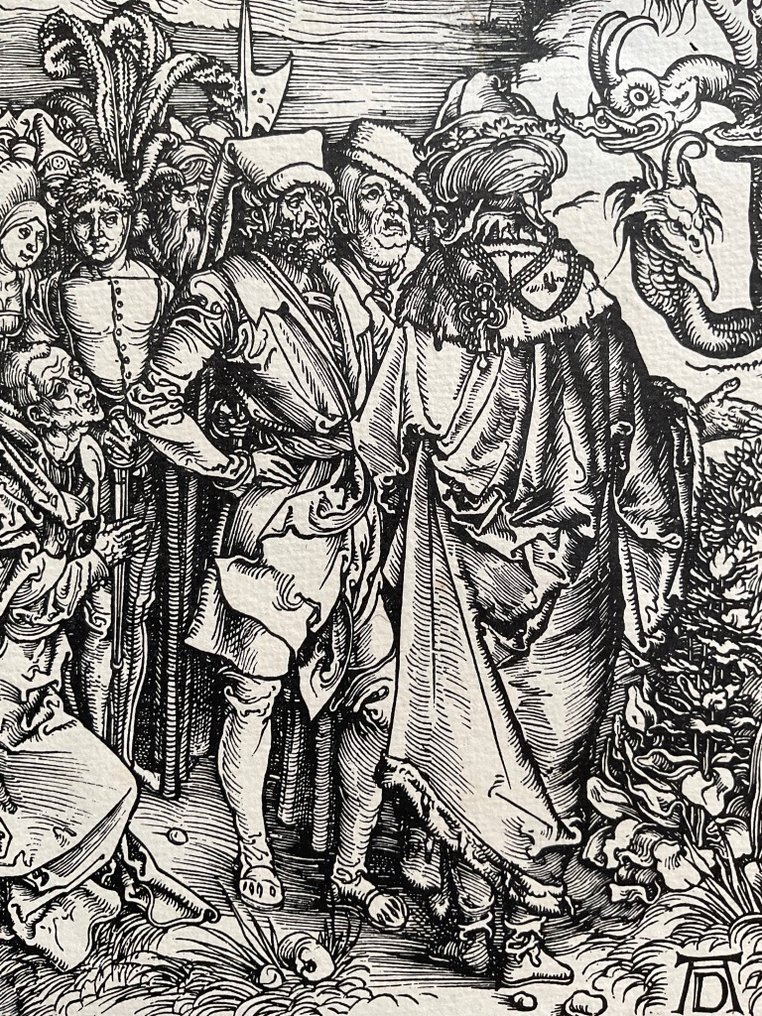
Albrecht Dürer (1471-1528), after - La meretrice di Babilonia



01
day
11
hours
37
minutes
59
seconds
Current bid
€ 36
No reserve price

Expert
Selected by David Elberg
Spent five years as a Classic Art Expert and three years as a commissaire-priseur.
Estimate € 150 - € 200
22 other people are watching this object
 Bidder 0747 Bidder 0747 | €36 | |
|---|---|---|
 Bidder 0788 Bidder 0788 | €31 | |
| Bidder 0747 | €22 | |
Catawiki Buyer Protection
Your payment’s safe with us until you receive your object.View details
Trustpilot 4.4 | 121899 reviews
Rated Excellent on Trustpilot.
Xylograph by Albrecht Dürer (after) titled La meretrice di Babilonia; measures 395 x 286 mm; signed on the plate; origin Germany; 19th century; Renaissance style; in good condition.
AI-assisted summary
Description from the seller
The Whore of Babylon
The Great Prostitute of Babylon is a biblical image symbolizing corrupt power and sin, often associated with the city of Babylon in Revelation. In Albrecht Dürer's work, the figure is depicted as a lavishly dressed woman sitting on a beast with seven heads and ten horns, symbolizing power and dominion.
The seven heads and ten horns of the beast, as well as the golden cup filled with abominations, are elements that further emphasize the theme of corruption and sin.
"The Harlot of Babylon" is a woodcut created by Albrecht Dürer, part of the series on the Apocalypse.
The work is part of a series of 15 woodcuts dated circa 1496-1498.
Bibliography
W.L. Strauss, The Illustrated Bartsch, 10, Commentary, New York, 1981, p. 343, n.273, B.73 (129); M. Pizzi, Albrecht Dürer and His Time - The Plates of the Apocalypse, Bergamo, 1990;
Very good conservation state impression from the mid-19th century on rag paper, with only a tiny hole visible under backlight, small margins.
Monogrammed at the bottom center: AD
Settling in Nuremberg, around 1496 he began to consider an ambitious project, in many ways innovative, preparing an illustrated edition of the Revelation of John, which appeared in 1498 in two editions, one in Latin and the other in German. The theme was particularly topical at the turn of the century, with the millenarian fears that were prevalent.
The work was the first book designed and published through the personal initiative of an artist, who drew its illustrations, engraved its woodcuts, and also served as the publisher.
With astonishing speed, the Apocalypse (and with it the name Albrecht Dürer) spread throughout all European countries and brought its author his first great success.
The Whore of Babylon
The Great Prostitute of Babylon is a biblical image symbolizing corrupt power and sin, often associated with the city of Babylon in Revelation. In Albrecht Dürer's work, the figure is depicted as a lavishly dressed woman sitting on a beast with seven heads and ten horns, symbolizing power and dominion.
The seven heads and ten horns of the beast, as well as the golden cup filled with abominations, are elements that further emphasize the theme of corruption and sin.
"The Harlot of Babylon" is a woodcut created by Albrecht Dürer, part of the series on the Apocalypse.
The work is part of a series of 15 woodcuts dated circa 1496-1498.
Bibliography
W.L. Strauss, The Illustrated Bartsch, 10, Commentary, New York, 1981, p. 343, n.273, B.73 (129); M. Pizzi, Albrecht Dürer and His Time - The Plates of the Apocalypse, Bergamo, 1990;
Very good conservation state impression from the mid-19th century on rag paper, with only a tiny hole visible under backlight, small margins.
Monogrammed at the bottom center: AD
Settling in Nuremberg, around 1496 he began to consider an ambitious project, in many ways innovative, preparing an illustrated edition of the Revelation of John, which appeared in 1498 in two editions, one in Latin and the other in German. The theme was particularly topical at the turn of the century, with the millenarian fears that were prevalent.
The work was the first book designed and published through the personal initiative of an artist, who drew its illustrations, engraved its woodcuts, and also served as the publisher.
With astonishing speed, the Apocalypse (and with it the name Albrecht Dürer) spread throughout all European countries and brought its author his first great success.
Details
Artist
Albrecht Dürer (1471-1528), after
Title of artwork
La meretrice di Babilonia
Technique
Woodcut print
Signature
Plate signed
Country of Origin
Germany
Condition
Good condition
Height
395 mm
Width
286 mm
Style
Renaissance
Period
19th century
Sold with frame
No
Sold by