Nr. 100153781

Verkauft
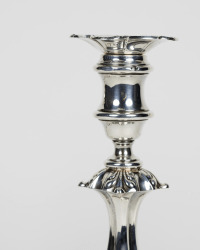
Gustaf Theodor Folcker - Year 1844 - Becher - .830 Silber - Schweden, Stockholm
Höchstgebot
€ 140
Vor 3 Tagen

Gustaf Theodor Folcker - Year 1844 - Becher - .830 Silber - Schweden, Stockholm

This is an antique Swedish silver beaker, crafted by the renowned Stockholm silversmith Gustaf Theodor Folcker (1782–1865), dated 1844. Folcker was a prominent figure in Swedish silverware during the early to mid-19th century, known for producing high-quality pieces in the late Empire and Biedermeier styles. His works often feature clean lines, functional design, and fine craftsmanship, and he was active in Stockholm from around 1807 until his death, with his maker's mark "GF" in a rectangular punch commonly used on his items. Hallmarks and Identification The hallmarks on the base include: Maker's mark: "GF" in a rectangular cartouche, identifying Gustaf Folcker. Town mark: The head of Saint Erik (Stockholm's patron saint) in a contoured shield, which is the standard town mark for Stockholm in the 19th century. This shield is often heart-shaped or inverted heart-like, and the head may appear "animal-like" in worn or stylized examples due to the artistic rendering of the saint's face with a crown or halo. Date letter: "O4" for 1844, Typical Swedish national mark is the three crowns in a trefoil (cat's paw) for silver fineness (usually 830/1000 or .830 standard, common for Swedish silver at the time). No purity number is visible in the photos, but 830 is standard for 19th-century Swedish silver, indicating 83% pure silver alloyed with copper for durability. Swedish hallmarking in the 19th century was compulsory, regulated by the state since 1752, to guarantee purity and origin. Pieces like this would be struck with the maker's mark, town mark, date letter, and national control mark. Your item's marks align with Stockholm production in 1844, confirming its authenticity as Swedish silver. Description and Style The beaker is a small, elegant drinking vessel, likely intended as a christening or presentation cup—a common custom in 19th-century Scandinavia for gifting to children at baptism or as family heirlooms. Its dimensions (height 8.5 cm, rim diameter 7.3 cm) and weight (120.9 grams) are typical for a single-handled tasting beaker, designed for small portions of liquid like milk or wine. The form is bulbous with a flared rim and a scalloped or gadrooned girdle (the decorative band around the middle), giving it a gentle, lobed base for stability and aesthetic appeal. The surface is polished to a high shine, showing minor scratches and patina consistent with age and use, but no major dents or repairs are apparent in the photos. The engravings add personal significance: "Elsa" on one side. "Christina" on other side. These are likely the names of recipients or owners, possibly indicating a family gift for a birth or christening. The cursive style is hand-engraved, typical for personalized items of the period. The style is transitional late Empire/Biedermeier, characterized by simple, neoclassical shapes with subtle ornamentation. Empire influence is seen in the flared form and gadrooning, while Biedermeier elements include the functional, understated elegance suited to middle-class households in 1840s Sweden. Condition and Value The piece appears in good antique condition, with normal wear for its age (181 years old as of 2025). The silver has a warm patina, and the weight suggests solid construction without thin spots or repairs. No major damage like cracks or solder marks is visible. There is 2 slight dent is beaker, showed on pictures

Nr. 100153781

Verkauft
Gustaf Theodor Folcker - Year 1844 - Becher - .830 Silber - Schweden, Stockholm

Gustaf Theodor Folcker - Year 1844 - Becher - .830 Silber - Schweden, Stockholm

This is an antique Swedish silver beaker, crafted by the renowned Stockholm silversmith Gustaf Theodor Folcker (1782–1865), dated 1844. Folcker was a prominent figure in Swedish silverware during the early to mid-19th century, known for producing high-quality pieces in the late Empire and Biedermeier styles. His works often feature clean lines, functional design, and fine craftsmanship, and he was active in Stockholm from around 1807 until his death, with his maker's mark "GF" in a rectangular punch commonly used on his items.
Hallmarks and Identification
The hallmarks on the base include:

Maker's mark: "GF" in a rectangular cartouche, identifying Gustaf Folcker.
Town mark: The head of Saint Erik (Stockholm's patron saint) in a contoured shield, which is the standard town mark for Stockholm in the 19th century. This shield is often heart-shaped or inverted heart-like, and the head may appear "animal-like" in worn or stylized examples due to the artistic rendering of the saint's face with a crown or halo.
Date letter: "O4" for 1844,
Typical Swedish national mark is the three crowns in a trefoil (cat's paw) for silver fineness (usually 830/1000 or .830 standard, common for Swedish silver at the time). No purity number is visible in the photos, but 830 is standard for 19th-century Swedish silver, indicating 83% pure silver alloyed with copper for durability.

Swedish hallmarking in the 19th century was compulsory, regulated by the state since 1752, to guarantee purity and origin. Pieces like this would be struck with the maker's mark, town mark, date letter, and national control mark. Your item's marks align with Stockholm production in 1844, confirming its authenticity as Swedish silver.
Description and Style
The beaker is a small, elegant drinking vessel, likely intended as a christening or presentation cup—a common custom in 19th-century Scandinavia for gifting to children at baptism or as family heirlooms. Its dimensions (height 8.5 cm, rim diameter 7.3 cm) and weight (120.9 grams) are typical for a single-handled tasting beaker, designed for small portions of liquid like milk or wine. The form is bulbous with a flared rim and a scalloped or gadrooned girdle (the decorative band around the middle), giving it a gentle, lobed base for stability and aesthetic appeal. The surface is polished to a high shine, showing minor scratches and patina consistent with age and use, but no major dents or repairs are apparent in the photos.
The engravings add personal significance:

"Elsa" on one side.
"Christina" on other side.

These are likely the names of recipients or owners, possibly indicating a family gift for a birth or christening. The cursive style is hand-engraved, typical for personalized items of the period.
The style is transitional late Empire/Biedermeier, characterized by simple, neoclassical shapes with subtle ornamentation. Empire influence is seen in the flared form and gadrooning, while Biedermeier elements include the functional, understated elegance suited to middle-class households in 1840s Sweden.
Condition and Value
The piece appears in good antique condition, with normal wear for its age (181 years old as of 2025). The silver has a warm patina, and the weight suggests solid construction without thin spots or repairs. No major damage like cracks or solder marks is visible. There is 2 slight dent is beaker, showed on pictures

Höchstgebot
€ 140
Chiara Scotto Pasanisi dei Foscarini
Experte
Schätzung  € 330 - € 400

Ähnliche Objekte

Für Sie aus der Kategorie

Silber- und Gold-Dekor

Suchalarm einrichten
Richten Sie einen Suchalarm ein, um benachrichtigt zu werden, sobald neue passende Objekte verfügbar sind.

Dieses Objekt wurde vorgestellt in:


So kaufen Sie auf Catawiki

Mehr zum Käuferschutz erfahren

      1. Etwas Besonderes entdecken

      Entdecken Sie in unseren Auktionen Tausende von besonderen Objekten, die von Experten ausgewählt wurden. Sehen Sie sich die Fotos, die ausführliche Beschreibung und den Schätzwert der besonderen Objekte an, die Sie interessieren. 

      2. Höchstgebot abgeben

      Finden Sie etwas, das Sie begeistert, und geben Sie das Höchstgebot ab. Sie können die Auktion bis zum Schluss mitverfolgen oder unser System für Sie bieten lassen. Dazu müssen Sie einfach nur den Maximalbetrag eingeben, den Sie für das jeweilige Objekt ausgeben möchten. 

      3. Sichere Zahlung durchführen

      Bezahlen Sie Ihr besonderes Objekt und wir verwahren Ihre Zahlung, bis Ihr Objekt unversehrt bei Ihnen angekommen ist. Wir wickeln alle Transaktionen mit einem zuverlässigen und sicheren Zahlungssystem ab. 

Haben Sie etwas Ähnliches zu verkaufen?

Unabhängig davon, ob Online-Auktionen Neuland für Sie sind oder ob Sie gewerblich verkaufen – wir helfen Ihnen, mehr mit Ihren besonderen Objekten zu verdienen.

Objekt verkaufen