Nr. 100153885

Verkauft
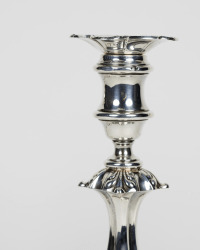
August Neresheimer & Co. - C. 1890, Hanau for Swedish Market - Teekanne - .835 Silber - 793 g
Höchstgebot
€ 1.001
Vor 3 Tagen

August Neresheimer & Co. - C. 1890, Hanau for Swedish Market - Teekanne - .835 Silber - 793 g

This ornate silver teapot, crafted by the renowned Hanau firm of B. Neresheimer & Söhne (often associated with August and Ludwig Neresheimer as key partners), exemplifies the Rococo revival style popular in late 19th-century German silverware. Established in 1890, the Neresheimer workshop specialized in high-quality pieces inspired by historical designs, frequently incorporating elaborate repoussé work and pseudo-hallmarks that evoked antique European silver traditions. This particular example, dating to around 1890, was produced for export to the Swedish market, as indicated by the presence of Swedish silver import hallmarks alongside German marks, or just model numbers or pseudo marks. Weight 793g The teapot stands 23 cm tall, with a body diameter of 12 cm and an overall width (including spout and handle) of 24 cm. Its form is characteristically bulbous and lobed, shaped like a stylized pumpkin or melon, with vertical fluting that adds texture and depth. The body is richly decorated with chased and repoussé floral motifs—prominent roses encircled by scrolling leaves and tendrils—creating a lush, asymmetrical garden-like effect typical of Rococo aesthetics. These embellishments are repeated on the curved gooseneck spout, which features acanthus leaf accents at its base and a molded floral detail near the tip for added elegance and functionality in pouring. The piece rests on three cabriole feet, each terminating in a scrolled pad with leaf motifs, providing stability while enhancing the overall baroque flair. The C-scroll handle is ergonomically arched, with a thumbpiece for secure grip, and includes insulating rings (likely ivory, bone, or a similar heat-resistant material) to prevent burns when handling hot contents. The hinged, domed lid mirrors the body's scalloped lobes and is topped by a finial resembling a budding flower or artichoke, complete with detailed petals and leaves for a naturalistic touch. On the base, the hallmarks include the "835" fineness mark, denoting 83.5% pure silver (a standard Continental European purity, slightly above the Swedish minimum of 830/1000). Additional marks Swedish import indicators. "S" in an oval or related symbol confirming silver content for import. Swedish import controls for foreign silver were formalized around the turn of the century, but pieces like this often bear combined marks reflecting export practices.

Nr. 100153885

Verkauft
August Neresheimer & Co. - C. 1890, Hanau for Swedish Market - Teekanne - .835 Silber - 793 g

August Neresheimer & Co. - C. 1890, Hanau for Swedish Market - Teekanne - .835 Silber - 793 g

This ornate silver teapot, crafted by the renowned Hanau firm of B. Neresheimer & Söhne (often associated with August and Ludwig Neresheimer as key partners), exemplifies the Rococo revival style popular in late 19th-century German silverware. Established in 1890, the Neresheimer workshop specialized in high-quality pieces inspired by historical designs, frequently incorporating elaborate repoussé work and pseudo-hallmarks that evoked antique European silver traditions. This particular example, dating to around 1890, was produced for export to the Swedish market, as indicated by the presence of Swedish silver import hallmarks alongside German marks, or just model numbers or pseudo marks.

Weight 793g

The teapot stands 23 cm tall, with a body diameter of 12 cm and an overall width (including spout and handle) of 24 cm. Its form is characteristically bulbous and lobed, shaped like a stylized pumpkin or melon, with vertical fluting that adds texture and depth. The body is richly decorated with chased and repoussé floral motifs—prominent roses encircled by scrolling leaves and tendrils—creating a lush, asymmetrical garden-like effect typical of Rococo aesthetics. These embellishments are repeated on the curved gooseneck spout, which features acanthus leaf accents at its base and a molded floral detail near the tip for added elegance and functionality in pouring.
The piece rests on three cabriole feet, each terminating in a scrolled pad with leaf motifs, providing stability while enhancing the overall baroque flair. The C-scroll handle is ergonomically arched, with a thumbpiece for secure grip, and includes insulating rings (likely ivory, bone, or a similar heat-resistant material) to prevent burns when handling hot contents. The hinged, domed lid mirrors the body's scalloped lobes and is topped by a finial resembling a budding flower or artichoke, complete with detailed petals and leaves for a naturalistic touch.
On the base, the hallmarks include the "835" fineness mark, denoting 83.5% pure silver (a standard Continental European purity, slightly above the Swedish minimum of 830/1000).
Additional marks Swedish import indicators. "S" in an oval or related symbol confirming silver content for import. Swedish import controls for foreign silver were formalized around the turn of the century, but pieces like this often bear combined marks reflecting export practices.

Höchstgebot
€ 1.001
Chiara Scotto Pasanisi dei Foscarini
Experte
Schätzung  € 550 - € 700

Ähnliche Objekte

Für Sie aus der Kategorie

Silber- und Gold-Dekor

Suchalarm einrichten
Richten Sie einen Suchalarm ein, um benachrichtigt zu werden, sobald neue passende Objekte verfügbar sind.

Dieses Objekt wurde vorgestellt in:


So kaufen Sie auf Catawiki

Mehr zum Käuferschutz erfahren

      1. Etwas Besonderes entdecken

      Entdecken Sie in unseren Auktionen Tausende von besonderen Objekten, die von Experten ausgewählt wurden. Sehen Sie sich die Fotos, die ausführliche Beschreibung und den Schätzwert der besonderen Objekte an, die Sie interessieren. 

      2. Höchstgebot abgeben

      Finden Sie etwas, das Sie begeistert, und geben Sie das Höchstgebot ab. Sie können die Auktion bis zum Schluss mitverfolgen oder unser System für Sie bieten lassen. Dazu müssen Sie einfach nur den Maximalbetrag eingeben, den Sie für das jeweilige Objekt ausgeben möchten. 

      3. Sichere Zahlung durchführen

      Bezahlen Sie Ihr besonderes Objekt und wir verwahren Ihre Zahlung, bis Ihr Objekt unversehrt bei Ihnen angekommen ist. Wir wickeln alle Transaktionen mit einem zuverlässigen und sicheren Zahlungssystem ab. 

Haben Sie etwas Ähnliches zu verkaufen?

Unabhängig davon, ob Online-Auktionen Neuland für Sie sind oder ob Sie gewerblich verkaufen – wir helfen Ihnen, mehr mit Ihren besonderen Objekten zu verdienen.

Objekt verkaufen