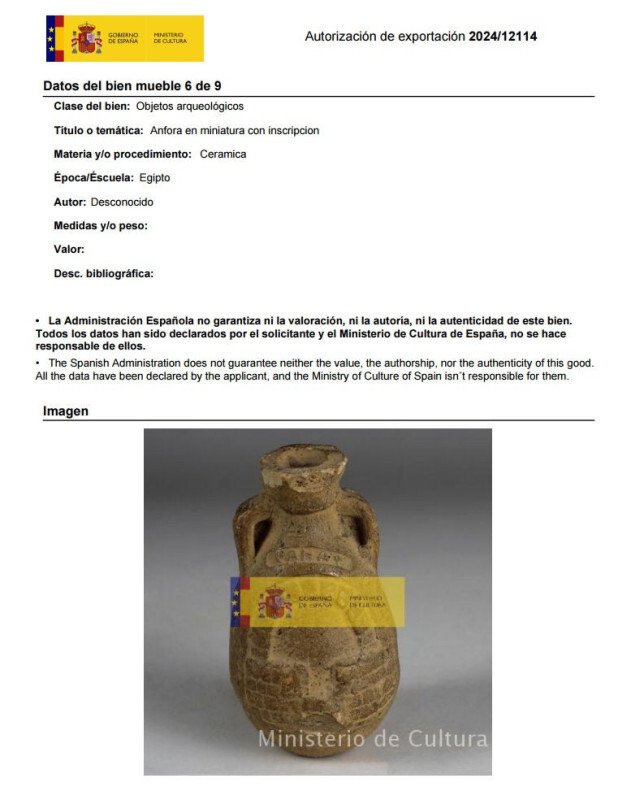
Altes Ägypten, Griechisch-römische Zeit Terracotta Flasche mit Bäckerofen und Inschrift über dem Wort 'PANAT'. Spanische Ausfuhrlizenz


07
Tage
23
Stunden
41
Minuten
46
Sekunden
Startgebot
€ 1
Mindestpreis nicht erreicht

Experte
Von Ruth Garrido Vila ausgewählt
Leitete das Ifergan Collection Museum, spezialisiert auf phönizische Archäologie.
Schätzung € 900 - € 1.100
Es wurden keine Gebote abgegeben
Käuferschutz auf Catawiki
Ihre Zahlung wird von uns sicher verwahrt, bis Sie Ihr Objekt erhalten.Details ansehen
Trustpilot 4.4 | 132444 Bewertungen
Auf Trustpilot als hervorragend bewertet.
Eine Terracotta-Flasche aus dem alten Ägypten (griechisch-römische Periode, 2. bis 1. Jahrhundert v.Chr.), Maße 69 × 37 mm, betitelt „Flask with baker's oven and inscription above 'PANAT'“, aus Privatbesitz USA, mit spanischer Exportlizenz und Echtheitszertifikat, guter Zustand.
KI-gestützte Zusammenfassung
Vom Verkäufer bereitgestellte Beschreibung
ITEM: Flask with baker's oven and inscription above 'PANAT'
MATERIAL: Pottery
CULTURE: Egyptian
PERIOD: 2nd - 1st Century B.C
DIMENSIONS: 69 mm x 37 mm
CONDITION: Good condition
PROVENANCE: Ex U.S Gallery, Ex American private collection, acquired before 2000s
Miniature amphoras from the Egyptian Hellenistic period (c. 4th–1st century BCE) were small ceramic vessels that often served as votive offerings, perfume containers, or symbolic representations of larger transport amphoras. These miniature vessels reflect the blending of Greek and Egyptian artistic traditions following Alexander the Great’s conquest and the establishment of the Ptolemaic dynasty. Unlike their full-sized counterparts used for storing wine, oil, or grain, these tiny amphoras were more decorative or ritualistic in function. Their production and distribution across Egypt, particularly in Alexandria and other key trade centers, highlight their role in both domestic and religious contexts.
One intriguing variation of these miniature amphoras features iconography depicting a baker’s oven, a motif associated with sustenance, prosperity, and daily life. The presence of such imagery suggests that these vessels may have been dedicated to deities linked to nourishment and abundance, such as Demeter, the Greek goddess of grain and agriculture, or Isis, who was revered for her protective and nurturing aspects. Bakers and grain merchants may have used these amphoras as offerings in temples or shrines, seeking divine favor for their trade. The imagery of ovens, often stylized in relief or painted onto the vessels, serves as a rare glimpse into the importance of bread production in the Hellenistic economy of Egypt.
Archaeological finds of these miniature amphoras in both temple sites and domestic settings indicate their widespread cultural significance. Some were discovered in funerary contexts, suggesting that they may have played a role in ensuring the deceased’s sustenance in the afterlife. Others were found in association with workshops or market areas, reinforcing their connection to trade and daily commerce. Today, these delicate artifacts, housed in museum collections, provide valuable insights into the intersection of Greek and Egyptian artistic traditions and the economic and religious life of Hellenistic Egypt.
Comes with Certificate of Authenticity and Export license
If you bid outside the European Union and win the item, we will have to apply for an export licence for your country and shipping will take 3 to 5 weeks.
#CollectorsFairMarch2026
Der Verkäufer stellt sich vor
Ihr Antiquar bietet antike Kunst und antike Münzen. Unser Hauptziel ist es, höchste Qualität zum besten Preis anzubieten und dabei die Gesetze zum Schutz des kulturellen Erbes und die Normen des UNESCO-Weltkulturerbes zu respektieren und strikt einzuhalten. Daher stammen alle veröffentlichten Stücke aus Privatsammlungen, in denen die Provenienz überprüft werden kann, oder aus internationalen Auktionen. Allen unseren Antiquitäten und Münzen liegt ein Echtheitszertifikat bei. Wir haben ein uneingeschränktes 90-tägiges Rückgaberecht. Bei Your Antiquarian engagieren wir uns dafür, benachteiligten Gruppen zu helfen. Aus diesem Grund wird ein Teil jedes Kaufs an Wohltätigkeitsorganisationen gespendet, um Menschen in Not zu helfen.
Übersetzt mit Google ÜbersetzerITEM: Flask with baker's oven and inscription above 'PANAT'
MATERIAL: Pottery
CULTURE: Egyptian
PERIOD: 2nd - 1st Century B.C
DIMENSIONS: 69 mm x 37 mm
CONDITION: Good condition
PROVENANCE: Ex U.S Gallery, Ex American private collection, acquired before 2000s
Miniature amphoras from the Egyptian Hellenistic period (c. 4th–1st century BCE) were small ceramic vessels that often served as votive offerings, perfume containers, or symbolic representations of larger transport amphoras. These miniature vessels reflect the blending of Greek and Egyptian artistic traditions following Alexander the Great’s conquest and the establishment of the Ptolemaic dynasty. Unlike their full-sized counterparts used for storing wine, oil, or grain, these tiny amphoras were more decorative or ritualistic in function. Their production and distribution across Egypt, particularly in Alexandria and other key trade centers, highlight their role in both domestic and religious contexts.
One intriguing variation of these miniature amphoras features iconography depicting a baker’s oven, a motif associated with sustenance, prosperity, and daily life. The presence of such imagery suggests that these vessels may have been dedicated to deities linked to nourishment and abundance, such as Demeter, the Greek goddess of grain and agriculture, or Isis, who was revered for her protective and nurturing aspects. Bakers and grain merchants may have used these amphoras as offerings in temples or shrines, seeking divine favor for their trade. The imagery of ovens, often stylized in relief or painted onto the vessels, serves as a rare glimpse into the importance of bread production in the Hellenistic economy of Egypt.
Archaeological finds of these miniature amphoras in both temple sites and domestic settings indicate their widespread cultural significance. Some were discovered in funerary contexts, suggesting that they may have played a role in ensuring the deceased’s sustenance in the afterlife. Others were found in association with workshops or market areas, reinforcing their connection to trade and daily commerce. Today, these delicate artifacts, housed in museum collections, provide valuable insights into the intersection of Greek and Egyptian artistic traditions and the economic and religious life of Hellenistic Egypt.
Comes with Certificate of Authenticity and Export license
If you bid outside the European Union and win the item, we will have to apply for an export licence for your country and shipping will take 3 to 5 weeks.
#CollectorsFairMarch2026
Der Verkäufer stellt sich vor
Ihr Antiquar bietet antike Kunst und antike Münzen. Unser Hauptziel ist es, höchste Qualität zum besten Preis anzubieten und dabei die Gesetze zum Schutz des kulturellen Erbes und die Normen des UNESCO-Weltkulturerbes zu respektieren und strikt einzuhalten. Daher stammen alle veröffentlichten Stücke aus Privatsammlungen, in denen die Provenienz überprüft werden kann, oder aus internationalen Auktionen. Allen unseren Antiquitäten und Münzen liegt ein Echtheitszertifikat bei. Wir haben ein uneingeschränktes 90-tägiges Rückgaberecht. Bei Your Antiquarian engagieren wir uns dafür, benachteiligten Gruppen zu helfen. Aus diesem Grund wird ein Teil jedes Kaufs an Wohltätigkeitsorganisationen gespendet, um Menschen in Not zu helfen.
Übersetzt mit Google ÜbersetzerDetails
Kultur
Altes Ägypten, Griechisch-römische Zeit
Jahrhundert/ Zeitraum
2nd - 1st Century B.C
Name of object
Flask with baker's oven and inscription above 'PANAT'. Spanish Export License
Erworben von
Privatsammlung
Jahr des Erwerbs
2024
Material
Terracotta
Erwerbsland
USA
Zustand
Gut
Vorbesitzer erworben von
Antikmarkt
Vorbesitzer – Jahr des Erwerbs
2000
Vorbesitzer – Erwerbsland
USA
Ich bestätige, dass ich dieses Objekt legal erworben habe und berechtigt bin, es zu verkaufen.
Ja
Authentizität
Original/offiziell
Verkauft von
Disclaimer
Der Verkäufer wurde von Catawiki über die Anforderungen an die Dokumentation informiert und garantiert Folgendes: - Das Objekt wurde rechtmäßig erworben. - Der Verkäufer hat das Recht, das Objekt zu verkaufen und/oder zu exportieren (sofern zutreffend). - Der Verkäufer wird die erforderlichen Herkunftsinformationen bereitstellen und die notwendigen Dokumente sowie Genehmigungen bzw. Lizenzen besorgen (soweit zutreffend und gemäß den örtlichen Gesetzen geboten). - Der Verkäufer wird den Käufer über etwaige Verzögerungen bei der Erlangung von Genehmigungen bzw. Lizenzen informieren. Mit der Abgabe eines Gebots erkennen Sie an, dass je nach Ihrem Wohnsitzland Importdokumente erforderlich sein können und die Beschaffung von Genehmigungen bzw. Lizenzen zu Verzögerungen bei der Lieferung Ihres Objekts führen kann.
Der Verkäufer wurde von Catawiki über die Anforderungen an die Dokumentation informiert und garantiert Folgendes: - Das Objekt wurde rechtmäßig erworben. - Der Verkäufer hat das Recht, das Objekt zu verkaufen und/oder zu exportieren (sofern zutreffend). - Der Verkäufer wird die erforderlichen Herkunftsinformationen bereitstellen und die notwendigen Dokumente sowie Genehmigungen bzw. Lizenzen besorgen (soweit zutreffend und gemäß den örtlichen Gesetzen geboten). - Der Verkäufer wird den Käufer über etwaige Verzögerungen bei der Erlangung von Genehmigungen bzw. Lizenzen informieren. Mit der Abgabe eines Gebots erkennen Sie an, dass je nach Ihrem Wohnsitzland Importdokumente erforderlich sein können und die Beschaffung von Genehmigungen bzw. Lizenzen zu Verzögerungen bei der Lieferung Ihres Objekts führen kann.
