Altgriechisch, Magna Graecia Terracotta Figurierte Oenochoe. 38 cm hoch. TL getestet. 4. Jahrhundert v. Chr.


02
Tage
01
Stunde
23
Minuten
15
Sekunden
Aktuelles Gebot
€ 110
Mindestpreis nicht erreicht

Experte
Von Ruth Garrido Vila ausgewählt
Leitete das Ifergan Collection Museum, spezialisiert auf phönizische Archäologie.
Schätzung € 7.200 - € 8.000
14 andere Benutzer beobachten dieses Objekt
 | 110 € | |
|---|---|---|
 | 100 € | |
 | 1 € |
Käuferschutz auf Catawiki
Ihre Zahlung wird von uns sicher verwahrt, bis Sie Ihr Objekt erhalten.Details ansehen
Trustpilot 4.4 | 134742 Bewertungen
Auf Trustpilot als hervorragend bewertet.
Figurative Oenochoe aus polychromierter Terrakotta aus Canosa, Magna Graecia, 4. Jahrhundert v. Chr., ca. 38 cm hoch, guter Zustand mit teilweiser Restaurierung der Polychromie; TL-Test durchgeführt.
KI-gestützte Zusammenfassung
Vom Verkäufer bereitgestellte Beschreibung
Figurative Oenochoe
Ancient Greek, Magna Graecia, Canosa, 4th century BC
Height: 38 cm
Pottery
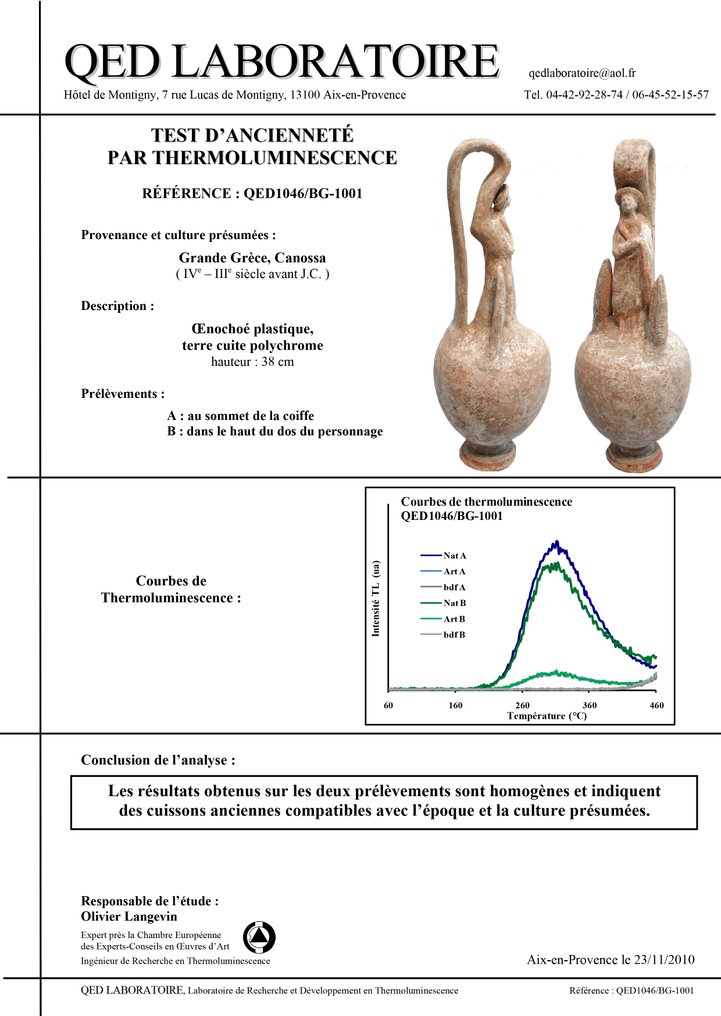
Attached thermoluminescence test
CONDITION: Good overall condition, with some areas of restoration to the polychromy, see photos.
PROVENANCE: Private collection, París, before 1970.
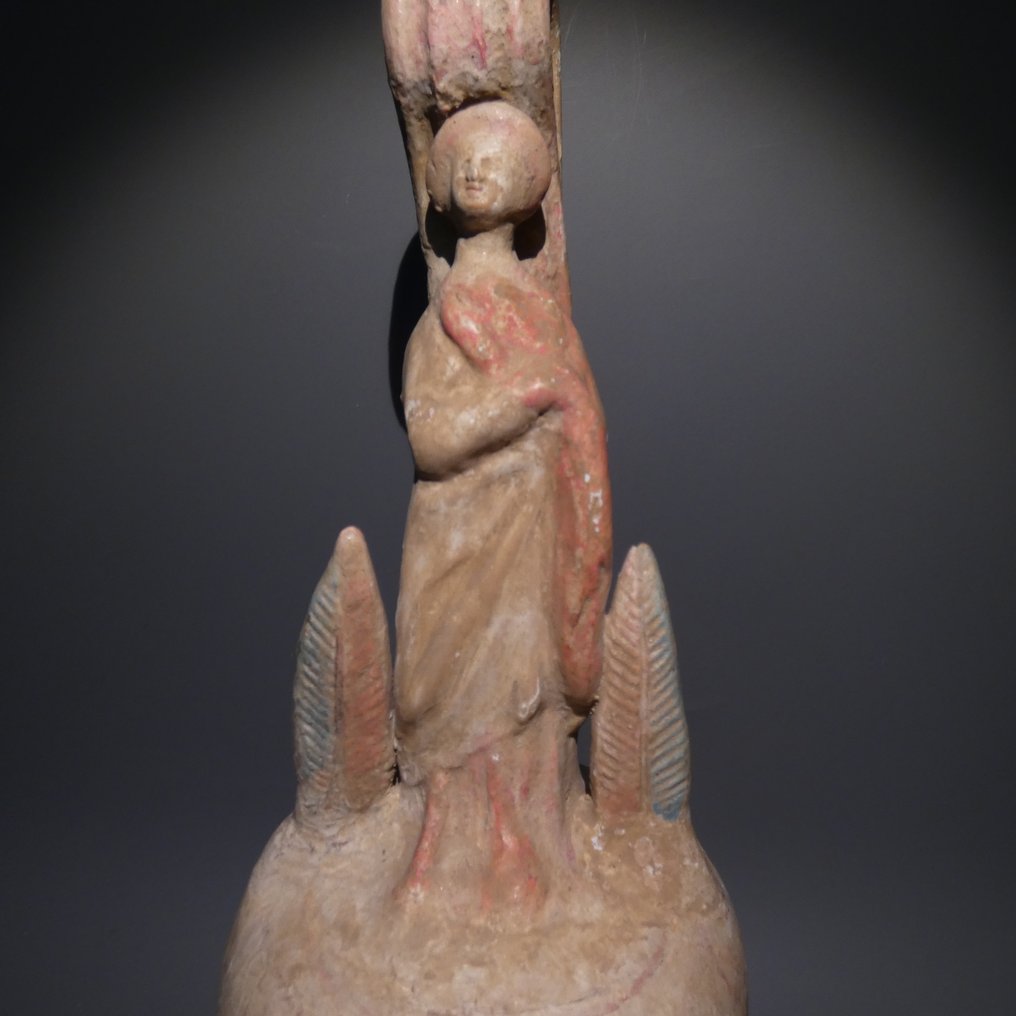
In the shape of a plastic-style oenochoe in polychrome terracotta. On the shoulder, two palmettes surround a young woman standing upright, dressed in a long peplum and a coat, leaning against a curved handle.
Magna Graecia was a region in southern Italy colonized by the Greeks between the 8th and 5th centuries BC. Canosa, known in ancient times as Canusium, although not a direct Greek colony, was strongly influenced by Hellenic culture due to its proximity to important Greek cities such as Taranto. This influence is reflected in its art, architecture, religion, and ceramics. Numerous funerary objects decorated with Greek motifs, such as craters and amphorae, have been found in Canosa, evidence of a strong presence of Greek beliefs and customs. The city was an important cultural and commercial center, where Greek, Roman, and local elements mixed, creating a unique identity. It also stood out for its production of painted pottery and for maintaining religious practices linked to Greek cults. Overall, Canosa represents a remarkable example of the cultural syncretism that characterized Magna Graecia in ancient times.
The oinochoe is a type of ceramic vessel from ancient Greece used mainly for serving wine. Its name comes from the Greek words “oinos” (wine) and “cheo” (to pour). It is characterized by a single vertical handle and a clover-shaped or rounded mouth, which made it easier to pour the liquid without spilling it. It was generally part of the set used in symposia, social gatherings where wine was drunk and various topics were discussed. Oinochoai were made of ceramic and often decorated with mythological scenes, rituals, or scenes from everyday life, especially in the black-figure and red-figure styles. In addition to their functional use, some oinochoai were placed in funerary contexts as offerings. Their shape and decoration vary according to period and region, allowing archaeologists to identify specific styles. These vessels are a valuable source of information about the life and culture of ancient Greece.
Der Verkäufer stellt sich vor
WICHTIGE HINWEISE:
-Wir sind ein professioneller Verkäufer.
- Alle verkauften Artikel werden mit einer professionellen Rechnung geliefert.
- Alle verkauften Artikel werden mit einem eigenen Echtheitszertifikat (Garantiedokument) geliefert, das die Beschreibung, das Bild und die Herkunft des Artikels enthält.
- Alle Artikel werden per privatem Kurier mit Versicherung versendet (DHL Express, CORREOS aus Spanien oder ähnliches mit Sendungsverfolgungsnummer).
- Alle Artikel werden beim Versand (falls erforderlich) als Antiquitäten deklariert, die älter als 100 Jahre sind, und ihr Preis wird bewertet.
- Für den Versand außerhalb der EU: Lieferzeit vorbehaltlich der Zollabfertigung. Die Haftung und die im Zielland geltenden Zollbestimmungen bzw. Einfuhrbestimmungen liegen ausschließlich in der Verantwortung des Käufers. Wir sind nicht verantwortlich für Verzögerungen, die durch Zollverfahren verursacht werden. Einfuhrsteuern und Mehrwertsteuer sind nicht in den Versandkosten enthalten. Die zu zahlende Einfuhrsteuer bzw. Mehrwertsteuer hängt vom Bestimmungsland ab. Die Zahlung etwaiger Steuern oder etwaige Streitigkeiten mit den Zollbehörden liegen in der alleinigen Verantwortung des Käufers.
- Für den Versand einiger der angebotenen Artikel außerhalb der Europäischen Union ist die Einholung einer Exportgenehmigung erforderlich, in der die Zahlung der Exportgebühren durch den Käufer gemäß spanischem Recht aufgeführt ist. Wenn es notwendig ist, wird es in der Beschreibung des Artikels erwähnt, denn nicht in allen Fällen ist es so. Diese Gebühren werden auf Kosten des Käufers der Rechnung hinzugefügt. Diese Ausfuhrgebühren werden auf den endgültigen Auktionspreis festgelegt und der Steuersatz wird nicht direkt auf den Gesamtwert des zu exportierenden Artikels angewendet, sondern es gelten die unterschiedlichen Prozentsätze nach Abschnitten: Bis zu 6.000 Euro: 5 %. Von 6.001 bis 60.000 Euro: 10 %.
Der Prozess zur Beantragung einer Exportgenehmigung kann maximal 1-2 Monate dauern.
- Wir garantieren, dass er dieses Stück im Einklang mit allen nationalen und internationalen Gesetzen zum Eigentum an Kulturgut erworben hat.
Übersetzt mit Google ÜbersetzerFigurative Oenochoe
Ancient Greek, Magna Graecia, Canosa, 4th century BC
Height: 38 cm
Pottery
Attached thermoluminescence test
CONDITION: Good overall condition, with some areas of restoration to the polychromy, see photos.
PROVENANCE: Private collection, París, before 1970.
In the shape of a plastic-style oenochoe in polychrome terracotta. On the shoulder, two palmettes surround a young woman standing upright, dressed in a long peplum and a coat, leaning against a curved handle.
Magna Graecia was a region in southern Italy colonized by the Greeks between the 8th and 5th centuries BC. Canosa, known in ancient times as Canusium, although not a direct Greek colony, was strongly influenced by Hellenic culture due to its proximity to important Greek cities such as Taranto. This influence is reflected in its art, architecture, religion, and ceramics. Numerous funerary objects decorated with Greek motifs, such as craters and amphorae, have been found in Canosa, evidence of a strong presence of Greek beliefs and customs. The city was an important cultural and commercial center, where Greek, Roman, and local elements mixed, creating a unique identity. It also stood out for its production of painted pottery and for maintaining religious practices linked to Greek cults. Overall, Canosa represents a remarkable example of the cultural syncretism that characterized Magna Graecia in ancient times.
The oinochoe is a type of ceramic vessel from ancient Greece used mainly for serving wine. Its name comes from the Greek words “oinos” (wine) and “cheo” (to pour). It is characterized by a single vertical handle and a clover-shaped or rounded mouth, which made it easier to pour the liquid without spilling it. It was generally part of the set used in symposia, social gatherings where wine was drunk and various topics were discussed. Oinochoai were made of ceramic and often decorated with mythological scenes, rituals, or scenes from everyday life, especially in the black-figure and red-figure styles. In addition to their functional use, some oinochoai were placed in funerary contexts as offerings. Their shape and decoration vary according to period and region, allowing archaeologists to identify specific styles. These vessels are a valuable source of information about the life and culture of ancient Greece.
Der Verkäufer stellt sich vor
WICHTIGE HINWEISE:
-Wir sind ein professioneller Verkäufer.
- Alle verkauften Artikel werden mit einer professionellen Rechnung geliefert.
- Alle verkauften Artikel werden mit einem eigenen Echtheitszertifikat (Garantiedokument) geliefert, das die Beschreibung, das Bild und die Herkunft des Artikels enthält.
- Alle Artikel werden per privatem Kurier mit Versicherung versendet (DHL Express, CORREOS aus Spanien oder ähnliches mit Sendungsverfolgungsnummer).
- Alle Artikel werden beim Versand (falls erforderlich) als Antiquitäten deklariert, die älter als 100 Jahre sind, und ihr Preis wird bewertet.
- Für den Versand außerhalb der EU: Lieferzeit vorbehaltlich der Zollabfertigung. Die Haftung und die im Zielland geltenden Zollbestimmungen bzw. Einfuhrbestimmungen liegen ausschließlich in der Verantwortung des Käufers. Wir sind nicht verantwortlich für Verzögerungen, die durch Zollverfahren verursacht werden. Einfuhrsteuern und Mehrwertsteuer sind nicht in den Versandkosten enthalten. Die zu zahlende Einfuhrsteuer bzw. Mehrwertsteuer hängt vom Bestimmungsland ab. Die Zahlung etwaiger Steuern oder etwaige Streitigkeiten mit den Zollbehörden liegen in der alleinigen Verantwortung des Käufers.
- Für den Versand einiger der angebotenen Artikel außerhalb der Europäischen Union ist die Einholung einer Exportgenehmigung erforderlich, in der die Zahlung der Exportgebühren durch den Käufer gemäß spanischem Recht aufgeführt ist. Wenn es notwendig ist, wird es in der Beschreibung des Artikels erwähnt, denn nicht in allen Fällen ist es so. Diese Gebühren werden auf Kosten des Käufers der Rechnung hinzugefügt. Diese Ausfuhrgebühren werden auf den endgültigen Auktionspreis festgelegt und der Steuersatz wird nicht direkt auf den Gesamtwert des zu exportierenden Artikels angewendet, sondern es gelten die unterschiedlichen Prozentsätze nach Abschnitten: Bis zu 6.000 Euro: 5 %. Von 6.001 bis 60.000 Euro: 10 %.
Der Prozess zur Beantragung einer Exportgenehmigung kann maximal 1-2 Monate dauern.
- Wir garantieren, dass er dieses Stück im Einklang mit allen nationalen und internationalen Gesetzen zum Eigentum an Kulturgut erworben hat.
Übersetzt mit Google ÜbersetzerDetails
Kultur
Altgriechisch, Magna Graecia
Jahrhundert/ Zeitraum
Canosa, 4th century BC.
Name of object
Figurative Oenochoe. 38 cm H. TL tested. 4th century BC.
Erworben von
Privatsammlung
Jahr des Erwerbs
2025
Material
Terracotta
Erwerbsland
Frankreich
Zustand
Gut
Vorbesitzer erworben von
Privatsammlung
Vorbesitzer – Jahr des Erwerbs
1970
Vorbesitzer – Erwerbsland
Frankreich
Ich bestätige, dass ich dieses Objekt legal erworben habe und berechtigt bin, es zu verkaufen.
Ja
Verkauft von
Disclaimer
Der Verkäufer wurde von Catawiki über die Anforderungen an die Dokumentation informiert und garantiert Folgendes: - Das Objekt wurde rechtmäßig erworben. - Der Verkäufer hat das Recht, das Objekt zu verkaufen und/oder zu exportieren (sofern zutreffend). - Der Verkäufer wird die erforderlichen Herkunftsinformationen bereitstellen und die notwendigen Dokumente sowie Genehmigungen bzw. Lizenzen besorgen (soweit zutreffend und gemäß den örtlichen Gesetzen geboten). - Der Verkäufer wird den Käufer über etwaige Verzögerungen bei der Erlangung von Genehmigungen bzw. Lizenzen informieren. Mit der Abgabe eines Gebots erkennen Sie an, dass je nach Ihrem Wohnsitzland Importdokumente erforderlich sein können und die Beschaffung von Genehmigungen bzw. Lizenzen zu Verzögerungen bei der Lieferung Ihres Objekts führen kann.
Der Verkäufer wurde von Catawiki über die Anforderungen an die Dokumentation informiert und garantiert Folgendes: - Das Objekt wurde rechtmäßig erworben. - Der Verkäufer hat das Recht, das Objekt zu verkaufen und/oder zu exportieren (sofern zutreffend). - Der Verkäufer wird die erforderlichen Herkunftsinformationen bereitstellen und die notwendigen Dokumente sowie Genehmigungen bzw. Lizenzen besorgen (soweit zutreffend und gemäß den örtlichen Gesetzen geboten). - Der Verkäufer wird den Käufer über etwaige Verzögerungen bei der Erlangung von Genehmigungen bzw. Lizenzen informieren. Mit der Abgabe eines Gebots erkennen Sie an, dass je nach Ihrem Wohnsitzland Importdokumente erforderlich sein können und die Beschaffung von Genehmigungen bzw. Lizenzen zu Verzögerungen bei der Lieferung Ihres Objekts führen kann.
