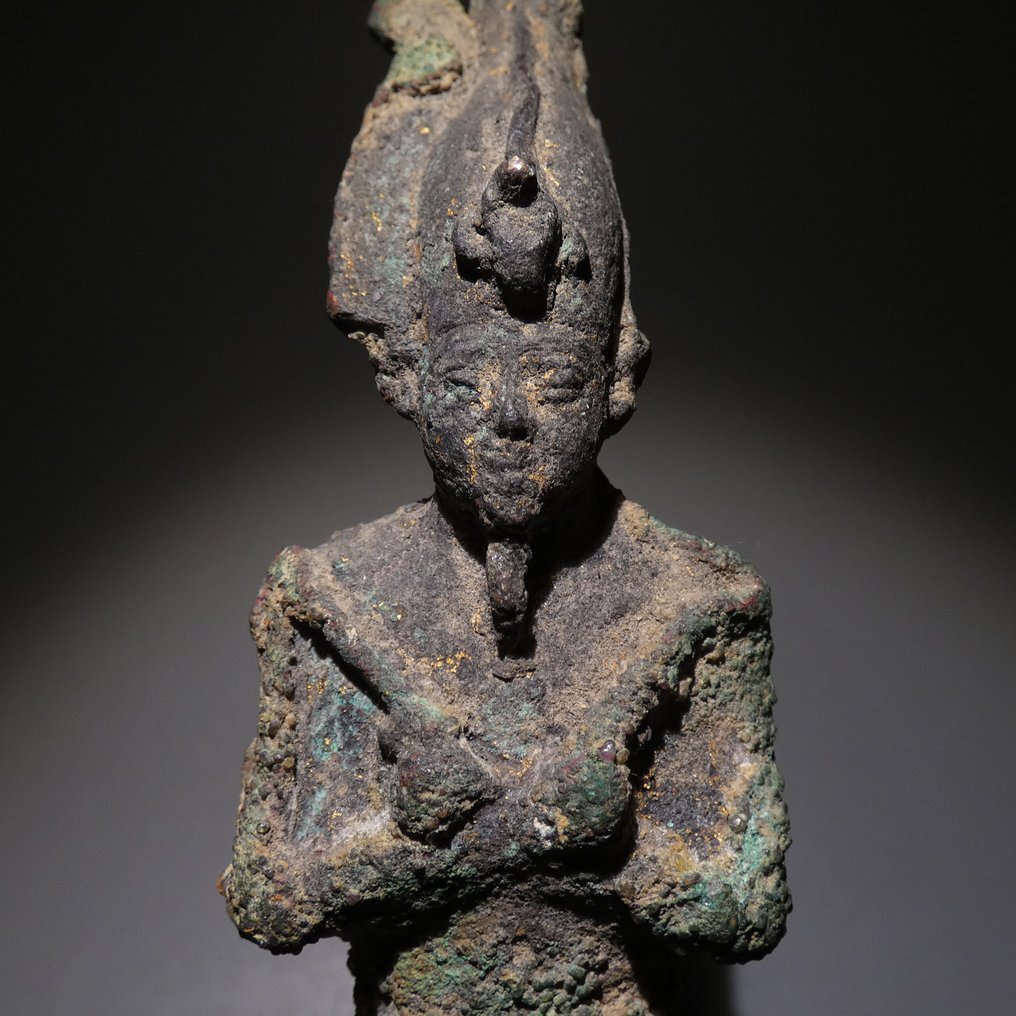
Altägyptisch Bronze Osiris-Gottestatue. Höhe 15,5 m. Spätzeit, 664–332 v. Chr.



09
Tage
03
Stunden
58
Minuten
25
Sekunden
Startgebot
€ 1
Mindestpreis nicht erreicht

Experte
Von Ruth Garrido Vila ausgewählt
Leitete das Ifergan Collection Museum, spezialisiert auf phönizische Archäologie.
Schätzung € 2.000 - € 2.200
Es wurden keine Gebote abgegeben
Käuferschutz auf Catawiki
Ihre Zahlung wird von uns sicher verwahrt, bis Sie Ihr Objekt erhalten.Details ansehen
Trustpilot 4.4 | 135253 Bewertungen
Auf Trustpilot als hervorragend bewertet.
Alter ägyptischer Bronzeskulptur des Gottes Osiris, Spätzeit (664–332 v. Chr.), ca. 13 cm hoch (15,5 cm mit Sockel), guter Zustand; 2025 aus einer privaten französischen Sammlung erworben.
KI-gestützte Zusammenfassung
Vom Verkäufer bereitgestellte Beschreibung
God Osiris
- very fine -
Ancient Egypt, Late Period, 664 - 332 BC
Solid Bronze with rest of gilted
13 cm height, 15,5 cm height with stand.
PROVENANCE:
- Private collection, Mr. I, France, before 1980.
CONDITION: Good condition, see photos.
Osiris, one of the most important gods of ancient Egypt. The origin of Osiris is obscure; he was a local god of Busiris, in Lower Egypt, and may have been a personification of chthonic (underworld) fertility. By about 2400 bce, however, Osiris clearly played a double role: he was both a god of fertility and the embodiment of the dead and resurrected king. This dual role was in turn combined with the Egyptian concept of divine kingship: the king at death became Osiris, god of the underworld; and the dead king’s son, the living king, was identified with Horus, a god of the sky. Osiris and Horus were thus father and son. The goddess Isis was the mother of the king and was thus the mother of Horus and consort of Osiris. The god Seth was considered the murderer of Osiris and adversary of Horus.
According to the form of the myth reported by the Greek author Plutarch, Osiris was slain or drowned by Seth, who tore the corpse into 14 pieces and flung them over Egypt. Eventually, Isis and her sister Nephthys found and buried all the pieces, except the phallus, thereby giving new life to Osiris, who thenceforth remained in the underworld as ruler and judge. His son Horus successfully fought against Seth, avenging Osiris and becoming the new king of Egypt.
Osiris was not only ruler of the dead but also the power that granted all life from the underworld, from sprouting vegetation to the annual flood of the Nile River. From about 2000 bce onward it was believed that every man, not just the deceased kings, became associated with Osiris at death. This identification with Osiris, however, did not imply resurrection, for even Osiris did not rise from the dead. Instead, it signified the renewal of life both in the next world and through one’s descendants on Earth. In this universalized form Osiris’s cult spread throughout Egypt, often joining with the cults of local fertility and underworld deities.
The idea that rebirth in the next life could be gained by following Osiris was maintained through certain cult forms. In the Middle Kingdom (1938–c. 1630 bce) the god’s festivals consisted of processions and nocturnal rites and were celebrated at the temple of Abydos, where Osiris had assimilated the very ancient god of the dead, Khenty-Imentiu. This name, meaning “Foremost of the Westerners,” was adopted by Osiris as an epithet. Because the festivals took place in the open, public participation was permitted, and by the early 2nd millennium bce it had become fashionable to be buried along the processional road at Abydos or to erect a cenotaph there as a representative of the dead.
Osiris festivals symbolically reenacting the god’s fate were celebrated annually in various towns throughout Egypt. A central feature of the festivals during the late period was the construction of the “Osiris garden,” a mold in the shape of Osiris, filled with soil. The mold was moistened with the water of the Nile and sown with grain. Later, the sprouting grain symbolized the vital strength of Osiris.
At Memphis the holy bull, Apis, was linked with Osiris, becoming Osiris-Apis, which eventually became the name of the Hellenistic god Serapis. Greco-Roman authors connected Osiris with the god Dionysus. Osiris was also identified with Soker, an ancient Memphite god of the dead.
The oldest known depiction of Osiris dates to about 2300 bce, but representations of him are rare before the New Kingdom (1539–1075 bce), when he was shown in an archaizing form as a mummy with his arms crossed on his breast, one hand holding a crook, the other a flail. On his head was the atef-crown, composed of the white crown of Upper Egypt and two ostrich feathers.
Der Verkäufer stellt sich vor
WICHTIGE HINWEISE:
-Wir sind ein professioneller Verkäufer.
- Alle verkauften Artikel werden mit einer professionellen Rechnung geliefert.
- Alle verkauften Artikel werden mit einem eigenen Echtheitszertifikat (Garantiedokument) geliefert, das die Beschreibung, das Bild und die Herkunft des Artikels enthält.
- Alle Artikel werden per privatem Kurier mit Versicherung versendet (DHL Express, CORREOS aus Spanien oder ähnliches mit Sendungsverfolgungsnummer).
- Alle Artikel werden beim Versand (falls erforderlich) als Antiquitäten deklariert, die älter als 100 Jahre sind, und ihr Preis wird bewertet.
- Für den Versand außerhalb der EU: Lieferzeit vorbehaltlich der Zollabfertigung. Die Haftung und die im Zielland geltenden Zollbestimmungen bzw. Einfuhrbestimmungen liegen ausschließlich in der Verantwortung des Käufers. Wir sind nicht verantwortlich für Verzögerungen, die durch Zollverfahren verursacht werden. Einfuhrsteuern und Mehrwertsteuer sind nicht in den Versandkosten enthalten. Die zu zahlende Einfuhrsteuer bzw. Mehrwertsteuer hängt vom Bestimmungsland ab. Die Zahlung etwaiger Steuern oder etwaige Streitigkeiten mit den Zollbehörden liegen in der alleinigen Verantwortung des Käufers.
- Für den Versand einiger der angebotenen Artikel außerhalb der Europäischen Union ist die Einholung einer Exportgenehmigung erforderlich, in der die Zahlung der Exportgebühren durch den Käufer gemäß spanischem Recht aufgeführt ist. Wenn es notwendig ist, wird es in der Beschreibung des Artikels erwähnt, denn nicht in allen Fällen ist es so. Diese Gebühren werden auf Kosten des Käufers der Rechnung hinzugefügt. Diese Ausfuhrgebühren werden auf den endgültigen Auktionspreis festgelegt und der Steuersatz wird nicht direkt auf den Gesamtwert des zu exportierenden Artikels angewendet, sondern es gelten die unterschiedlichen Prozentsätze nach Abschnitten: Bis zu 6.000 Euro: 5 %. Von 6.001 bis 60.000 Euro: 10 %.
Der Prozess zur Beantragung einer Exportgenehmigung kann maximal 1-2 Monate dauern.
- Wir garantieren, dass er dieses Stück im Einklang mit allen nationalen und internationalen Gesetzen zum Eigentum an Kulturgut erworben hat.
Übersetzt mit Google ÜbersetzerGod Osiris
- very fine -
Ancient Egypt, Late Period, 664 - 332 BC
Solid Bronze with rest of gilted
13 cm height, 15,5 cm height with stand.
PROVENANCE:
- Private collection, Mr. I, France, before 1980.
CONDITION: Good condition, see photos.
Osiris, one of the most important gods of ancient Egypt. The origin of Osiris is obscure; he was a local god of Busiris, in Lower Egypt, and may have been a personification of chthonic (underworld) fertility. By about 2400 bce, however, Osiris clearly played a double role: he was both a god of fertility and the embodiment of the dead and resurrected king. This dual role was in turn combined with the Egyptian concept of divine kingship: the king at death became Osiris, god of the underworld; and the dead king’s son, the living king, was identified with Horus, a god of the sky. Osiris and Horus were thus father and son. The goddess Isis was the mother of the king and was thus the mother of Horus and consort of Osiris. The god Seth was considered the murderer of Osiris and adversary of Horus.
According to the form of the myth reported by the Greek author Plutarch, Osiris was slain or drowned by Seth, who tore the corpse into 14 pieces and flung them over Egypt. Eventually, Isis and her sister Nephthys found and buried all the pieces, except the phallus, thereby giving new life to Osiris, who thenceforth remained in the underworld as ruler and judge. His son Horus successfully fought against Seth, avenging Osiris and becoming the new king of Egypt.
Osiris was not only ruler of the dead but also the power that granted all life from the underworld, from sprouting vegetation to the annual flood of the Nile River. From about 2000 bce onward it was believed that every man, not just the deceased kings, became associated with Osiris at death. This identification with Osiris, however, did not imply resurrection, for even Osiris did not rise from the dead. Instead, it signified the renewal of life both in the next world and through one’s descendants on Earth. In this universalized form Osiris’s cult spread throughout Egypt, often joining with the cults of local fertility and underworld deities.
The idea that rebirth in the next life could be gained by following Osiris was maintained through certain cult forms. In the Middle Kingdom (1938–c. 1630 bce) the god’s festivals consisted of processions and nocturnal rites and were celebrated at the temple of Abydos, where Osiris had assimilated the very ancient god of the dead, Khenty-Imentiu. This name, meaning “Foremost of the Westerners,” was adopted by Osiris as an epithet. Because the festivals took place in the open, public participation was permitted, and by the early 2nd millennium bce it had become fashionable to be buried along the processional road at Abydos or to erect a cenotaph there as a representative of the dead.
Osiris festivals symbolically reenacting the god’s fate were celebrated annually in various towns throughout Egypt. A central feature of the festivals during the late period was the construction of the “Osiris garden,” a mold in the shape of Osiris, filled with soil. The mold was moistened with the water of the Nile and sown with grain. Later, the sprouting grain symbolized the vital strength of Osiris.
At Memphis the holy bull, Apis, was linked with Osiris, becoming Osiris-Apis, which eventually became the name of the Hellenistic god Serapis. Greco-Roman authors connected Osiris with the god Dionysus. Osiris was also identified with Soker, an ancient Memphite god of the dead.
The oldest known depiction of Osiris dates to about 2300 bce, but representations of him are rare before the New Kingdom (1539–1075 bce), when he was shown in an archaizing form as a mummy with his arms crossed on his breast, one hand holding a crook, the other a flail. On his head was the atef-crown, composed of the white crown of Upper Egypt and two ostrich feathers.
Der Verkäufer stellt sich vor
WICHTIGE HINWEISE:
-Wir sind ein professioneller Verkäufer.
- Alle verkauften Artikel werden mit einer professionellen Rechnung geliefert.
- Alle verkauften Artikel werden mit einem eigenen Echtheitszertifikat (Garantiedokument) geliefert, das die Beschreibung, das Bild und die Herkunft des Artikels enthält.
- Alle Artikel werden per privatem Kurier mit Versicherung versendet (DHL Express, CORREOS aus Spanien oder ähnliches mit Sendungsverfolgungsnummer).
- Alle Artikel werden beim Versand (falls erforderlich) als Antiquitäten deklariert, die älter als 100 Jahre sind, und ihr Preis wird bewertet.
- Für den Versand außerhalb der EU: Lieferzeit vorbehaltlich der Zollabfertigung. Die Haftung und die im Zielland geltenden Zollbestimmungen bzw. Einfuhrbestimmungen liegen ausschließlich in der Verantwortung des Käufers. Wir sind nicht verantwortlich für Verzögerungen, die durch Zollverfahren verursacht werden. Einfuhrsteuern und Mehrwertsteuer sind nicht in den Versandkosten enthalten. Die zu zahlende Einfuhrsteuer bzw. Mehrwertsteuer hängt vom Bestimmungsland ab. Die Zahlung etwaiger Steuern oder etwaige Streitigkeiten mit den Zollbehörden liegen in der alleinigen Verantwortung des Käufers.
- Für den Versand einiger der angebotenen Artikel außerhalb der Europäischen Union ist die Einholung einer Exportgenehmigung erforderlich, in der die Zahlung der Exportgebühren durch den Käufer gemäß spanischem Recht aufgeführt ist. Wenn es notwendig ist, wird es in der Beschreibung des Artikels erwähnt, denn nicht in allen Fällen ist es so. Diese Gebühren werden auf Kosten des Käufers der Rechnung hinzugefügt. Diese Ausfuhrgebühren werden auf den endgültigen Auktionspreis festgelegt und der Steuersatz wird nicht direkt auf den Gesamtwert des zu exportierenden Artikels angewendet, sondern es gelten die unterschiedlichen Prozentsätze nach Abschnitten: Bis zu 6.000 Euro: 5 %. Von 6.001 bis 60.000 Euro: 10 %.
Der Prozess zur Beantragung einer Exportgenehmigung kann maximal 1-2 Monate dauern.
- Wir garantieren, dass er dieses Stück im Einklang mit allen nationalen und internationalen Gesetzen zum Eigentum an Kulturgut erworben hat.
Übersetzt mit Google ÜbersetzerDetails
Kultur
Altägyptisch
Jahrhundert/ Zeitraum
Late Period, 664 - 332 BC
Name of object
Osiris God Sculpture. 15.5 H. Late Period, 664 - 332 BC
Erworben von
Privatsammlung
Jahr des Erwerbs
2025
Material
Bronze
Erwerbsland
Frankreich
Zustand
Gut
Vorbesitzer erworben von
Privatsammlung
Vorbesitzer – Jahr des Erwerbs
1970
Vorbesitzer – Erwerbsland
Frankreich
Ich bestätige, dass ich dieses Objekt legal erworben habe und berechtigt bin, es zu verkaufen.
Ja
Verkauft von
Disclaimer
Der Verkäufer wurde von Catawiki über die Anforderungen an die Dokumentation informiert und garantiert Folgendes: - Das Objekt wurde rechtmäßig erworben. - Der Verkäufer hat das Recht, das Objekt zu verkaufen und/oder zu exportieren (sofern zutreffend). - Der Verkäufer wird die erforderlichen Herkunftsinformationen bereitstellen und die notwendigen Dokumente sowie Genehmigungen bzw. Lizenzen besorgen (soweit zutreffend und gemäß den örtlichen Gesetzen geboten). - Der Verkäufer wird den Käufer über etwaige Verzögerungen bei der Erlangung von Genehmigungen bzw. Lizenzen informieren. Mit der Abgabe eines Gebots erkennen Sie an, dass je nach Ihrem Wohnsitzland Importdokumente erforderlich sein können und die Beschaffung von Genehmigungen bzw. Lizenzen zu Verzögerungen bei der Lieferung Ihres Objekts führen kann.
Der Verkäufer wurde von Catawiki über die Anforderungen an die Dokumentation informiert und garantiert Folgendes: - Das Objekt wurde rechtmäßig erworben. - Der Verkäufer hat das Recht, das Objekt zu verkaufen und/oder zu exportieren (sofern zutreffend). - Der Verkäufer wird die erforderlichen Herkunftsinformationen bereitstellen und die notwendigen Dokumente sowie Genehmigungen bzw. Lizenzen besorgen (soweit zutreffend und gemäß den örtlichen Gesetzen geboten). - Der Verkäufer wird den Käufer über etwaige Verzögerungen bei der Erlangung von Genehmigungen bzw. Lizenzen informieren. Mit der Abgabe eines Gebots erkennen Sie an, dass je nach Ihrem Wohnsitzland Importdokumente erforderlich sein können und die Beschaffung von Genehmigungen bzw. Lizenzen zu Verzögerungen bei der Lieferung Ihres Objekts führen kann.
