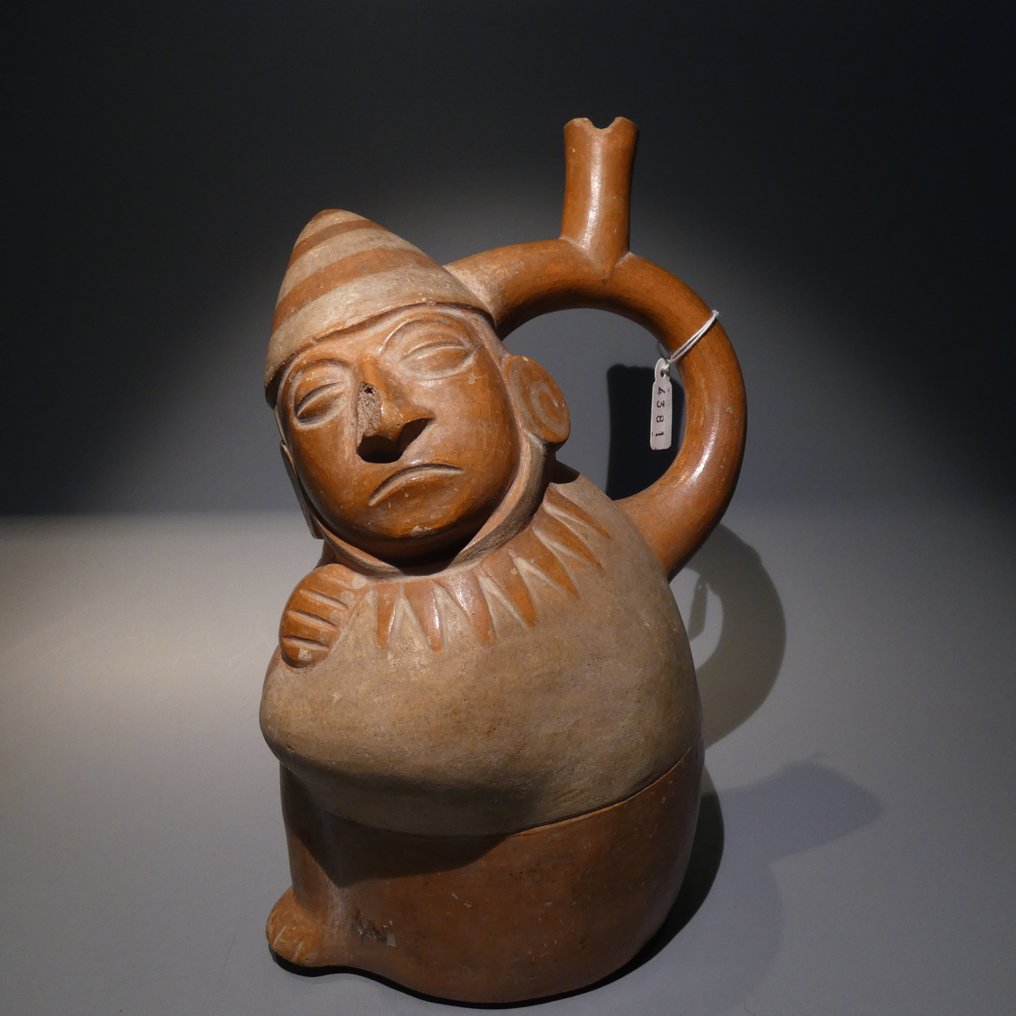
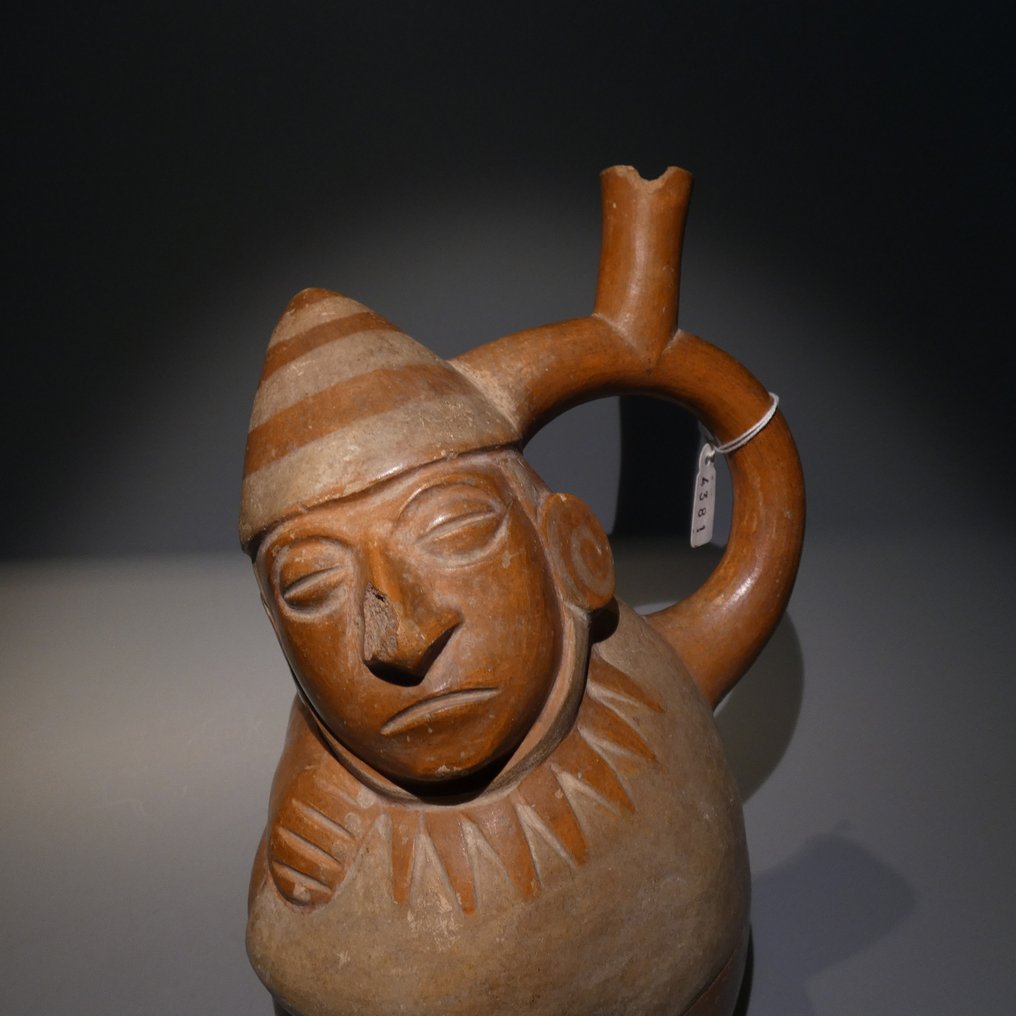
Moche, Peru, Terracotta Feine Huaco-Häuptlingsfigur. Höhe 23 cm. 400–800 n. Chr. Spanische Exportlizenz


07
Tage
23
Stunden
47
Minuten
13
Sekunden
Startgebot
€ 1
Mindestpreis nicht erreicht

Experte
Von Ruth Garrido Vila ausgewählt
Leitete das Ifergan Collection Museum, spezialisiert auf phönizische Archäologie.
Schätzung € 2.800 - € 3.100
Es wurden keine Gebote abgegeben
Käuferschutz auf Catawiki
Ihre Zahlung wird von uns sicher verwahrt, bis Sie Ihr Objekt erhalten.Details ansehen
Trustpilot 4.4 | 135350 Bewertungen
Auf Trustpilot als hervorragend bewertet.
Feine Huaco-Kopfsfigur, eine Moche-Terra-Cotta Skulptur aus Peru, datiert 400–800 n.Chr., 23 cm hoch mit Pigmenten, guter Zustand, mit spanischer Exportlizenz und Echtheitszertifikat.
KI-gestützte Zusammenfassung
Vom Verkäufer bereitgestellte Beschreibung
Fine Stirrup jar Huaco figure of a chief
Moche, Peru, 400 - 800 AD.
Terracotta and pigments
23 cm height
Provenance:
- Private collection, J. R. (1928 - 2013) Barcelona, formed since 1950 until 2000. Thence by descendent. Old label of the collection number 4381.
DOCUMENTS:
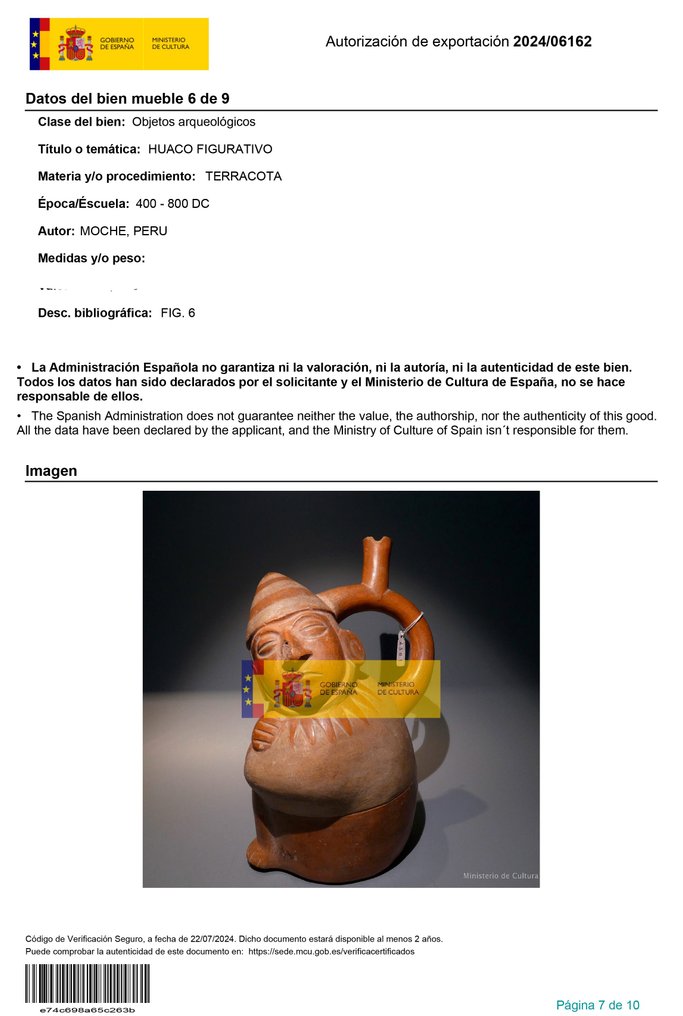
- Spanish Export License.
Condition: Good condition, see photos.
The Moche culture inhabited the coast of present-day northern Peru, concentrating in the valleys of Lambayeque, Chicama, Moche and Virú. This desert region is crossed by several rivers that flow down into the Pacific Ocean, where marine resources are plentiful.
The Moche produced fine ceramic, textile and precious metal pieces. Their characteristic style can be seen in a wide range of goods such as fire-engraved gourds, wall murals, featherwork art, body painting and tattoos. Their ceramic decoration displays a level of skill that has rarely been surpassed, and included such techniques as incision, bas-relief with stamps, and painting on smooth surfaces. Many were made in state-run workshops that mass-produced pieces from molds. Their ceramics came in a variety of forms and decorative styles and displayed myths and ritual motifs as well. Notable among these earthenware forms were the so-called “portrait bottles”, bottles molded with the face of a well-known Moche figure. These highly detailed facial portraits reflect the Moche’s own use of face paint and/or tattoos, as well as elaborate headdresses. This portrait-making expertise can also be observed in everyday scenes and erotic representations, as well as in figures of individuals that were hunch backed, blind, or suffered from other disorders. They were skillful metalworkers, using gold, copper and silver to make ear ornaments, nose rings, bracelets, necklace beads, tweezers and a variety of tools. Especially notable is the tumi or ceremonial knife that was usually only carried by Moche officials.
Moche ceramics provide detailed representations of the culture’s supernatural world, including deities, myths, sacred animals and ceremonial practices. Their deities take the form of foxes, owls, hummingbirds, falcons and felines. These figures were servants of greater gods that had human form and sported elaborate outfits and ferocious faces with crossed fangs.
Tombs of important Moche individuals were rectangular and made of adobe, with niches for offerings. Some bodies were laid on cane mats, while others were left in caves inside cane coffins. People of the elite class were buried with metal masks and a rich array of grave goods, servants and animals accompanying them. The famous “Lord of Sipán” is the most notable example of this kind of burial.
Notes:
- The piece includes authenticity certificate.
- The piece includes Spanish Export License (Passport for European Union). NOT TAXES.
- According to Spanish legislation, items sent outside the European Union are subject to export taxes and will be added to the invoice, at the buyer's expense. These export fees are fixed on the final auction price and the tax rate is not applied directly on the total value of the item to be exported, but rather the different percentages by sections are applied to it:
- Up to 6,000 euros: 5%.
- From 6,001 to 60,000 euros: 10%.
This export permit application process can take between 1-2 months maximum.
- The seller guarantees that he acquired this piece according to all national and international laws related to the ownership of cultural property. Provenance statement seen by Catawiki.
Der Verkäufer stellt sich vor
WICHTIGE HINWEISE:
-Wir sind ein professioneller Verkäufer.
- Alle verkauften Artikel werden mit einer professionellen Rechnung geliefert.
- Alle verkauften Artikel werden mit einem eigenen Echtheitszertifikat (Garantiedokument) geliefert, das die Beschreibung, das Bild und die Herkunft des Artikels enthält.
- Alle Artikel werden per privatem Kurier mit Versicherung versendet (DHL Express, CORREOS aus Spanien oder ähnliches mit Sendungsverfolgungsnummer).
- Alle Artikel werden beim Versand (falls erforderlich) als Antiquitäten deklariert, die älter als 100 Jahre sind, und ihr Preis wird bewertet.
- Für den Versand außerhalb der EU: Lieferzeit vorbehaltlich der Zollabfertigung. Die Haftung und die im Zielland geltenden Zollbestimmungen bzw. Einfuhrbestimmungen liegen ausschließlich in der Verantwortung des Käufers. Wir sind nicht verantwortlich für Verzögerungen, die durch Zollverfahren verursacht werden. Einfuhrsteuern und Mehrwertsteuer sind nicht in den Versandkosten enthalten. Die zu zahlende Einfuhrsteuer bzw. Mehrwertsteuer hängt vom Bestimmungsland ab. Die Zahlung etwaiger Steuern oder etwaige Streitigkeiten mit den Zollbehörden liegen in der alleinigen Verantwortung des Käufers.
- Für den Versand einiger der angebotenen Artikel außerhalb der Europäischen Union ist die Einholung einer Exportgenehmigung erforderlich, in der die Zahlung der Exportgebühren durch den Käufer gemäß spanischem Recht aufgeführt ist. Wenn es notwendig ist, wird es in der Beschreibung des Artikels erwähnt, denn nicht in allen Fällen ist es so. Diese Gebühren werden auf Kosten des Käufers der Rechnung hinzugefügt. Diese Ausfuhrgebühren werden auf den endgültigen Auktionspreis festgelegt und der Steuersatz wird nicht direkt auf den Gesamtwert des zu exportierenden Artikels angewendet, sondern es gelten die unterschiedlichen Prozentsätze nach Abschnitten: Bis zu 6.000 Euro: 5 %. Von 6.001 bis 60.000 Euro: 10 %.
Der Prozess zur Beantragung einer Exportgenehmigung kann maximal 1-2 Monate dauern.
- Wir garantieren, dass er dieses Stück im Einklang mit allen nationalen und internationalen Gesetzen zum Eigentum an Kulturgut erworben hat.
Übersetzt mit Google ÜbersetzerFine Stirrup jar Huaco figure of a chief
Moche, Peru, 400 - 800 AD.
Terracotta and pigments
23 cm height
Provenance:
- Private collection, J. R. (1928 - 2013) Barcelona, formed since 1950 until 2000. Thence by descendent. Old label of the collection number 4381.
DOCUMENTS:
- Spanish Export License.
Condition: Good condition, see photos.
The Moche culture inhabited the coast of present-day northern Peru, concentrating in the valleys of Lambayeque, Chicama, Moche and Virú. This desert region is crossed by several rivers that flow down into the Pacific Ocean, where marine resources are plentiful.
The Moche produced fine ceramic, textile and precious metal pieces. Their characteristic style can be seen in a wide range of goods such as fire-engraved gourds, wall murals, featherwork art, body painting and tattoos. Their ceramic decoration displays a level of skill that has rarely been surpassed, and included such techniques as incision, bas-relief with stamps, and painting on smooth surfaces. Many were made in state-run workshops that mass-produced pieces from molds. Their ceramics came in a variety of forms and decorative styles and displayed myths and ritual motifs as well. Notable among these earthenware forms were the so-called “portrait bottles”, bottles molded with the face of a well-known Moche figure. These highly detailed facial portraits reflect the Moche’s own use of face paint and/or tattoos, as well as elaborate headdresses. This portrait-making expertise can also be observed in everyday scenes and erotic representations, as well as in figures of individuals that were hunch backed, blind, or suffered from other disorders. They were skillful metalworkers, using gold, copper and silver to make ear ornaments, nose rings, bracelets, necklace beads, tweezers and a variety of tools. Especially notable is the tumi or ceremonial knife that was usually only carried by Moche officials.
Moche ceramics provide detailed representations of the culture’s supernatural world, including deities, myths, sacred animals and ceremonial practices. Their deities take the form of foxes, owls, hummingbirds, falcons and felines. These figures were servants of greater gods that had human form and sported elaborate outfits and ferocious faces with crossed fangs.
Tombs of important Moche individuals were rectangular and made of adobe, with niches for offerings. Some bodies were laid on cane mats, while others were left in caves inside cane coffins. People of the elite class were buried with metal masks and a rich array of grave goods, servants and animals accompanying them. The famous “Lord of Sipán” is the most notable example of this kind of burial.
Notes:
- The piece includes authenticity certificate.
- The piece includes Spanish Export License (Passport for European Union). NOT TAXES.
- According to Spanish legislation, items sent outside the European Union are subject to export taxes and will be added to the invoice, at the buyer's expense. These export fees are fixed on the final auction price and the tax rate is not applied directly on the total value of the item to be exported, but rather the different percentages by sections are applied to it:
- Up to 6,000 euros: 5%.
- From 6,001 to 60,000 euros: 10%.
This export permit application process can take between 1-2 months maximum.
- The seller guarantees that he acquired this piece according to all national and international laws related to the ownership of cultural property. Provenance statement seen by Catawiki.
Der Verkäufer stellt sich vor
WICHTIGE HINWEISE:
-Wir sind ein professioneller Verkäufer.
- Alle verkauften Artikel werden mit einer professionellen Rechnung geliefert.
- Alle verkauften Artikel werden mit einem eigenen Echtheitszertifikat (Garantiedokument) geliefert, das die Beschreibung, das Bild und die Herkunft des Artikels enthält.
- Alle Artikel werden per privatem Kurier mit Versicherung versendet (DHL Express, CORREOS aus Spanien oder ähnliches mit Sendungsverfolgungsnummer).
- Alle Artikel werden beim Versand (falls erforderlich) als Antiquitäten deklariert, die älter als 100 Jahre sind, und ihr Preis wird bewertet.
- Für den Versand außerhalb der EU: Lieferzeit vorbehaltlich der Zollabfertigung. Die Haftung und die im Zielland geltenden Zollbestimmungen bzw. Einfuhrbestimmungen liegen ausschließlich in der Verantwortung des Käufers. Wir sind nicht verantwortlich für Verzögerungen, die durch Zollverfahren verursacht werden. Einfuhrsteuern und Mehrwertsteuer sind nicht in den Versandkosten enthalten. Die zu zahlende Einfuhrsteuer bzw. Mehrwertsteuer hängt vom Bestimmungsland ab. Die Zahlung etwaiger Steuern oder etwaige Streitigkeiten mit den Zollbehörden liegen in der alleinigen Verantwortung des Käufers.
- Für den Versand einiger der angebotenen Artikel außerhalb der Europäischen Union ist die Einholung einer Exportgenehmigung erforderlich, in der die Zahlung der Exportgebühren durch den Käufer gemäß spanischem Recht aufgeführt ist. Wenn es notwendig ist, wird es in der Beschreibung des Artikels erwähnt, denn nicht in allen Fällen ist es so. Diese Gebühren werden auf Kosten des Käufers der Rechnung hinzugefügt. Diese Ausfuhrgebühren werden auf den endgültigen Auktionspreis festgelegt und der Steuersatz wird nicht direkt auf den Gesamtwert des zu exportierenden Artikels angewendet, sondern es gelten die unterschiedlichen Prozentsätze nach Abschnitten: Bis zu 6.000 Euro: 5 %. Von 6.001 bis 60.000 Euro: 10 %.
Der Prozess zur Beantragung einer Exportgenehmigung kann maximal 1-2 Monate dauern.
- Wir garantieren, dass er dieses Stück im Einklang mit allen nationalen und internationalen Gesetzen zum Eigentum an Kulturgut erworben hat.
Übersetzt mit Google ÜbersetzerDetails
Kultur
Moche, Peru,
Jahrhundert/ Zeitraum
400 - 800 AD
Name of object
Fine Huaco Chief Figure. 23 cm H. 400 - 800 AD. Spanish Export License
Erworben von
Privatsammlung
Jahr des Erwerbs
2024
Material
Terracotta
Erwerbsland
Spanien
Zustand
Gut
Vorbesitzer erworben von
Privatsammlung
Vorbesitzer – Jahr des Erwerbs
1960
Vorbesitzer – Erwerbsland
Spanien
Ich bestätige, dass ich dieses Objekt legal erworben habe und berechtigt bin, es zu verkaufen.
Ja
Authentizität
Original/offiziell
Verkauft von
Disclaimer
Der Verkäufer wurde von Catawiki über die Anforderungen an die Dokumentation informiert und garantiert Folgendes: - Das Objekt wurde rechtmäßig erworben. - Der Verkäufer hat das Recht, das Objekt zu verkaufen und/oder zu exportieren (sofern zutreffend). - Der Verkäufer wird die erforderlichen Herkunftsinformationen bereitstellen und die notwendigen Dokumente sowie Genehmigungen bzw. Lizenzen besorgen (soweit zutreffend und gemäß den örtlichen Gesetzen geboten). - Der Verkäufer wird den Käufer über etwaige Verzögerungen bei der Erlangung von Genehmigungen bzw. Lizenzen informieren. Mit der Abgabe eines Gebots erkennen Sie an, dass je nach Ihrem Wohnsitzland Importdokumente erforderlich sein können und die Beschaffung von Genehmigungen bzw. Lizenzen zu Verzögerungen bei der Lieferung Ihres Objekts führen kann.
Der Verkäufer wurde von Catawiki über die Anforderungen an die Dokumentation informiert und garantiert Folgendes: - Das Objekt wurde rechtmäßig erworben. - Der Verkäufer hat das Recht, das Objekt zu verkaufen und/oder zu exportieren (sofern zutreffend). - Der Verkäufer wird die erforderlichen Herkunftsinformationen bereitstellen und die notwendigen Dokumente sowie Genehmigungen bzw. Lizenzen besorgen (soweit zutreffend und gemäß den örtlichen Gesetzen geboten). - Der Verkäufer wird den Käufer über etwaige Verzögerungen bei der Erlangung von Genehmigungen bzw. Lizenzen informieren. Mit der Abgabe eines Gebots erkennen Sie an, dass je nach Ihrem Wohnsitzland Importdokumente erforderlich sein können und die Beschaffung von Genehmigungen bzw. Lizenzen zu Verzögerungen bei der Lieferung Ihres Objekts führen kann.
