Nr. 99096731

Verkauft
Tennyson / Sangorski - Morte d'Arthur - 1912
Höchstgebot
€ 115
Vor 6 Wochen

Tennyson / Sangorski - Morte d'Arthur - 1912

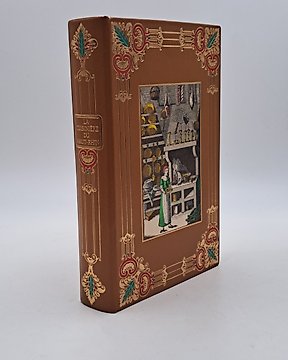
Alfred Tennyson, Alberto Sangorski Morte d'Arthur: a poem Chatto & Windus, London, 1912 King Arthur stands as one of the most enduring symbols of mythic kingship, chivalry, and the tragic rise and fall of idealism in Western literature. Rooted in medieval legend and expanded through centuries of retelling, his story forms the heart of the Arthurian cycle—an epic tapestry of knights, magic, betrayal, and doomed quests. At its core lies the figure of Merlin, the enigmatic wizard whose prophecies and interventions shape Arthur's destiny from birth to death. Central to the legend is the Round Table, a revolutionary symbol of unity and equality among knights, where none sat above another. This idea of a circle—a seat of justice, mutual respect, and honor—elevated Arthur’s court into a utopia of sorts, albeit a fragile one. The legends have long held a mirror to human virtue and failure, inspiring countless adaptations, from Malory’s 15th century Le Morte d’Arthur to modern novels, films, and operas. Arthur’s tale is not just one of battles and betrayals, but of striving toward an ideal world always just out of reach. Tennyson’s Morte d’Arthur forms a key part of his Idylls of the King, a Victorian reimagining of the Arthurian legend infused with melancholy, symbolism, and moral weight. Written in 1833 but published in its full poetic form in the 1850s, the Morte d’Arthur centers on the twilight of Arthur’s reign, casting the king as a Christ-like figure betrayed by those closest to him. The poem opens with a wounded Arthur, abandoned on a battlefield after the final clash with Mordred, awaiting passage to Avalon. Tennyson evokes the decay of noble ideals in the face of personal weakness and political corruption, speaking not just to medieval romance but to the anxieties of his own time. His Arthur is introspective, burdened by the failure of his vision, yet still hopeful that “more things are wrought by prayer than this world dreams of.” The poem’s solemn cadence and elegiac imagery mark it as one of the most poignant Victorian meditations on loss and spiritual perseverance. The Sangorski-illustrated edition of Morte d’Arthur brings this vision vividly to life. Rich with medievalist flair, the illustrations shimmer with gold leaf, intricate borders, and jewel-toned watercolors that seem to emerge from a dream. Each image is a meticulous blend of Pre-Raphaelite romanticism and illuminated manuscript tradition, capturing the sorrow, grandeur, and transcendence of Tennyson’s verse. Knights are draped in ornate armor, holy relics glimmer with mysticism, and Avalon appears as an ethereal realm of quiet light. Sangorski's art does not merely decorate the text; it enhances its emotional depth and mythic scale. George Sangorski, born in London in 1875, was a celebrated bookbinder and illustrator, known for his collaboration with Francis Sangorski and binding partner Sutcliffe. His life was tragically cut short in 1912, shortly before the sinking of the Titanic, aboard which one of his most famous jewel-encrusted books was destined to travel. His work remains among the finest in the tradition of luxurious literary illustration. 24 pages : color illustrations ; 27 cm ; 4to First edition. Binding is sound, covers slightly soiled. Pages are clean and crisp, with only light foxing to the endpapers. Albeit worn and partly torn, the scarce dust jacket is present. The illuminated miniatures remain splendid: vibrant, unfaded, and delicately detailed, PS: I'll ship the book carefully packaged in bubble wrap, via An Post, the Irish Postal Service ("Registered Post, Tracking & Insurance included to protect your valuable items"). I will provide the tracking number once dispatched.

Nr. 99096731

Verkauft
Tennyson / Sangorski - Morte d'Arthur - 1912

Tennyson / Sangorski - Morte d'Arthur - 1912

Alfred Tennyson, Alberto Sangorski
Morte d'Arthur: a poem
Chatto & Windus, London, 1912

King Arthur stands as one of the most enduring symbols of mythic kingship, chivalry, and the tragic rise and fall of idealism in Western literature. Rooted in medieval legend and expanded through centuries of retelling, his story forms the heart of the Arthurian cycle—an epic tapestry of knights, magic, betrayal, and doomed quests. At its core lies the figure of Merlin, the enigmatic wizard whose prophecies and interventions shape Arthur's destiny from birth to death. Central to the legend is the Round Table, a revolutionary symbol of unity and equality among knights, where none sat above another. This idea of a circle—a seat of justice, mutual respect, and honor—elevated Arthur’s court into a utopia of sorts, albeit a fragile one. The legends have long held a mirror to human virtue and failure, inspiring countless adaptations, from Malory’s 15th century Le Morte d’Arthur to modern novels, films, and operas. Arthur’s tale is not just one of battles and betrayals, but of striving toward an ideal world always just out of reach.

Tennyson’s Morte d’Arthur forms a key part of his Idylls of the King, a Victorian reimagining of the Arthurian legend infused with melancholy, symbolism, and moral weight. Written in 1833 but published in its full poetic form in the 1850s, the Morte d’Arthur centers on the twilight of Arthur’s reign, casting the king as a Christ-like figure betrayed by those closest to him. The poem opens with a wounded Arthur, abandoned on a battlefield after the final clash with Mordred, awaiting passage to Avalon. Tennyson evokes the decay of noble ideals in the face of personal weakness and political corruption, speaking not just to medieval romance but to the anxieties of his own time. His Arthur is introspective, burdened by the failure of his vision, yet still hopeful that “more things are wrought by prayer than this world dreams of.” The poem’s solemn cadence and elegiac imagery mark it as one of the most poignant Victorian meditations on loss and spiritual perseverance.

The Sangorski-illustrated edition of Morte d’Arthur brings this vision vividly to life. Rich with medievalist flair, the illustrations shimmer with gold leaf, intricate borders, and jewel-toned watercolors that seem to emerge from a dream. Each image is a meticulous blend of Pre-Raphaelite romanticism and illuminated manuscript tradition, capturing the sorrow, grandeur, and transcendence of Tennyson’s verse. Knights are draped in ornate armor, holy relics glimmer with mysticism, and Avalon appears as an ethereal realm of quiet light. Sangorski's art does not merely decorate the text; it enhances its emotional depth and mythic scale. George Sangorski, born in London in 1875, was a celebrated bookbinder and illustrator, known for his collaboration with Francis Sangorski and binding partner Sutcliffe. His life was tragically cut short in 1912, shortly before the sinking of the Titanic, aboard which one of his most famous jewel-encrusted books was destined to travel. His work remains among the finest in the tradition of luxurious literary illustration.


24 pages : color illustrations ; 27 cm ; 4to
First edition.

Binding is sound, covers slightly soiled. Pages are clean and crisp, with only light foxing to the endpapers. Albeit worn and partly torn, the scarce dust jacket is present. The illuminated miniatures remain splendid: vibrant, unfaded, and delicately detailed,


PS: I'll ship the book carefully packaged in bubble wrap, via An Post, the Irish Postal Service ("Registered Post, Tracking & Insurance included to protect your valuable items"). I will provide the tracking number once dispatched.

Höchstgebot
€ 115
Sebastian Hau
Experte
Schätzung  € 180 - € 220

Ähnliche Objekte

Für Sie aus der Kategorie

Bücher

Suchalarm einrichten
Richten Sie einen Suchalarm ein, um benachrichtigt zu werden, sobald neue passende Objekte verfügbar sind.

Dieses Objekt wurde vorgestellt in:


So kaufen Sie auf Catawiki

Mehr zum Käuferschutz erfahren

      1. Etwas Besonderes entdecken

      Entdecken Sie in unseren Auktionen Tausende von besonderen Objekten, die von Experten ausgewählt wurden. Sehen Sie sich die Fotos, die ausführliche Beschreibung und den Schätzwert der besonderen Objekte an, die Sie interessieren. 

      2. Höchstgebot abgeben

      Finden Sie etwas, das Sie begeistert, und geben Sie das Höchstgebot ab. Sie können die Auktion bis zum Schluss mitverfolgen oder unser System für Sie bieten lassen. Dazu müssen Sie einfach nur den Maximalbetrag eingeben, den Sie für das jeweilige Objekt ausgeben möchten. 

      3. Sichere Zahlung durchführen

      Bezahlen Sie Ihr besonderes Objekt und wir verwahren Ihre Zahlung, bis Ihr Objekt unversehrt bei Ihnen angekommen ist. Wir wickeln alle Transaktionen mit einem zuverlässigen und sicheren Zahlungssystem ab. 

Haben Sie etwas Ähnliches zu verkaufen?

Unabhängig davon, ob Online-Auktionen Neuland für Sie sind oder ob Sie gewerblich verkaufen – wir helfen Ihnen, mehr mit Ihren besonderen Objekten zu verdienen.

Objekt verkaufen