No. 100195413

No longer available
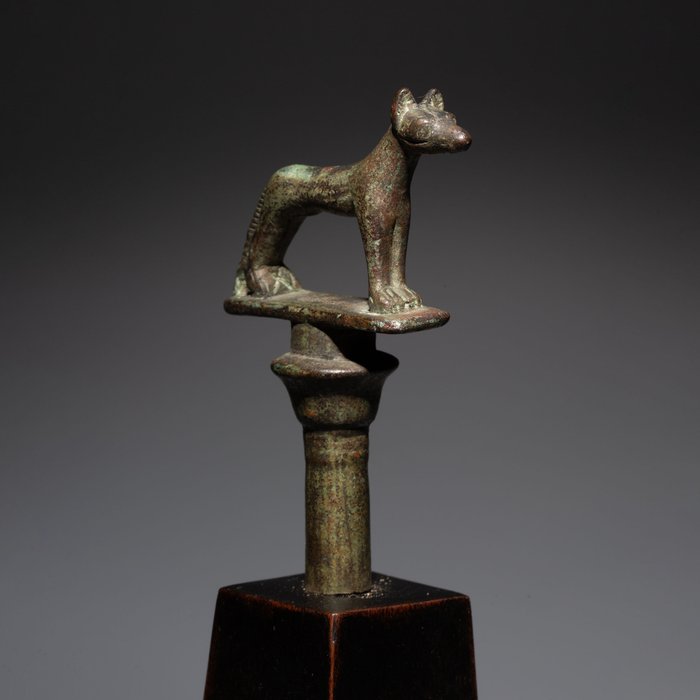
Ancient Egyptian Bronze God Wepwawet - Upuaut scepter terminal. Late Period, 626 - 323 BC. 17,5 cm H.
Bidding closed
2 days ago

Ancient Egyptian Bronze God Wepwawet - Upuaut scepter terminal. Late Period, 626 - 323 BC. 17,5 cm H.

God Wepwawet - Upuaut scepter terminal CULTURE: Ancient Egypt PERIOD: Late Period, 626 - 323 BC MATERIAL: Solid Bronze DIMENSIONS: Height 17,5 cm . Height 9,5 cm without stand. PROVENANCE: Collection of Guy Delbès (1928 - 2019), Paris. Private collection, Barcelona. CONDITION: Intact. DESCRIPTION: Terminal of the upper area of a baton or scepter with the effigy of a canid. The piece has a simple finish, with geometric shapes, inspired by columns, especially a typology characteristic of ancient Egypt such as lotiform columns, influenced by the shapes of the lotus flower. On the small capital with a camping structure, a circular podium raises the flat rectangular base where rests in a slender and elegant form, a dog or jackal in a standing position, is the image of the god Wepwawet. Wepwawet "the one who opens the roads", deity of the Duat (Beyond), funerary god and of the war in the Egyptian mythology. Wepwawet was represented in the form of a black dog or jackal with a white head, on an ensign, with one or two uraeus emerging from the sides of the paws. His warrior attributes were a mace and a bow. The Greeks interpreted him as a wolf, from which comes the name of Lycopolis, his city. It is likely that Wepwawet was originally a symbol of the pharaoh, attempting to associate himself with lupine attributes, later deifying himself as a mascot to accompany the pharaoh. Likewise, Wepwawet was said to accompany the pharaoh on hunts, in which capacity it was titled "(one with a) sharp arrow more powerful than the gods alone." In time, the connection with war, and thus with death, led Wepwawet to be seen as the one who opened the gates through and across the Duat to the spirits of the dead. With this and the similarity of the jackal to the wolf, Wepwawet became associated with Anubis, a deity who was worshipped in Asiut, eventually considering himself his son. Viscous as a jackal, he was also said to be the son of Set. Therefore, Wepwawet is often confused with Anubis. This deity appears in the temple of Seti I at Abydos. PARALLELS: Fig. 1 God Upuaut. Ancient Egypt, Lower Epoch, 664 - 323 B.C., bronze. Norwich Castle, Norfolk, inv. 1894.76.725. Fig. 2 God Upuaut. Ancient Egypt, Late Antiquity, 664 - 323 BC, bronze. Christie's London, Antiquities, April 26, 2012, lot 47. Notes: - The piece includes authenticity certificate. - The piece includes Spanish Export License. - The seller guarantees that he acquired this piece according to all national and international laws related to the ownership of cultural property. Provenance statement seen by Catawiki.

No. 100195413

No longer available
Ancient Egyptian Bronze God Wepwawet - Upuaut scepter terminal. Late Period, 626 - 323 BC. 17,5 cm H.

Ancient Egyptian Bronze God Wepwawet - Upuaut scepter terminal. Late Period, 626 - 323 BC. 17,5 cm H.

God Wepwawet - Upuaut scepter terminal

CULTURE: Ancient Egypt

PERIOD: Late Period, 626 - 323 BC

MATERIAL: Solid Bronze

DIMENSIONS: Height 17,5 cm . Height 9,5 cm without stand.

PROVENANCE: Collection of Guy Delbès (1928 - 2019), Paris. Private collection, Barcelona.

CONDITION: Intact.

DESCRIPTION:

Terminal of the upper area of a baton or scepter with the effigy of a canid. The piece has a simple finish, with geometric shapes, inspired by columns, especially a typology characteristic of ancient Egypt such as lotiform columns, influenced by the shapes of the lotus flower. On the small capital with a camping structure, a circular podium raises the flat rectangular base where rests in a slender and elegant form, a dog or jackal in a standing position, is the image of the god Wepwawet.

Wepwawet "the one who opens the roads", deity of the Duat (Beyond), funerary god and of the war in the Egyptian mythology. Wepwawet was represented in the form of a black dog or jackal with a white head, on an ensign, with one or two uraeus emerging from the sides of the paws. His warrior attributes were a mace and a bow. The Greeks interpreted him as a wolf, from which comes the name of Lycopolis, his city.

It is likely that Wepwawet was originally a symbol of the pharaoh, attempting to associate himself with lupine attributes, later deifying himself as a mascot to accompany the pharaoh. Likewise, Wepwawet was said to accompany the pharaoh on hunts, in which capacity it was titled "(one with a) sharp arrow more powerful than the gods alone."

In time, the connection with war, and thus with death, led Wepwawet to be seen as the one who opened the gates through and across the Duat to the spirits of the dead. With this and the similarity of the jackal to the wolf, Wepwawet became associated with Anubis, a deity who was worshipped in Asiut, eventually considering himself his son. Viscous as a jackal, he was also said to be the son of Set. Therefore, Wepwawet is often confused with Anubis. This deity appears in the temple of Seti I at Abydos.

PARALLELS:

Fig. 1 God Upuaut. Ancient Egypt, Lower Epoch, 664 - 323 B.C., bronze. Norwich Castle, Norfolk, inv. 1894.76.725.

Fig. 2 God Upuaut. Ancient Egypt, Late Antiquity, 664 - 323 BC, bronze. Christie's London, Antiquities, April 26, 2012, lot 47.


Notes:
- The piece includes authenticity certificate.
- The piece includes Spanish Export License.
- The seller guarantees that he acquired this piece according to all national and international laws related to the ownership of cultural property. Provenance statement seen by Catawiki.

Bidding closed
Ruth Garrido Vila
Expert
Estimate  € 13,000 - € 15,000

Similar objects

For you in

Archaeology

Set a search alert
Set a search alert to get notified when new matches are available.

This object was featured in


How to buy on Catawiki

Learn more about our Buyer Protection

      1. Discover something special

      Browse through thousands of special objects selected by experts. View the photos, details and estimated value of each special object. 

      2. Place the top bid

      Find something you love and place the top bid. You can follow the auction to the end or let our system do the bidding for you. All you have to do is set a bid for the maximum amount you want to pay. 

      3. Make a secure payment

      Pay for your special object and we’ll keep your payment secure until it arrives safe and sound. We use a trusted payment system to handle all transactions. 

Have something similar to sell?

Whether you're new to online auctions or sell professionally, we can help you earn more for your special objects.

Sell your object
