Salvador Dali (1904-1989) - King David


09
days
02
hours
36
minutes
23
seconds
No bids placed
Catawiki Buyer Protection
Your payment’s safe with us until you receive your object.View details
Trustpilot 4.4 | 145879 reviews
Rated Excellent on Trustpilot.
Salvador Dalí’s surrealist colour etching *King David* is a hand-signed, limited edition of 202/250, measuring 77 × 57 cm.
AI-assisted summary
Description from the seller
This colour etching on paper, entitled King David, depicts the biblical King David as a monumental, long-haired and bearded figure, dressed in an ornate robe in soft pink and salmon tones. His face is rendered with fine, detailed lines, while his body and clothing are depicted through delicate areas of colour and flowing contours. Above his head appears a radiant golden-yellow crown with a vivid red centre. On the right side of the composition, David raises his arms beside a harp, a traditional attribute of the biblical king.
A distinctive feature of the work is the contrast between the precise, almost calligraphic linework and the transparent, freely applied areas of colour. The elongated forms, elegant lines and unconventional proportions lend the composition a distinctly Surrealist character. The light background and restrained colour palette further emphasise the figure and his expressive gestures.
The work is executed on paper and measures 77 x 57 cm. A pencil signature is located in the lower right corner, while the edition number 232/250 appears in the lower left corner.
Condition: The paper shows some signs of age, including slight discolouration and minor areas of staining. Please refer to the photographs for further details regarding its condition.
Salvador Dalí (1904–1989) was a Spanish painter, draughtsman, printmaker and sculptor, and is regarded as one of the most influential figures of Surrealism. Born in Figueres, Catalonia, he demonstrated exceptional artistic talent from an early age. He studied at the Royal Academy of Fine Arts of San Fernando in Madrid, where he developed his knowledge of classical painting techniques and became acquainted with modern art movements such as Cubism.
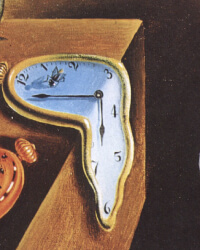
In 1929, Dalí joined the Surrealist movement in Paris, led by André Breton. He developed his distinctive paranoiac-critical method, through which he transformed dream imagery, hallucinatory visions and unexpected visual associations into meticulously detailed compositions. His paintings combine almost photographic precision with extraordinary imaginative freedom. Works such as The Persistence of Memory (1931), featuring his characteristic melting clocks, became defining images of Surrealism.
From the 1940s onwards, Dalí increasingly turned his attention to classical painting, religious subjects, science and mysticism. Alongside his paintings, he produced an extensive body of graphic work, including etchings, lithographs and illustrations for literary and biblical publications, such as Dante's Divine Comedy and the Biblia Sacra. His graphic works are distinguished by virtuoso draughtsmanship, expressive figures and a rich symbolic visual language.
Throughout his career, Dalí established himself as a remarkably versatile artist, also working in sculpture, film, photography and design. His collaborations with filmmaker Luis Buñuel, among others, and his connections with artists such as Pablo Picasso and Joan Miró reflect his involvement in the European avant-garde. Through his distinctive artistic vision and innovative visual language, Dalí secured a lasting place in international art history. His works continue to be collected, studied and exhibited worldwide, forming an essential part of twentieth-century modern art.
Seller's Story
About Art Dumay
Art Dumay is a professional art company in Nuenen, the Netherlands, with over 25 years of experience in buying, selling and valuing fine art.
We offer a carefully selected range of modern, contemporary and classical artworks to collectors worldwide.
Every artwork is professionally assessed, securely stored and carefully packed for shipment. We use appropriate protective materials and specialised transport solutions where needed.
With expertise, reliability and personal service at the heart of our business, we aim to make buying art online safe, transparent and enjoyable.
Art Dumay — from our collection to yours.
Translated by Google TranslateThis colour etching on paper, entitled King David, depicts the biblical King David as a monumental, long-haired and bearded figure, dressed in an ornate robe in soft pink and salmon tones. His face is rendered with fine, detailed lines, while his body and clothing are depicted through delicate areas of colour and flowing contours. Above his head appears a radiant golden-yellow crown with a vivid red centre. On the right side of the composition, David raises his arms beside a harp, a traditional attribute of the biblical king.
A distinctive feature of the work is the contrast between the precise, almost calligraphic linework and the transparent, freely applied areas of colour. The elongated forms, elegant lines and unconventional proportions lend the composition a distinctly Surrealist character. The light background and restrained colour palette further emphasise the figure and his expressive gestures.
The work is executed on paper and measures 77 x 57 cm. A pencil signature is located in the lower right corner, while the edition number 232/250 appears in the lower left corner.
Condition: The paper shows some signs of age, including slight discolouration and minor areas of staining. Please refer to the photographs for further details regarding its condition.
Salvador Dalí (1904–1989) was a Spanish painter, draughtsman, printmaker and sculptor, and is regarded as one of the most influential figures of Surrealism. Born in Figueres, Catalonia, he demonstrated exceptional artistic talent from an early age. He studied at the Royal Academy of Fine Arts of San Fernando in Madrid, where he developed his knowledge of classical painting techniques and became acquainted with modern art movements such as Cubism.
In 1929, Dalí joined the Surrealist movement in Paris, led by André Breton. He developed his distinctive paranoiac-critical method, through which he transformed dream imagery, hallucinatory visions and unexpected visual associations into meticulously detailed compositions. His paintings combine almost photographic precision with extraordinary imaginative freedom. Works such as The Persistence of Memory (1931), featuring his characteristic melting clocks, became defining images of Surrealism.
From the 1940s onwards, Dalí increasingly turned his attention to classical painting, religious subjects, science and mysticism. Alongside his paintings, he produced an extensive body of graphic work, including etchings, lithographs and illustrations for literary and biblical publications, such as Dante's Divine Comedy and the Biblia Sacra. His graphic works are distinguished by virtuoso draughtsmanship, expressive figures and a rich symbolic visual language.
Throughout his career, Dalí established himself as a remarkably versatile artist, also working in sculpture, film, photography and design. His collaborations with filmmaker Luis Buñuel, among others, and his connections with artists such as Pablo Picasso and Joan Miró reflect his involvement in the European avant-garde. Through his distinctive artistic vision and innovative visual language, Dalí secured a lasting place in international art history. His works continue to be collected, studied and exhibited worldwide, forming an essential part of twentieth-century modern art.
Seller's Story
About Art Dumay
Art Dumay is a professional art company in Nuenen, the Netherlands, with over 25 years of experience in buying, selling and valuing fine art.
We offer a carefully selected range of modern, contemporary and classical artworks to collectors worldwide.
Every artwork is professionally assessed, securely stored and carefully packed for shipment. We use appropriate protective materials and specialised transport solutions where needed.
With expertise, reliability and personal service at the heart of our business, we aim to make buying art online safe, transparent and enjoyable.
Art Dumay — from our collection to yours.
Translated by Google TranslateDetails
Sold by
Gallery
Edition
Limited edition
Edition number
202/250
Artist
Salvador Dali (1904-1989)
Title of artwork
King David
Technique
Etching
Signature
Hand signed
Country of origin
Netherlands
Condition
Fair condition
Height
77 cm
Width
57 cm
Style
Surrealism
Sold with frame
No
Period
1970-1980