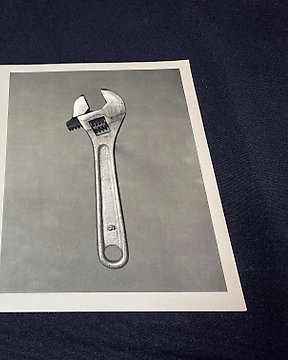
Joel-Peter Witkin - Photographies de Joel-Peter Witkin - 2012

00
days
04
hours
33
minutes
20
seconds
Current bid
€ 55
No reserve price
Felipe Abreu
Expert
Estimate  € 140 - € 210
19 other people are watching this object
itBidder 5098 €55
nlBidder 4085 €52
itBidder 5098 €45

Catawiki Buyer Protection

Your payment’s safe with us until you receive your object.View details

Trustpilot 4.4 | 122028 reviews

Rated Excellent on Trustpilot.

Description from the seller

29.5 x 30.5 cm, 304 pages, hardcover with dust jacket, front hinge is loose as shown in the photo, otherwise in excellent condition.

------------------------------------------------------------------

While a photographer was taking a photo of Lola Montès in a building, a man in the neighboring building was strangled.

Joel-Peter Witkin says he is the air that floats between two buildings. He says that at the same moment, he can hear the sound of his camera shutter and see the flow of blood in the eyes of the dying man.

If this is possible, it is because within us there is an intrinsic malevolence, like a malignant tumor, that makes us accept both the simultaneity and the separation of passions, the silent coexistence between the exacerbation of beauty and the brutality of a crime.

Witkin claims to be a portrait artist. Not of people, mind you, but of the conditions in which people exist. He says he shows how the destiny of a single person involves the entire world. He states that his work is the biography in images of a man who wishes to converse with infinity.

I've never read or heard a more ambitious statement. What's surprising is that he embraces this excessiveness. He even explains it. He recounts how it all began — with his earliest memory.

She is six years old and it is Sunday. She is holding her mother's hand. Suddenly, there is a terrible noise; screams fill the air. A horrible accident has just happened. Something rolls to the ground near her feet. It is a girl's head. She wants to touch it, to touch it. To speak. She is pushed away.

It all started with a severed head. Ten years later, when he began taking photos, he realized he wasn't holding a camera. What he had in his hand was the head of that girl.

It would be absurd to accept this story as a simple anecdote, repeated in every biography of Witkin. It would be absurd to try to explain the inexplicable, to seek the roots of such a special means of expression, or to attempt to analyze someone so complex solely through the tragic events that punctuated his life.

Witkin sums everything up with the brutality that is a constant in his work. 'Between the origin of all pain, which is birth, and the apotheosis, which is death,' he says, 'there is a convalescence, which is life.' It would be hard to imagine a more compact sense of life.

Witkin's convalescence crackles with ideas; it explodes into fragments of himself, fragments that are images—images that surprise, provoke, disturb, repulse, overwhelm, blaspheme, insult, exasperate, fascinate. But they are all images that no one has ever seen. His work is a monologue interspersed with quotations and allusions to art history or photography. But the artists he respects and admires are not the ones he converses with. Whether they are famous paintings or images cut out from a local newspaper, the sources he reveals with astonishing detail—and that can be seen on the walls of his exhibitions—enhance a constantly vigilant curiosity, an extraordinary ability to react, assimilate, absorb. It doesn't matter if Weegee doesn't speak with him when they meet. The important thing is that both see, each in their own way, the same hell.

Talking about Witkin, commentators often mention names. But neither Céline nor Soutine, Bataille nor Goya approach the intensity of Witkin in sacrilege and horror, a horror distanced to the point of compassion. "For me," he says, "there's no difference between a flower and a severed arm or leg." His is a radiant, sublime horror that reaches an indefinable grace, a convulsive yet exorcised beauty. It would be difficult to find equivalents in contemporary art.

Only he can say, 'No one so beautiful and so deeply damaged has ever asked me to photograph him.'

He describes himself as a dark poetry. It is true. This man of many talents is an artist who transcends abnormality and degradation, the agony of the flesh and the torment of the soul, in a desperate search for divine ecstasy that can only be achieved through beauty.

It is the man who wrote the dark poetry that opens the pages of this book in a collection called Maestro, where he will rightly be paired with Henri Cartier-Bresson, Marey, and Koudelka.

And we also chose to present the images in a way that magnifies their specific quality. We aim to offer the reader a different approach from what can be found in other books, emphasizing the lushness of the images, whether they are already considered classics or more recent. We focused on details that even an enchanted reader might overlook. Scrutinized, they reveal beyond the splendor of the composition the obsessively recurring themes of Witkin's world.

This book is a statement. It aims to be the most truthful reflection of a lifetime's work.

Few artists can be qualified as unique. Joel-Peter Witkin can. He is.

Robert Delpire

29.5 x 30.5 cm, 304 pages, hardcover with dust jacket, front hinge is loose as shown in the photo, otherwise in excellent condition.

------------------------------------------------------------------

While a photographer was taking a photo of Lola Montès in a building, a man in the neighboring building was strangled.

Joel-Peter Witkin says he is the air that floats between two buildings. He says that at the same moment, he can hear the sound of his camera shutter and see the flow of blood in the eyes of the dying man.

If this is possible, it is because within us there is an intrinsic malevolence, like a malignant tumor, that makes us accept both the simultaneity and the separation of passions, the silent coexistence between the exacerbation of beauty and the brutality of a crime.

Witkin claims to be a portrait artist. Not of people, mind you, but of the conditions in which people exist. He says he shows how the destiny of a single person involves the entire world. He states that his work is the biography in images of a man who wishes to converse with infinity.

I've never read or heard a more ambitious statement. What's surprising is that he embraces this excessiveness. He even explains it. He recounts how it all began — with his earliest memory.

She is six years old and it is Sunday. She is holding her mother's hand. Suddenly, there is a terrible noise; screams fill the air. A horrible accident has just happened. Something rolls to the ground near her feet. It is a girl's head. She wants to touch it, to touch it. To speak. She is pushed away.

It all started with a severed head. Ten years later, when he began taking photos, he realized he wasn't holding a camera. What he had in his hand was the head of that girl.

It would be absurd to accept this story as a simple anecdote, repeated in every biography of Witkin. It would be absurd to try to explain the inexplicable, to seek the roots of such a special means of expression, or to attempt to analyze someone so complex solely through the tragic events that punctuated his life.

Witkin sums everything up with the brutality that is a constant in his work. 'Between the origin of all pain, which is birth, and the apotheosis, which is death,' he says, 'there is a convalescence, which is life.' It would be hard to imagine a more compact sense of life.

Witkin's convalescence crackles with ideas; it explodes into fragments of himself, fragments that are images—images that surprise, provoke, disturb, repulse, overwhelm, blaspheme, insult, exasperate, fascinate. But they are all images that no one has ever seen. His work is a monologue interspersed with quotations and allusions to art history or photography. But the artists he respects and admires are not the ones he converses with. Whether they are famous paintings or images cut out from a local newspaper, the sources he reveals with astonishing detail—and that can be seen on the walls of his exhibitions—enhance a constantly vigilant curiosity, an extraordinary ability to react, assimilate, absorb. It doesn't matter if Weegee doesn't speak with him when they meet. The important thing is that both see, each in their own way, the same hell.

Talking about Witkin, commentators often mention names. But neither Céline nor Soutine, Bataille nor Goya approach the intensity of Witkin in sacrilege and horror, a horror distanced to the point of compassion. "For me," he says, "there's no difference between a flower and a severed arm or leg." His is a radiant, sublime horror that reaches an indefinable grace, a convulsive yet exorcised beauty. It would be difficult to find equivalents in contemporary art.

Only he can say, 'No one so beautiful and so deeply damaged has ever asked me to photograph him.'

He describes himself as a dark poetry. It is true. This man of many talents is an artist who transcends abnormality and degradation, the agony of the flesh and the torment of the soul, in a desperate search for divine ecstasy that can only be achieved through beauty.

It is the man who wrote the dark poetry that opens the pages of this book in a collection called Maestro, where he will rightly be paired with Henri Cartier-Bresson, Marey, and Koudelka.

And we also chose to present the images in a way that magnifies their specific quality. We aim to offer the reader a different approach from what can be found in other books, emphasizing the lushness of the images, whether they are already considered classics or more recent. We focused on details that even an enchanted reader might overlook. Scrutinized, they reveal beyond the splendor of the composition the obsessively recurring themes of Witkin's world.

This book is a statement. It aims to be the most truthful reflection of a lifetime's work.

Few artists can be qualified as unique. Joel-Peter Witkin can. He is.

Robert Delpire

Details

Number of Books
1
Subject
Art, Photography
Book Title
Photographies de Joel-Peter Witkin
Author/ Illustrator
Joel-Peter Witkin
Condition
Good
Publication year oldest item
2012
Height
29.5 cm
Edition
1st Edition
Width
30.5 cm
Language
English, French
Original language
Yes
Publisher
Robert Delpire
Binding/ Material
Hardback
Extras
Dust jacket
Number of pages
304
ItalyVerified
61
Objects sold
100%
pro

Similar objects

For you in

Art & Photography Books