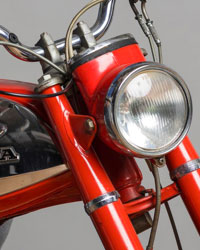
Indian - Board Tracker Replica - 1912


10
dagen
20
uren
37
minuten
48
seconden
Huidig bod
€ 1.500
Minimumprijs niet bereikt

Expert
Geselecteerd door John Searle
Meer dan 25 jaar ervaring met klassieke motoren en internationale racedeelname.
Geschatte waarde € 6.800 - € 7.500
 | € 1.500 | |
|---|---|---|
| € 750 | |
| € 500 | |
Catawiki Kopersbescherming
Je betaling is veilig bij ons totdat je het object hebt ontvangen.Bekijk details
Trustpilot 4.4 | 142358 reviews
Beoordeeld als "Uitstekend" op Trustpilot.
Board Tracker Replica met 200 cc motor, eerste registratie in 1912, gevestigd in Nederland, in uitstekende staat en zonder registratiepapieren en zonder CoC.
AI-gegenereerde samenvatting
Beschrijving van de verkoper
As seen at the Big Twin Bike Show of 2025
VIDEO:
https://youtube.com/shorts/PqE1nh32E_A?feature=share
"My vision for technical education is that in this way, you introduce students to the many aspects of technology in a broader manner. I work with short assignments to build parts that are needed, because what they build is actually used in our projects. Besides the skills needed for all these projects, they also learn to collaborate, solve problems, plan, and organize. I'm doing pretty well with that! My enthusiasm for (motorcycle) technology is strengthened in this way by working from their own design and ideas. At the moment, we are working on the practical exams; later this school year, we will start on our second and even third replica (Harley-Davidson and a Flying Merkel). The frame for this is ready, and the motor is being overhauled."
First a word on board track racing: a phenomenon from the time when men were still 'Men'. Fearless, but certainly not immortal. Around the turn of the century—the previous century, that is—primitive motorcycles were used for racing on wooden, bowl-shaped cycle tracks. The races attracted a lot of spectators and generated a lot of publicity for the relevant motorcycle manufacturers. These were mainly Indian and Harley-Davidson.
DANGEROUS
Board track racing was an extremely dangerous sport. The motorcycles had no brakes, and from a standing start, they went full throttle. Deceleration was only possible with a 'kill switch', a button on the handlebar (often a piece of saw blade) that cut the ignition circuit when pressed to interrupt the spark plug's spark. High risk of injury: the so-called 'hooking'—pushing each other off the track. Grasping the opponent's handlebar was also an option. Actions that were forbidden, but forgotten in the heat of the battle to win the prize pot. And the crowd was crazy about it.
In a fall, splinters from the wooden track caused nasty abrasions, and the tires could easily pop off the rim and hit the rider (and the crowd) in the helmet area. There were injuries and deaths among the riders and the audience. The motorcycles often went faster than 160 km/h. The branch of sport was almost gone by 1925. And with it, racing with auto's was made more accessible and popular.
THE STATE OF AFFAIRS IN GROESBEEK
There, close to the German border, the Montessori College is located. The founder of this type of education is the Italian Maria Montessori. Montessori studied in 1896 as a doctor and was thus one of the first female doctors in Italy. She died in the Netherlands, having lived a busy life here. Maria Montessori was of the opinion that children are born with an enormous energy and a need to learn and develop. The current smartphone madness among youth shows how right she was. 'Help me do it myself' is central to Montessori education. It is the task of parents and teachers to recognize what a child wants to learn at a certain moment, and to offer the right materials and environment. In this way, a child learns as much as possible at their own pace. And with as positive a result as possible.
In an enviable, fully equipped workshop (including a waterjet cutter), all kinds of mechanical operations can be taught and executed. But making custom, unique workpieces didn't fit into the vision of Maria Montessori (and Max). Therefore, Max works project-based with groups of students. And what is more interesting for youngsters in puberty than machines that make noise? So various two-wheeler projects were made where we—as old white men, and motorcyclists—felt right at home. The story that a 'home-made' Cushman-like scooter in an airborne-like event is being ridden fits right into that better adventure-book feel.
INDIAN BOARDTRACK RACER PROJECT
Practically from Groesbeek, work is being done on a six-school partnership. From the Montessori College, Max facilitates and supports the other schools. Max explains: "They all want to participate. And they all ask: 'Do you have drawings?' No, so. You design as you go. You go sit on the ground and draw a frame or chassis around you. Then you hold the handlebars in your mind and measure left and right with the tape measure: short consultation and help, let's start!"
THE COURSE OF AFFAIRS
A project is guided step by step. The learning/students are personally guided, and collaboration grows naturally. After that, the practice follows step by step, in which problem-solving/alternative thinking is stimulated.
IN THE BEGINNING
Based on practical grounds, certain dimensions of the frame tubes were chosen at ROC (Nijmegen) because they have strong professional pipe benders there. After that, it was the turn of the building team consisting of Gio, Kay, Stijn, Tim, and Yanick to build. The frame was welded together. And if you have a (reinforced) front fork and 21-inch rims mounted, then you already have a lot of motorcycle. The boys . For the mounting of the front wheel, bushings were turned for the new bearings. The brake disc, including caliper, comes from a moped. The tires with their unique, cool retro profile? They were meant for use under a rickshaw. The tank and brackets were made in sheet metal work practice. The engine is a Bernard single-cylinder. Bernard Moteurs made many (best nice) utility engine blocks. Also for threshers. The Groesbeek stake is 100% time-original compared to the time back then, when companies like ILO, JAP, MAG, Motosacoche, Villiers engine blocks supplied to every manufacturer that wanted to compete in the motorcycle market...
...to step in. This 200 cc, 3.75 hp W10 engine was also used. And gone in connection with too much compression for the hand starter with pull cord back again. With the waterjet, the digitally designed coupling plate will soon be cut out of steel to make starting easier. Oh yeah: what looks like a real magneto ignition is the cover of an 8V coil. The handlebars have bicycle levers as controls. The operation from the handlebar is not with cables, but with rods. Under the saddle, the Indian—also not like before—has no gearbox. To transfer the power to the rear axle, a lawnmower clutch was used.
It is clear that such a project is not completed in a week together with the students. The students leave room 15 and then not as grown metalworkers. But they have tasted skills in (metal) technology in a motivating way. And the proof of their work is showcase-worthy. They can be proud of it, but the completely freely breathing engine must actually be allowed to bark for a bit.
This motorcycle is intended solely as a static display model and is not constructed for operational use, although it is in running condition as shown in the video.
Inspired by the 1912 original, made in 2025
As seen at the Big Twin Bike Show of 2025
VIDEO:
https://youtube.com/shorts/PqE1nh32E_A?feature=share
"My vision for technical education is that in this way, you introduce students to the many aspects of technology in a broader manner. I work with short assignments to build parts that are needed, because what they build is actually used in our projects. Besides the skills needed for all these projects, they also learn to collaborate, solve problems, plan, and organize. I'm doing pretty well with that! My enthusiasm for (motorcycle) technology is strengthened in this way by working from their own design and ideas. At the moment, we are working on the practical exams; later this school year, we will start on our second and even third replica (Harley-Davidson and a Flying Merkel). The frame for this is ready, and the motor is being overhauled."
First a word on board track racing: a phenomenon from the time when men were still 'Men'. Fearless, but certainly not immortal. Around the turn of the century—the previous century, that is—primitive motorcycles were used for racing on wooden, bowl-shaped cycle tracks. The races attracted a lot of spectators and generated a lot of publicity for the relevant motorcycle manufacturers. These were mainly Indian and Harley-Davidson.
DANGEROUS
Board track racing was an extremely dangerous sport. The motorcycles had no brakes, and from a standing start, they went full throttle. Deceleration was only possible with a 'kill switch', a button on the handlebar (often a piece of saw blade) that cut the ignition circuit when pressed to interrupt the spark plug's spark. High risk of injury: the so-called 'hooking'—pushing each other off the track. Grasping the opponent's handlebar was also an option. Actions that were forbidden, but forgotten in the heat of the battle to win the prize pot. And the crowd was crazy about it.
In a fall, splinters from the wooden track caused nasty abrasions, and the tires could easily pop off the rim and hit the rider (and the crowd) in the helmet area. There were injuries and deaths among the riders and the audience. The motorcycles often went faster than 160 km/h. The branch of sport was almost gone by 1925. And with it, racing with auto's was made more accessible and popular.
THE STATE OF AFFAIRS IN GROESBEEK
There, close to the German border, the Montessori College is located. The founder of this type of education is the Italian Maria Montessori. Montessori studied in 1896 as a doctor and was thus one of the first female doctors in Italy. She died in the Netherlands, having lived a busy life here. Maria Montessori was of the opinion that children are born with an enormous energy and a need to learn and develop. The current smartphone madness among youth shows how right she was. 'Help me do it myself' is central to Montessori education. It is the task of parents and teachers to recognize what a child wants to learn at a certain moment, and to offer the right materials and environment. In this way, a child learns as much as possible at their own pace. And with as positive a result as possible.
In an enviable, fully equipped workshop (including a waterjet cutter), all kinds of mechanical operations can be taught and executed. But making custom, unique workpieces didn't fit into the vision of Maria Montessori (and Max). Therefore, Max works project-based with groups of students. And what is more interesting for youngsters in puberty than machines that make noise? So various two-wheeler projects were made where we—as old white men, and motorcyclists—felt right at home. The story that a 'home-made' Cushman-like scooter in an airborne-like event is being ridden fits right into that better adventure-book feel.
INDIAN BOARDTRACK RACER PROJECT
Practically from Groesbeek, work is being done on a six-school partnership. From the Montessori College, Max facilitates and supports the other schools. Max explains: "They all want to participate. And they all ask: 'Do you have drawings?' No, so. You design as you go. You go sit on the ground and draw a frame or chassis around you. Then you hold the handlebars in your mind and measure left and right with the tape measure: short consultation and help, let's start!"
THE COURSE OF AFFAIRS
A project is guided step by step. The learning/students are personally guided, and collaboration grows naturally. After that, the practice follows step by step, in which problem-solving/alternative thinking is stimulated.
IN THE BEGINNING
Based on practical grounds, certain dimensions of the frame tubes were chosen at ROC (Nijmegen) because they have strong professional pipe benders there. After that, it was the turn of the building team consisting of Gio, Kay, Stijn, Tim, and Yanick to build. The frame was welded together. And if you have a (reinforced) front fork and 21-inch rims mounted, then you already have a lot of motorcycle. The boys . For the mounting of the front wheel, bushings were turned for the new bearings. The brake disc, including caliper, comes from a moped. The tires with their unique, cool retro profile? They were meant for use under a rickshaw. The tank and brackets were made in sheet metal work practice. The engine is a Bernard single-cylinder. Bernard Moteurs made many (best nice) utility engine blocks. Also for threshers. The Groesbeek stake is 100% time-original compared to the time back then, when companies like ILO, JAP, MAG, Motosacoche, Villiers engine blocks supplied to every manufacturer that wanted to compete in the motorcycle market...
...to step in. This 200 cc, 3.75 hp W10 engine was also used. And gone in connection with too much compression for the hand starter with pull cord back again. With the waterjet, the digitally designed coupling plate will soon be cut out of steel to make starting easier. Oh yeah: what looks like a real magneto ignition is the cover of an 8V coil. The handlebars have bicycle levers as controls. The operation from the handlebar is not with cables, but with rods. Under the saddle, the Indian—also not like before—has no gearbox. To transfer the power to the rear axle, a lawnmower clutch was used.
It is clear that such a project is not completed in a week together with the students. The students leave room 15 and then not as grown metalworkers. But they have tasted skills in (metal) technology in a motivating way. And the proof of their work is showcase-worthy. They can be proud of it, but the completely freely breathing engine must actually be allowed to bark for a bit.
This motorcycle is intended solely as a static display model and is not constructed for operational use, although it is in running condition as shown in the video.
Inspired by the 1912 original, made in 2025
Details
Merk
Indian
Model Type
Board Tracker Replica
Eerste registratiejaar
1912
Staat
Uitstekend
Registratiepapieren
Nee
Bevindt zich in
Nederland
CoC (Conformiteitscertificaat) aanwezig
Nee
Voertuigregistratie
Via onze betrouwbare externe partner kunnen we kopers helpen hun voertuig te registreren. Dit is een eenvoudig proces, dat na aankoop kan worden doorlopen. De registratie van het voertuig blijft de verantwoordelijkheid van de koper.
Verkocht door
Disclaimer
Bij Catawiki streven we er altijd naar u de best mogelijke koopervaring te bieden. Onze experts bekijken en selecteren elk voertuig virtueel volgens onze richtlijnen voor het indienen van objecten en we vragen onze verkopers om de meest nauwkeurige beschrijving van het voertuig te geven. Het is echter zeer moeilijk, zo niet onmogelijk, om een volledig gedetailleerde analyse van het voertuig te verstrekken. Om u te helpen, vragen we onze verkopers om informatie te verstrekken over de staat van het voertuig. Houd er rekening mee dat de meeste te koop aangeboden voertuigen oldtimers zijn en vaak al een heel leven achter de rug hebben. Dit betekent dat zelfs voertuigen met een conditieklasse 1 of 2 mogelijk onderhoud vereisen voordat ze klaar zijn voor gebruik op de weg. We adviseren u om onze richtlijnen voor het indienen van objecten zorgvuldig door te nemen. Daarin vindt u meer details over de verschillende conditieklassen en -types, zodat u een goed beeld krijgt van wat u kunt verwachten. Auto's worden verkocht ""as is"", d.w.z. zoals beschreven en in de staat waarin ze zich bevinden op het moment van de verkoop en zonder enige verklaring, garantie of aanvaarding van aansprakelijkheid van welke aard dan ook met betrekking tot de staat door Catawiki of door de verkoper. De staat van dit object is de mening van de verkoper en kan verschillen van die van u, uw lokale garage of de mening van de dealer. Dit betekent echter niet automatisch dat de auto niet voldoet aan de beschrijving. Controleer alstublieft uw lokale wetgeving met betrekking tot voertuigregistratie voordat u een bod uitbrengt. Noch de verkoper, noch Catawiki is verantwoordelijk voor de registratie van het voertuig in uw land en zal geen annulering accepteren als u verzuimt het voertuig te registreren. We raden ook aan dat u, indien mogelijk, een bezichtiging regelt met de verkoper voordat u een bod plaatst.
Bij Catawiki streven we er altijd naar u de best mogelijke koopervaring te bieden. Onze experts bekijken en selecteren elk voertuig virtueel volgens onze richtlijnen voor het indienen van objecten en we vragen onze verkopers om de meest nauwkeurige beschrijving van het voertuig te geven. Het is echter zeer moeilijk, zo niet onmogelijk, om een volledig gedetailleerde analyse van het voertuig te verstrekken. Om u te helpen, vragen we onze verkopers om informatie te verstrekken over de staat van het voertuig. Houd er rekening mee dat de meeste te koop aangeboden voertuigen oldtimers zijn en vaak al een heel leven achter de rug hebben. Dit betekent dat zelfs voertuigen met een conditieklasse 1 of 2 mogelijk onderhoud vereisen voordat ze klaar zijn voor gebruik op de weg. We adviseren u om onze richtlijnen voor het indienen van objecten zorgvuldig door te nemen. Daarin vindt u meer details over de verschillende conditieklassen en -types, zodat u een goed beeld krijgt van wat u kunt verwachten. Auto's worden verkocht ""as is"", d.w.z. zoals beschreven en in de staat waarin ze zich bevinden op het moment van de verkoop en zonder enige verklaring, garantie of aanvaarding van aansprakelijkheid van welke aard dan ook met betrekking tot de staat door Catawiki of door de verkoper. De staat van dit object is de mening van de verkoper en kan verschillen van die van u, uw lokale garage of de mening van de dealer. Dit betekent echter niet automatisch dat de auto niet voldoet aan de beschrijving. Controleer alstublieft uw lokale wetgeving met betrekking tot voertuigregistratie voordat u een bod uitbrengt. Noch de verkoper, noch Catawiki is verantwoordelijk voor de registratie van het voertuig in uw land en zal geen annulering accepteren als u verzuimt het voertuig te registreren. We raden ook aan dat u, indien mogelijk, een bezichtiging regelt met de verkoper voordat u een bod plaatst.