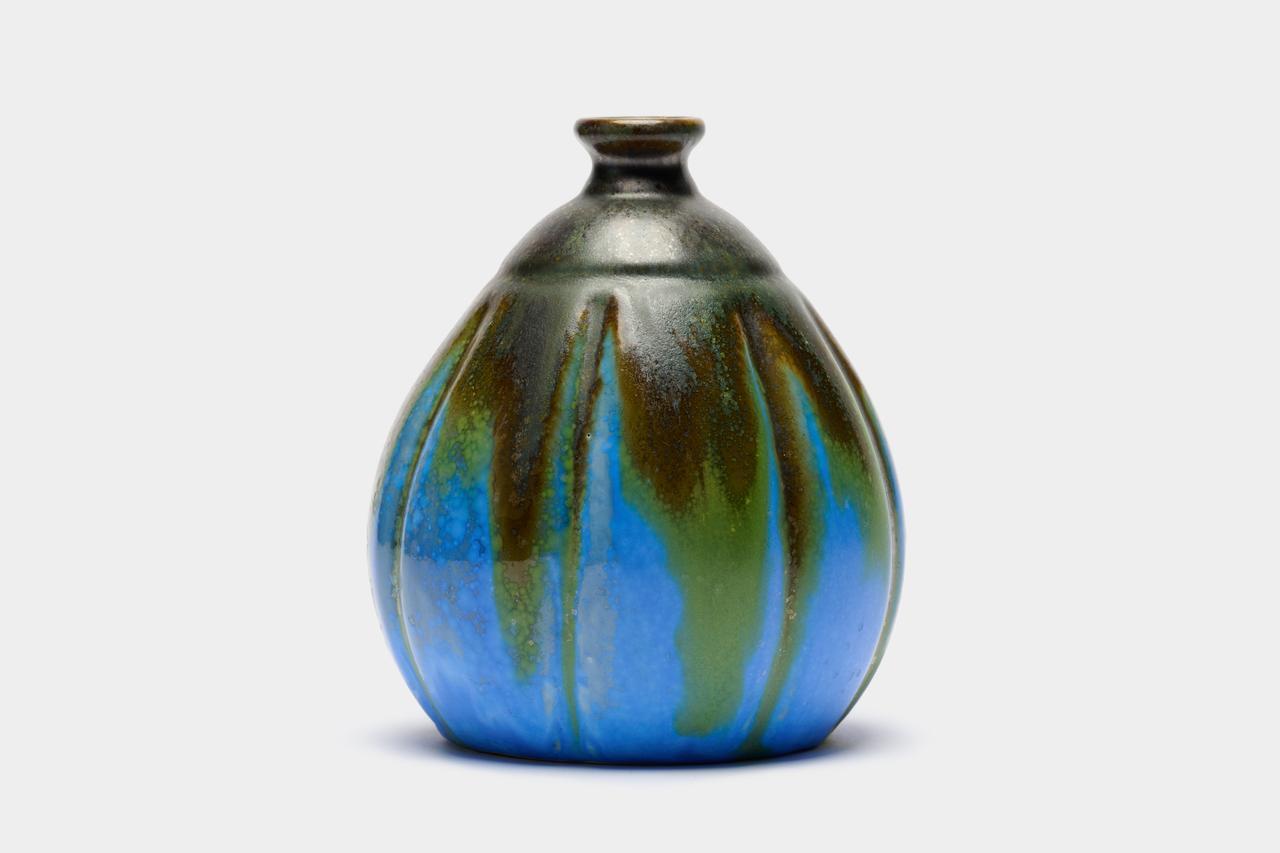
Gustavsberg - Stig Lindberg - Schalen-Set (4) - Keramik - Signiert - 1974 bis 1981


Fünf Jahre Erfahrung bei Sotheby’s Paris im Bereich Keramik und Glas.
110 € | ||
|---|---|---|
100 € | ||
38 € | ||
Käuferschutz auf Catawiki
Ihre Zahlung wird von uns sicher verwahrt, bis Sie Ihr Objekt erhalten.Details ansehen
Trustpilot 4.4 | 133504 Bewertungen
Auf Trustpilot als hervorragend bewertet.
Vier Steinzeug-Keramikobjekte entworfen von Stig Lindberg für Gustavsberg Studio in Schweden, hergestellt 1974, 1979 und 1981, mit Oxblood-Glasur, bestehend aus zwei Vasen, einer runden Schale und einer kleinen Schale.
Vom Verkäufer bereitgestellte Beschreibung
Provenant d'une collection européenne : Collection de Mr D.
Stig Lindberg
Ensemble de quatre céramiques pour Gustavsberg Studio – Suède, 1974, 1979, 1981
Ensemble de quatre pièces en grès conçues par Stig Lindberg pour le Studio de Gustavsberg. L'ensemble comprend deux vases de formes distinctes, un bol et une petite coupe. Les pièces sont recouvertes d'une glaçure "sang de bœuf" (oxblood) caractéristique, présentant des variations de rouge, de pourpre et des nuances bleutées selon la cuisson.
Chaque pièce porte la marque au tampon ou à l'incision de la manufacture, incluant la main levée du Studio de Gustavsberg (G-Studio) et l'année de production :
Vase bouteille à col évasé (1974)
Bol circulaire (1979)
Vase cylindrique à col court (1981)
Petite coupe/bol bas (1974)
H : de 4,5 cm à 13 cm ; D : de 3,5 cm à 13 cm
Stig Lindberg (1916–1982) est l'une des figures les plus influentes du design suédois du XXe siècle. Directeur artistique de la manufacture de Gustavsberg à deux reprises (1949-1957 et 1972-1980), il a supervisé le "Studio", un département dédié à la production de céramiques de haute qualité, souvent issues de recherches sur les glaçures anciennes.
La glaçure "sang de bœuf" utilisée ici est emblématique du travail technique réalisé au Studio de Gustavsberg. Elle s'inspire des céramiques classiques chinoises et nécessite une atmosphère de cuisson réductrice très précise pour obtenir cette profondeur de rouge.
L'œuvre de Stig Lindberg figure dans les collections permanentes des institutions suivantes :
Nationalmuseum (Stockholm)
Victoria and Albert Museum (Londres)
Metropolitan Museum of Art (New York)
Museum of Modern Art (MoMA) (New York)
Cooper Hewitt, Smithsonian Design Museum (New York)
------
From a private European collection : Mr D. Collection
Stig Lindberg
Set of four stoneware ceramics for Gustavsberg Studio – Sweden, 1974, 1979, 1981
Set of four stoneware pieces designed by Stig Lindberg for the Gustavsberg Studio. The set includes two vases of distinct shapes, one bowl, and one small cup. The pieces are covered in a signature "oxblood" glaze, showing variations of red, purple, and bluish tones depending on the firing.
Each piece bears the factory's stamped or incised mark, including the Gustavsberg Studio hand (G-Studio) and the year of production:
Bottle vase with flared neck (1974)
Circular bowl (1979)
Cylindrical vase with short neck (1981)
Small cup/low bowl (1974)
H: 4.5 cm to 13 cm; D: 3.5 cm to 13 cm
Stig Lindberg (1916–1982) was one of the most influential figures in 20th-century Swedish design. As artistic director of the Gustavsberg factory on two occasions (1949-1957 and 1972-1980), he oversaw the "Studio," a department dedicated to high-quality ceramic production, often resulting from research into ancient glazes.
The "oxblood" glaze used here is emblematic of the technical work achieved at the Gustavsberg Studio. It is inspired by classic Chinese ceramics and requires a very precise reducing firing atmosphere to achieve such depth of red.
Stig Lindberg's work is included in the permanent collections of the following institutions:
Nationalmuseum (Stockholm)
Victoria and Albert Museum (London)
Metropolitan Museum of Art (New York)
Museum of Modern Art (MoMA) (New York)
Cooper Hewitt, Smithsonian Design Museum (New York)
Provenant d'une collection européenne : Collection de Mr D.
Stig Lindberg
Ensemble de quatre céramiques pour Gustavsberg Studio – Suède, 1974, 1979, 1981
Ensemble de quatre pièces en grès conçues par Stig Lindberg pour le Studio de Gustavsberg. L'ensemble comprend deux vases de formes distinctes, un bol et une petite coupe. Les pièces sont recouvertes d'une glaçure "sang de bœuf" (oxblood) caractéristique, présentant des variations de rouge, de pourpre et des nuances bleutées selon la cuisson.
Chaque pièce porte la marque au tampon ou à l'incision de la manufacture, incluant la main levée du Studio de Gustavsberg (G-Studio) et l'année de production :
Vase bouteille à col évasé (1974)
Bol circulaire (1979)
Vase cylindrique à col court (1981)
Petite coupe/bol bas (1974)
H : de 4,5 cm à 13 cm ; D : de 3,5 cm à 13 cm
Stig Lindberg (1916–1982) est l'une des figures les plus influentes du design suédois du XXe siècle. Directeur artistique de la manufacture de Gustavsberg à deux reprises (1949-1957 et 1972-1980), il a supervisé le "Studio", un département dédié à la production de céramiques de haute qualité, souvent issues de recherches sur les glaçures anciennes.
La glaçure "sang de bœuf" utilisée ici est emblématique du travail technique réalisé au Studio de Gustavsberg. Elle s'inspire des céramiques classiques chinoises et nécessite une atmosphère de cuisson réductrice très précise pour obtenir cette profondeur de rouge.
L'œuvre de Stig Lindberg figure dans les collections permanentes des institutions suivantes :
Nationalmuseum (Stockholm)
Victoria and Albert Museum (Londres)
Metropolitan Museum of Art (New York)
Museum of Modern Art (MoMA) (New York)
Cooper Hewitt, Smithsonian Design Museum (New York)
------
From a private European collection : Mr D. Collection
Stig Lindberg
Set of four stoneware ceramics for Gustavsberg Studio – Sweden, 1974, 1979, 1981
Set of four stoneware pieces designed by Stig Lindberg for the Gustavsberg Studio. The set includes two vases of distinct shapes, one bowl, and one small cup. The pieces are covered in a signature "oxblood" glaze, showing variations of red, purple, and bluish tones depending on the firing.
Each piece bears the factory's stamped or incised mark, including the Gustavsberg Studio hand (G-Studio) and the year of production:
Bottle vase with flared neck (1974)
Circular bowl (1979)
Cylindrical vase with short neck (1981)
Small cup/low bowl (1974)
H: 4.5 cm to 13 cm; D: 3.5 cm to 13 cm
Stig Lindberg (1916–1982) was one of the most influential figures in 20th-century Swedish design. As artistic director of the Gustavsberg factory on two occasions (1949-1957 and 1972-1980), he oversaw the "Studio," a department dedicated to high-quality ceramic production, often resulting from research into ancient glazes.
The "oxblood" glaze used here is emblematic of the technical work achieved at the Gustavsberg Studio. It is inspired by classic Chinese ceramics and requires a very precise reducing firing atmosphere to achieve such depth of red.
Stig Lindberg's work is included in the permanent collections of the following institutions:
Nationalmuseum (Stockholm)
Victoria and Albert Museum (London)
Metropolitan Museum of Art (New York)
Museum of Modern Art (MoMA) (New York)
Cooper Hewitt, Smithsonian Design Museum (New York)