Nr. 106752016

Nicht mehr verfügbar
Seleucid Kingdom. Civic issue. AE14 Circa 150–145 BC (Seemingly unpublished in the standard references)
Auktion beendet
Vor 5 Tagen

Seleucid Kingdom. Civic issue. AE14 Circa 150–145 BC (Seemingly unpublished in the standard references)

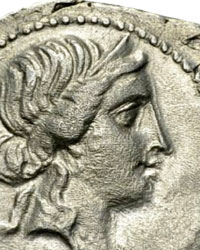
UNIQUE/EXCESSIVELY RARE ANCIENT GREECE. SELEUKIS AND PIERIA, SELEUKEIA AND ANTIOCH. Bronze AE14, circa 150-145 BC. Adelphoi Demi issue. Obv: jugate bearded heads of the Demoi of Seleukeia and Antioch right, wearing tainiai. Rev: thunderbolt, АДЕЛФ above, AHMON and uncertain monogram below; all within wreath. In secure plastic holder, graded NGC Graded AU Strike: 4/5, Surface: 4/5 Fine Style, certification number 2164075-001. Unique: unpublished in the standard references and no other examples on CoinArchives. A fascinating issue, the Adelphoi Demi coins have sparked a great deal of debate, largely centred on who exactly these 'brother peoples' were who were responsible for their minting. The traditional view, that these coins were issued jointly from a tetrarchy of the cities of Antioch on the Orontes, Apameia on the Orontes, Laodikeia ad Mare and Seleukeia Pieria, followed from Strabo's statement that these cities 'were called sisters (adelphai) because of the concord (homonoia) between them' (16.2.4). The consensus now, however, is that this issue was released by the cities of Antioch and Seleukeia only, in alliance: examples of this coinage have been found only in these two cities; for the most part, the 'typology of the series is entirely drawn from the regular numismatic iconography' of the two 'brother peoples' conjoined rather than four. This series is interesting for a number of other reasons. It contains one of the earliest personifications of the Demos (the 'People') in the numismatic record; it looks forward to the Roman Imperial period, when such 'alliance' (homonoia) coinages between cities were common, particularly in the Greek East; and it speaks to the strength and rulership of the Seleukid kings, in particular Alexander I Balas, under whose reign this issue was produced - for example, there has been debate as to whether the existence of city-based alliances within the Kingdom implies that the relative power of the Seleukid overlords was waning which combines the heads of the Demoi with the thunderbolt motif usually found only in conjunction with the head of Zeus (HGC 9-1396). Reference: Unpublished in the standard references: BMC-; HGC-; SNG Copenhagen-; Mionnet-; for obv., cf. HGC 6-1395; for rev., cf. HGC 6-1396. Weight: 8.24 g. Shipping Restrictions Worldwide free shipping is offered. Sorry, but I am unable to ship to the following countries: Russia, Belarus, Ukraine, China, India, Turkey, Brazil and Mexico. Thank you for your understanding.

Nr. 106752016

Nicht mehr verfügbar
Seleucid Kingdom. Civic issue. AE14 Circa 150–145 BC (Seemingly unpublished in the standard references)

Seleucid Kingdom. Civic issue. AE14 Circa 150–145 BC (Seemingly unpublished in the standard references)

UNIQUE/EXCESSIVELY RARE ANCIENT GREECE.
SELEUKIS AND PIERIA, SELEUKEIA AND ANTIOCH.
Bronze AE14, circa 150-145 BC.
Adelphoi Demi issue. Obv: jugate bearded heads of the Demoi of Seleukeia and Antioch right, wearing tainiai.
Rev: thunderbolt, АДЕЛФ above, AHMON and uncertain monogram below; all within wreath.
In secure plastic holder, graded NGC Graded AU Strike:
4/5, Surface:
4/5 Fine Style, certification number 2164075-001.
Unique: unpublished in the standard references and no other examples on CoinArchives.
A fascinating issue, the Adelphoi Demi coins have sparked a great deal of debate, largely centred on who exactly these 'brother peoples' were who were responsible for their minting. The traditional view, that these coins were issued jointly from a tetrarchy of the cities of Antioch on the Orontes, Apameia on the Orontes, Laodikeia ad Mare and Seleukeia Pieria, followed from Strabo's statement that these cities 'were called sisters (adelphai) because of the concord (homonoia) between them' (16.2.4). The consensus now, however, is that this issue was released by the cities of Antioch and Seleukeia only, in alliance: examples of this coinage have been found only in these two cities; for the most part, the 'typology of the series is entirely drawn from the regular numismatic iconography' of the two

'brother peoples' conjoined rather than four.
This series is interesting for a number of other reasons. It contains one of the earliest personifications of the Demos (the 'People') in the numismatic record; it looks forward to the Roman Imperial period, when such
'alliance' (homonoia) coinages between cities were common, particularly in the Greek East; and it speaks to the strength and rulership of the Seleukid kings, in particular Alexander I Balas, under whose reign this issue was produced - for example, there has been debate as to whether the existence of city-based alliances within the Kingdom implies that the relative power of the Seleukid overlords was waning
which combines the heads of the Demoi with the thunderbolt motif usually found only in conjunction with the head of Zeus (HGC 9-1396).
Reference: Unpublished in the standard references:
BMC-; HGC-; SNG Copenhagen-; Mionnet-; for obv., cf.
HGC 6-1395; for rev., cf. HGC 6-1396.
Weight: 8.24 g.

Shipping Restrictions

Worldwide free shipping is offered.
Sorry, but I am unable to ship to the following countries:

Russia, Belarus, Ukraine, China, India, Turkey, Brazil and Mexico.

Thank you for your understanding.

Auktion beendet
Carmen Vera Gutiérrez
Experte
Schätzung  € 2.800 - € 3.500

Ähnliche Objekte

  • ​
    ​
    ​
  • ​
    ​
    ​
  • ​
    ​
    ​
  • ​
    ​
    ​
  • ​
    ​
    ​
  • ​
    ​
    ​
  • ​
    ​
    ​
  • ​
    ​
    ​
  • ​
    ​
    ​
  • ​
    ​
    ​

Für Sie aus der Kategorie

Antike Münzen

  • ​
    ​
    ​
  • ​
    ​
    ​
  • ​
    ​
    ​
  • ​
    ​
    ​
  • ​
    ​
    ​
  • ​
    ​
    ​
  • ​
    ​
    ​
  • ​
    ​
    ​
  • ​
    ​
    ​
  • ​
    ​
    ​
Suchalarm einrichten
Richten Sie einen Suchalarm ein, um benachrichtigt zu werden, sobald neue passende Objekte verfügbar sind.

Dieses Objekt wurde vorgestellt in:


So kaufen Sie auf Catawiki

Mehr zum Käuferschutz erfahren

      1. Etwas Besonderes entdecken

      Entdecken Sie in unseren Auktionen Tausende von besonderen Objekten, die von Experten ausgewählt wurden. Sehen Sie sich die Fotos, die ausführliche Beschreibung und den Schätzwert der besonderen Objekte an, die Sie interessieren. 

      2. Höchstgebot abgeben

      Finden Sie etwas, das Sie begeistert, und geben Sie das Höchstgebot ab. Sie können die Auktion bis zum Schluss mitverfolgen oder unser System für Sie bieten lassen. Dazu müssen Sie einfach nur den Maximalbetrag eingeben, den Sie für das jeweilige Objekt ausgeben möchten. 

      3. Sichere Zahlung durchführen

      Bezahlen Sie Ihr besonderes Objekt und wir verwahren Ihre Zahlung, bis Ihr Objekt unversehrt bei Ihnen angekommen ist. Wir wickeln alle Transaktionen mit einem zuverlässigen und sicheren Zahlungssystem ab. 

Haben Sie etwas Ähnliches zu verkaufen?

Unabhängig davon, ob Online-Auktionen Neuland für Sie sind oder ob Sie gewerblich verkaufen – wir helfen Ihnen, mehr mit Ihren besonderen Objekten zu verdienen.

Objekt verkaufen