Nr. 106924417

Verkauft
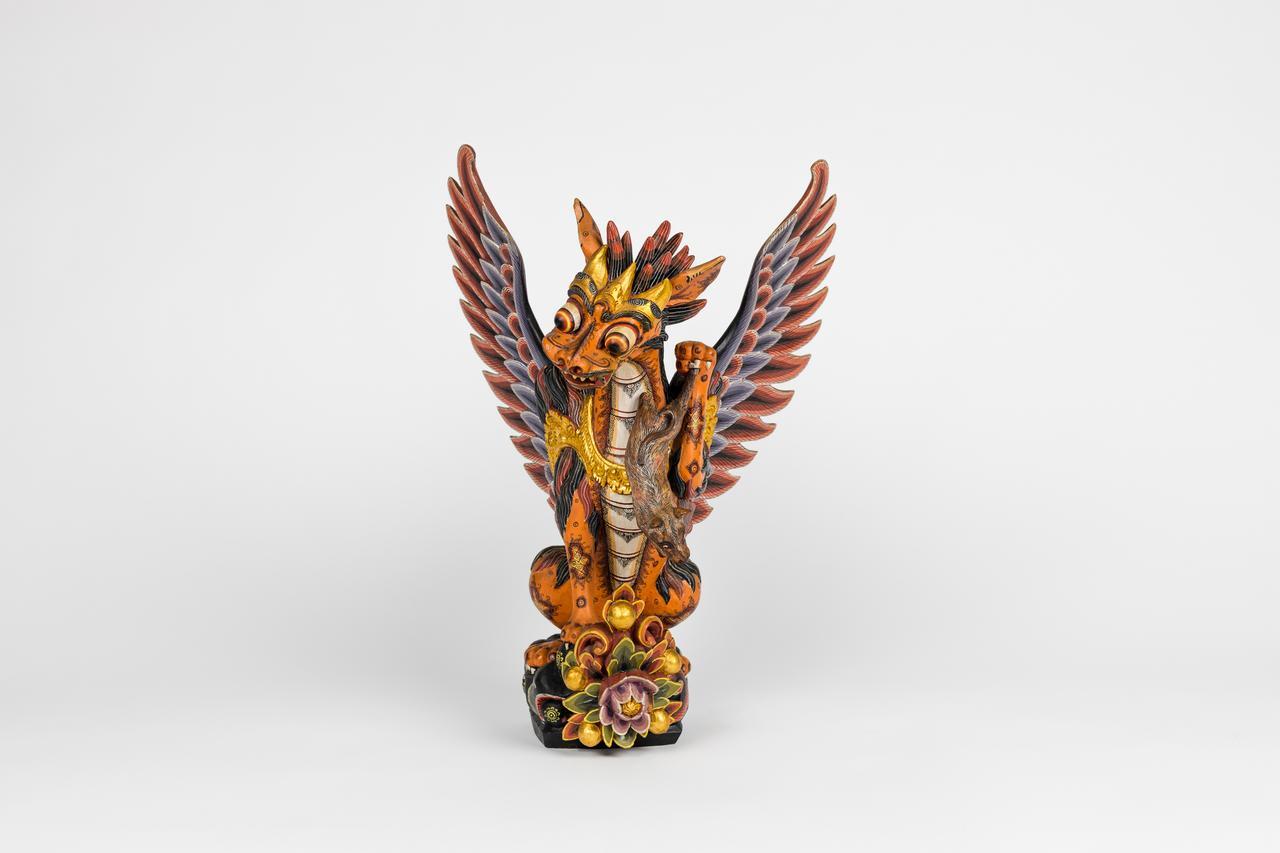
Marionette Balinesisch - Wasserbüffelhaut - Die zweite Hälfte des 20. Jahrhunderts
Höchstgebot
€ 82
Ohne mindestpreis
Vor 30 min

Marionette Balinesisch - Wasserbüffelhaut - Die zweite Hälfte des 20. Jahrhunderts

Originating from the island of Bali, this pair of theatrical shadow figures (wayang kulit) reflects the rich mythological and folkloric repertoire central to Balinese Hindu performance traditions. Hand-carved and painted on cured water buffalo parchment, the ensemble brings together a crowned serpent (Nāga) and a wild forest boar (Celeng), both integral supporting characters in epic narratives such as the Mahabharata, Ramayana, and indigenous Tantri fables. The larger figure, measuring 60 cm in length, portrays a celestial serpent deity, stylistically aligned with Nāga Basuki or Anantaboga, revered in Balinese cosmology as subterranean guardians of cosmic order and sacred waters. Executed in an openwork chiseled technique, the serpent features an expressive terracotta-red head crowned by an ornate Balinese headdress, an open maw with exposed fangs, and an undulating body patterned in turquoise-green scales. The pale underbelly curves upward toward an elevated, zoomorphic tail terminal. In visual dialogue, the boar figure presents an earthy, grounded presence, rendered with a dark, textured hide silhouette, defined tusks, and a stylized terrain base. The figure incorporates an articulated head and jaw connected by a pivot pin and cord mechanism, designed to evoke lively, naturalistic motion against the backlit cotton screen. Acquired in Bali in 1994, both figures display the authentic patina and wear characteristic of traditional handling and age. Consistent with puppets retired from performance use, the original horn or bamboo support and manipulation rods (cempurit) have been removed, leaving binding perforations along the bodies. The rawhide exhibits natural undulation, edge curling, and drying consistent with organic material. The polychrome surfaces show honest wear, including fine craquelure, pigment loss, and scattered flaking, revealing the translucent rawhide substrate beneath and underscoring their authentic, historic character. PROVENANCE Private collection, Germany (field-collected in Bali, 1994). Thence by descent to the present owner.

Nr. 106924417

Verkauft
Marionette Balinesisch - Wasserbüffelhaut - Die zweite Hälfte des 20. Jahrhunderts

Marionette Balinesisch - Wasserbüffelhaut - Die zweite Hälfte des 20. Jahrhunderts

Originating from the island of Bali, this pair of theatrical shadow figures (wayang kulit) reflects the rich mythological and folkloric repertoire central to Balinese Hindu performance traditions. Hand-carved and painted on cured water buffalo parchment, the ensemble brings together a crowned serpent (Nāga) and a wild forest boar (Celeng), both integral supporting characters in epic narratives such as the Mahabharata, Ramayana, and indigenous Tantri fables.

The larger figure, measuring 60 cm in length, portrays a celestial serpent deity, stylistically aligned with Nāga Basuki or Anantaboga, revered in Balinese cosmology as subterranean guardians of cosmic order and sacred waters. Executed in an openwork chiseled technique, the serpent features an expressive terracotta-red head crowned by an ornate Balinese headdress, an open maw with exposed fangs, and an undulating body patterned in turquoise-green scales. The pale underbelly curves upward toward an elevated, zoomorphic tail terminal. In visual dialogue, the boar figure presents an earthy, grounded presence, rendered with a dark, textured hide silhouette, defined tusks, and a stylized terrain base. The figure incorporates an articulated head and jaw connected by a pivot pin and cord mechanism, designed to evoke lively, naturalistic motion against the backlit cotton screen.

Acquired in Bali in 1994, both figures display the authentic patina and wear characteristic of traditional handling and age. Consistent with puppets retired from performance use, the original horn or bamboo support and manipulation rods (cempurit) have been removed, leaving binding perforations along the bodies. The rawhide exhibits natural undulation, edge curling, and drying consistent with organic material. The polychrome surfaces show honest wear, including fine craquelure, pigment loss, and scattered flaking, revealing the translucent rawhide substrate beneath and underscoring their authentic, historic character.


PROVENANCE
Private collection, Germany (field-collected in Bali, 1994).
Thence by descent to the present owner.

Höchstgebot
€ 82
Ohne mindestpreis
Alexandra Xu
Experte
Schätzung  € 150 - € 200

Ähnliche Objekte

  • ​
    ​
    ​
  • ​
    ​
    ​
  • ​
    ​
    ​
  • ​
    ​
    ​
  • ​
    ​
    ​
  • ​
    ​
    ​
  • ​
    ​
    ​
  • ​
    ​
    ​
  • ​
    ​
    ​
  • ​
    ​
    ​

Für Sie aus der Kategorie

Kunst aus Südostasien, Ozeanien und Amerika

  • ​
    ​
    ​
  • ​
    ​
    ​
  • ​
    ​
    ​
  • ​
    ​
    ​
  • ​
    ​
    ​
  • ​
    ​
    ​
  • ​
    ​
    ​
  • ​
    ​
    ​
  • ​
    ​
    ​
  • ​
    ​
    ​
Suchalarm einrichten
Richten Sie einen Suchalarm ein, um benachrichtigt zu werden, sobald neue passende Objekte verfügbar sind.

Dieses Objekt wurde vorgestellt in:


So kaufen Sie auf Catawiki

Mehr zum Käuferschutz erfahren

      1. Etwas Besonderes entdecken

      Entdecken Sie in unseren Auktionen Tausende von besonderen Objekten, die von Experten ausgewählt wurden. Sehen Sie sich die Fotos, die ausführliche Beschreibung und den Schätzwert der besonderen Objekte an, die Sie interessieren. 

      2. Höchstgebot abgeben

      Finden Sie etwas, das Sie begeistert, und geben Sie das Höchstgebot ab. Sie können die Auktion bis zum Schluss mitverfolgen oder unser System für Sie bieten lassen. Dazu müssen Sie einfach nur den Maximalbetrag eingeben, den Sie für das jeweilige Objekt ausgeben möchten. 

      3. Sichere Zahlung durchführen

      Bezahlen Sie Ihr besonderes Objekt und wir verwahren Ihre Zahlung, bis Ihr Objekt unversehrt bei Ihnen angekommen ist. Wir wickeln alle Transaktionen mit einem zuverlässigen und sicheren Zahlungssystem ab. 

Haben Sie etwas Ähnliches zu verkaufen?

Unabhängig davon, ob Online-Auktionen Neuland für Sie sind oder ob Sie gewerblich verkaufen – wir helfen Ihnen, mehr mit Ihren besonderen Objekten zu verdienen.

Objekt verkaufen