Nr. 108556604

Verkauft
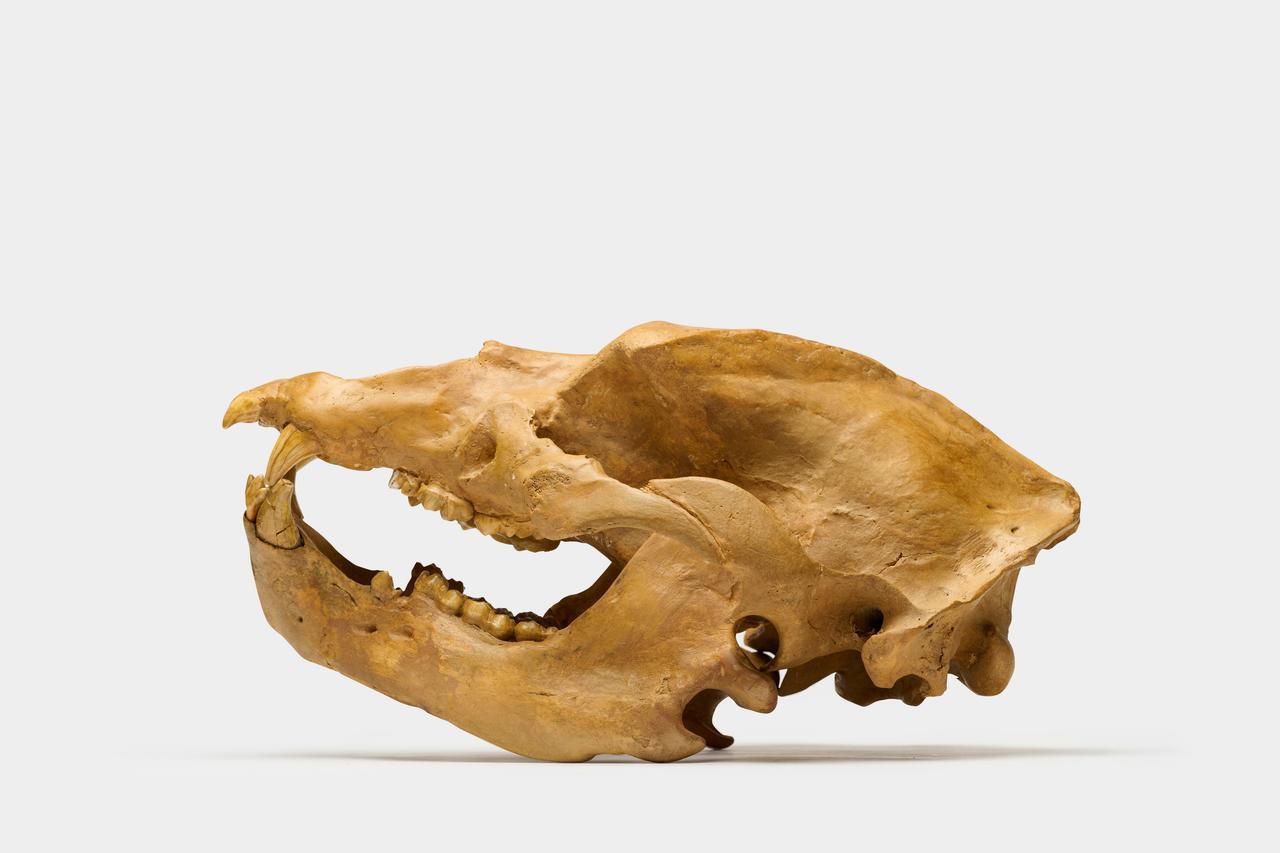
Bison - Tierfossil - Bison sp. - 42 cm - 20 cm  (Ohne mindestpreis)
Höchstgebot
€ 27
Ohne mindestpreis
Vor 1 Tag

Bison - Tierfossil - Bison sp. - 42 cm - 20 cm (Ohne mindestpreis)

The teeth are gone. The sockets are not. For most fossils that would be a loss. Here it is the opposite: with the crowns out of the way, you can see the architecture the teeth were set into — the alveolar bone along the top of the jaw, the thin partitions between the roots, the shape of the holes themselves. Each socket is a cast of a tooth that no longer exists. What you are looking at is the negative space of something that stood here tens of thousands of years ago. It tells you more than a full row would. A socket shows where a tooth was rooted, how deep it went, how the bone wrapped it. A few worn stumps and a scatter of fragments remain along the row; the rest of the jaw is bone. The bone itself is grey-brown rather than the warm ochre you get in some beds — greyer, closer to stone, with the surface split into a fine network of cracks and the original grain still readable across the body of the jaw. The flange at the rear rises into a hooked, forked process. It measures 42 × 20 cm and weighs 1000 g exactly. Look at it: Exposed tooth sockets — the empty architecture of the tooth row, partitions and all. A few worn stumps remaining — plus fragments along the row. Grey-brown fossil bone — cooler in tone than ochre, surface cracked into a fine network. Hooked, forked flange at the rear — the muscle process, intact. 42 × 20 cm, 1000 g — a large, evenly weighted piece. This is a cabinet specimen — the one fossil in a group that shows you how a jaw is built rather than what was in it. Honest note: this is a fossilised bison mandible from the Ice Age, identified as bison on the basis of the bone and the dentition, and listed at genus level (Bison sp.); the exact species is not claimed. Most teeth are missing and only worn stumps and fragments remain, as shown. It is a Late Pleistocene fossil, roughly 10,000 to 50,000 years old depending on the deposit it came from. Measurements and weight as measured. Specifications: Type: Fossilised bison mandible (lower jaw) Species: Bison sp. — Ice Age bison Size: 42 × 20 cm Weight: 1000 g Teeth: mostly missing; worn stumps and fragments remain Age: Late Pleistocene, approx. 10,000–50,000 years BP Condition: as shown It is a jaw with the seats empty and the structure showing. You get to display it.

Nr. 108556604

Verkauft
Bison - Tierfossil - Bison sp. - 42 cm - 20 cm  (Ohne mindestpreis)

Bison - Tierfossil - Bison sp. - 42 cm - 20 cm (Ohne mindestpreis)

The teeth are gone. The sockets are not.
For most fossils that would be a loss. Here it is the opposite: with the crowns out of the way, you can see the architecture the teeth were set into — the alveolar bone along the top of the jaw, the thin partitions between the roots, the shape of the holes themselves. Each socket is a cast of a tooth that no longer exists. What you are looking at is the negative space of something that stood here tens of thousands of years ago.
It tells you more than a full row would. A socket shows where a tooth was rooted, how deep it went, how the bone wrapped it. A few worn stumps and a scatter of fragments remain along the row; the rest of the jaw is bone.
The bone itself is grey-brown rather than the warm ochre you get in some beds — greyer, closer to stone, with the surface split into a fine network of cracks and the original grain still readable across the body of the jaw. The flange at the rear rises into a hooked, forked process. It measures 42 × 20 cm and weighs 1000 g exactly.
Look at it:
Exposed tooth sockets — the empty architecture of the tooth row, partitions and all.
A few worn stumps remaining — plus fragments along the row.
Grey-brown fossil bone — cooler in tone than ochre, surface cracked into a fine network.
Hooked, forked flange at the rear — the muscle process, intact.
42 × 20 cm, 1000 g — a large, evenly weighted piece.
This is a cabinet specimen — the one fossil in a group that shows you how a jaw is built rather than what was in it.
Honest note: this is a fossilised bison mandible from the Ice Age, identified as bison on the basis of the bone and the dentition, and listed at genus level (Bison sp.); the exact species is not claimed. Most teeth are missing and only worn stumps and fragments remain, as shown. It is a Late Pleistocene fossil, roughly 10,000 to 50,000 years old depending on the deposit it came from. Measurements and weight as measured.
Specifications:
Type: Fossilised bison mandible (lower jaw)
Species: Bison sp. — Ice Age bison
Size: 42 × 20 cm
Weight: 1000 g
Teeth: mostly missing; worn stumps and fragments remain
Age: Late Pleistocene, approx. 10,000–50,000 years BP
Condition: as shown
It is a jaw with the seats empty and the structure showing. You get to display it.

Höchstgebot
€ 27
Ohne mindestpreis

Ähnliche Objekte

  • ​
    ​
    ​
  • ​
    ​
    ​
  • ​
    ​
    ​
  • ​
    ​
    ​
  • ​
    ​
    ​
  • ​
    ​
    ​
  • ​
    ​
    ​
  • ​
    ​
    ​
  • ​
    ​
    ​
  • ​
    ​
    ​

Für Sie aus der Kategorie

Fossilien

  • ​
    ​
    ​
  • ​
    ​
    ​
  • ​
    ​
    ​
  • ​
    ​
    ​
  • ​
    ​
    ​
  • ​
    ​
    ​
  • ​
    ​
    ​
  • ​
    ​
    ​
  • ​
    ​
    ​
  • ​
    ​
    ​
Suchalarm einrichten
Richten Sie einen Suchalarm ein, um benachrichtigt zu werden, sobald neue passende Objekte verfügbar sind.

Dieses Objekt wurde vorgestellt in:


So kaufen Sie auf Catawiki

Mehr zum Käuferschutz erfahren

      1. Etwas Besonderes entdecken

      Entdecken Sie in unseren Auktionen Tausende von besonderen Objekten, die von Experten ausgewählt wurden. Sehen Sie sich die Fotos, die ausführliche Beschreibung und den Schätzwert der besonderen Objekte an, die Sie interessieren. 

      2. Höchstgebot abgeben

      Finden Sie etwas, das Sie begeistert, und geben Sie das Höchstgebot ab. Sie können die Auktion bis zum Schluss mitverfolgen oder unser System für Sie bieten lassen. Dazu müssen Sie einfach nur den Maximalbetrag eingeben, den Sie für das jeweilige Objekt ausgeben möchten. 

      3. Sichere Zahlung durchführen

      Bezahlen Sie Ihr besonderes Objekt und wir verwahren Ihre Zahlung, bis Ihr Objekt unversehrt bei Ihnen angekommen ist. Wir wickeln alle Transaktionen mit einem zuverlässigen und sicheren Zahlungssystem ab. 

Haben Sie etwas Ähnliches zu verkaufen?

Unabhängig davon, ob Online-Auktionen Neuland für Sie sind oder ob Sie gewerblich verkaufen – wir helfen Ihnen, mehr mit Ihren besonderen Objekten zu verdienen.

Objekt verkaufen