Nr. 108557000

Verkauft
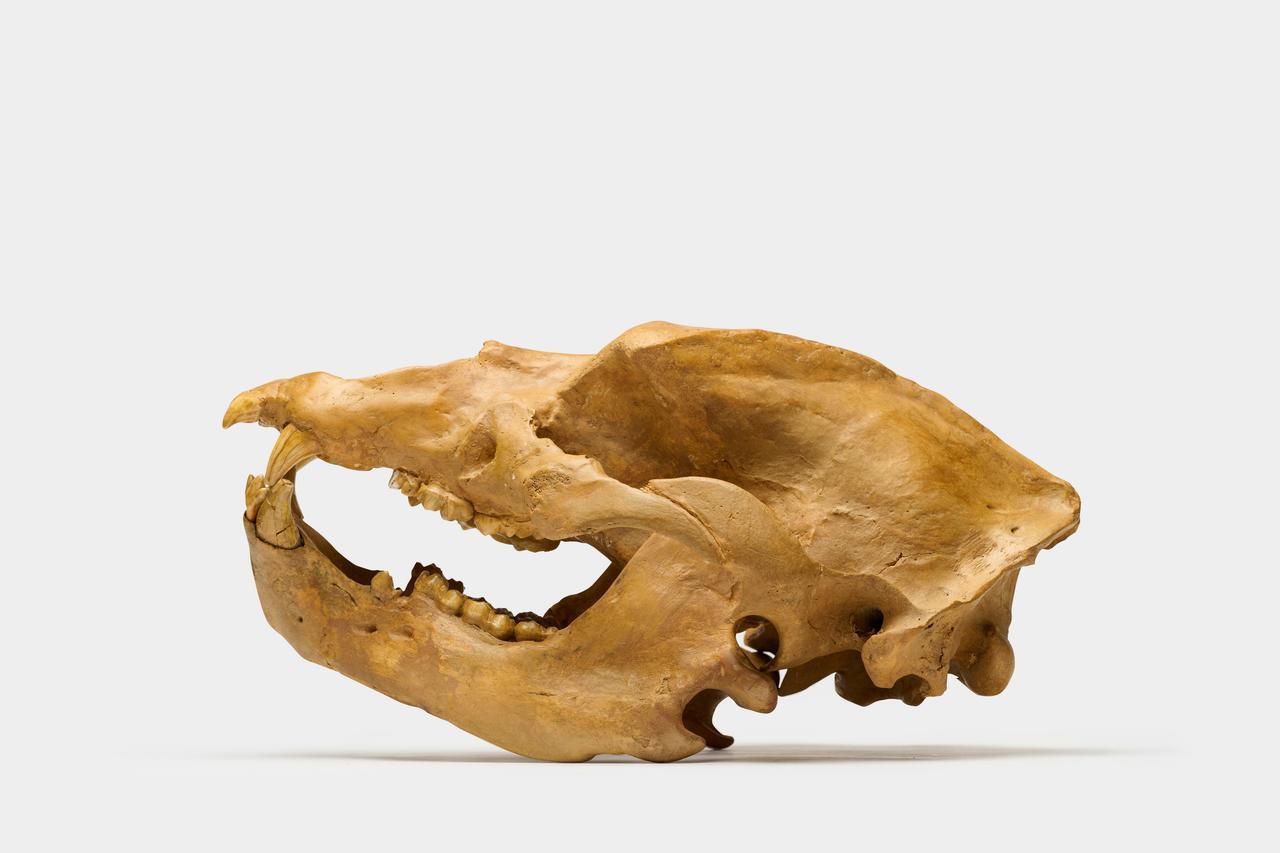
Bison - Tierfossil - Bison sp. - 34.5 cm - 12 cm  (Ohne mindestpreis)
Höchstgebot
€ 94
Ohne mindestpreis
Vor 2 Tagen

Bison - Tierfossil - Bison sp. - 34.5 cm - 12 cm (Ohne mindestpreis)

The first thing anyone does with this piece is lift it. The second thing they do is look at the label. Thirty-four and a half centimetres of horn core, and 1750 grams of it. That is heavier than the length suggests, and there is a reason for it. Living bone is porous — it has to be, to carry blood. Buried bone fills with mineral, grain by grain, over thousands of years, until the pores close. Fossil bone is denser than the bone it came from, which is why a piece this size sits in the hand like a stone rather than like an object. What you are holding is the core of a bison horn: the bony structure that grew out of the skull, curved through roughly a quarter of a circle, broad at the base and narrowing along its length, cut across at both ends. The sheath that covered it — the keratin, the part you would have seen on the animal — is long gone. The surface is grooved end to end with the vascular channels that once fed that sheath, and the colour runs from pale ochre to deep earth brown depending on which way the light falls. One long fracture follows the body of the horn from one end toward the other. It does not split the piece; it is the seam along which the fossil dried, and it reads as a dark line drawn on the surface. It comes on a black metal display stand with curved supports, sized to hold the weight. Look at it: 1750 g in 34.5 cm — dense fossil bone, heavier than it looks. Quarter-circle curve — broad at the base, narrowing along its length. Grooved surface throughout — the vascular channels, still traceable. Ochre to earth brown — colour changing with the light. One long fracture, stable — the seam along which the fossil dried. This is a cabinet specimen — the heaviest piece in a group, and the one that makes people check the label after they pick it up. Honest note: this is a fossilised bison horn core from the Ice Age — the bony core only, the keratin sheath not preserved. It is a section, cut across at both ends rather than a complete horn, with one long fracture running along its body. It is listed at genus level (Bison sp.); the exact species is not claimed. It is a Late Pleistocene fossil, roughly 10,000 to 50,000 years old depending on the deposit it came from. Measurements and weight as measured; the stand is included. Specifications: Type: Fossilised bison horn core Species: Bison sp. — Ice Age bison Size: 34.5 × 12 cm Weight: 1750 g Completeness: a section, cut across at both ends Stand: black metal display stand, included Age: Late Pleistocene, approx. 10,000–50,000 years BP Condition: as shown It is the bone a horn grew on, and it weighs like stone. You get to display it.

Nr. 108557000

Verkauft
Bison - Tierfossil - Bison sp. - 34.5 cm - 12 cm  (Ohne mindestpreis)

Bison - Tierfossil - Bison sp. - 34.5 cm - 12 cm (Ohne mindestpreis)

The first thing anyone does with this piece is lift it. The second thing they do is look at the label.
Thirty-four and a half centimetres of horn core, and 1750 grams of it. That is heavier than the length suggests, and there is a reason for it. Living bone is porous — it has to be, to carry blood. Buried bone fills with mineral, grain by grain, over thousands of years, until the pores close. Fossil bone is denser than the bone it came from, which is why a piece this size sits in the hand like a stone rather than like an object.
What you are holding is the core of a bison horn: the bony structure that grew out of the skull, curved through roughly a quarter of a circle, broad at the base and narrowing along its length, cut across at both ends. The sheath that covered it — the keratin, the part you would have seen on the animal — is long gone.
The surface is grooved end to end with the vascular channels that once fed that sheath, and the colour runs from pale ochre to deep earth brown depending on which way the light falls. One long fracture follows the body of the horn from one end toward the other. It does not split the piece; it is the seam along which the fossil dried, and it reads as a dark line drawn on the surface.
It comes on a black metal display stand with curved supports, sized to hold the weight.
Look at it:
1750 g in 34.5 cm — dense fossil bone, heavier than it looks.
Quarter-circle curve — broad at the base, narrowing along its length.
Grooved surface throughout — the vascular channels, still traceable.
Ochre to earth brown — colour changing with the light.
One long fracture, stable — the seam along which the fossil dried.
This is a cabinet specimen — the heaviest piece in a group, and the one that makes people check the label after they pick it up.
Honest note: this is a fossilised bison horn core from the Ice Age — the bony core only, the keratin sheath not preserved. It is a section, cut across at both ends rather than a complete horn, with one long fracture running along its body. It is listed at genus level (Bison sp.); the exact species is not claimed. It is a Late Pleistocene fossil, roughly 10,000 to 50,000 years old depending on the deposit it came from. Measurements and weight as measured; the stand is included.
Specifications:
Type: Fossilised bison horn core
Species: Bison sp. — Ice Age bison
Size: 34.5 × 12 cm
Weight: 1750 g
Completeness: a section, cut across at both ends
Stand: black metal display stand, included
Age: Late Pleistocene, approx. 10,000–50,000 years BP
Condition: as shown
It is the bone a horn grew on, and it weighs like stone. You get to display it.

Höchstgebot
€ 94
Ohne mindestpreis

Ähnliche Objekte

  • ​
    ​
    ​
  • ​
    ​
    ​
  • ​
    ​
    ​
  • ​
    ​
    ​
  • ​
    ​
    ​
  • ​
    ​
    ​
  • ​
    ​
    ​
  • ​
    ​
    ​
  • ​
    ​
    ​
  • ​
    ​
    ​

Für Sie aus der Kategorie

Fossilien

  • ​
    ​
    ​
  • ​
    ​
    ​
  • ​
    ​
    ​
  • ​
    ​
    ​
  • ​
    ​
    ​
  • ​
    ​
    ​
  • ​
    ​
    ​
  • ​
    ​
    ​
  • ​
    ​
    ​
  • ​
    ​
    ​
Suchalarm einrichten
Richten Sie einen Suchalarm ein, um benachrichtigt zu werden, sobald neue passende Objekte verfügbar sind.

Dieses Objekt wurde vorgestellt in:


So kaufen Sie auf Catawiki

Mehr zum Käuferschutz erfahren

      1. Etwas Besonderes entdecken

      Entdecken Sie in unseren Auktionen Tausende von besonderen Objekten, die von Experten ausgewählt wurden. Sehen Sie sich die Fotos, die ausführliche Beschreibung und den Schätzwert der besonderen Objekte an, die Sie interessieren. 

      2. Höchstgebot abgeben

      Finden Sie etwas, das Sie begeistert, und geben Sie das Höchstgebot ab. Sie können die Auktion bis zum Schluss mitverfolgen oder unser System für Sie bieten lassen. Dazu müssen Sie einfach nur den Maximalbetrag eingeben, den Sie für das jeweilige Objekt ausgeben möchten. 

      3. Sichere Zahlung durchführen

      Bezahlen Sie Ihr besonderes Objekt und wir verwahren Ihre Zahlung, bis Ihr Objekt unversehrt bei Ihnen angekommen ist. Wir wickeln alle Transaktionen mit einem zuverlässigen und sicheren Zahlungssystem ab. 

Haben Sie etwas Ähnliches zu verkaufen?

Unabhängig davon, ob Online-Auktionen Neuland für Sie sind oder ob Sie gewerblich verkaufen – wir helfen Ihnen, mehr mit Ihren besonderen Objekten zu verdienen.

Objekt verkaufen