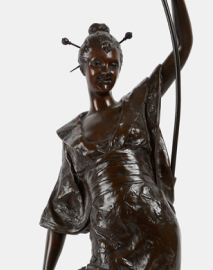
Sculpture, Pan con pifferi - 71 cm - Bronze


Add to your favourites to get an alert when the auction starts.

He accumulated 18 years' experience, worked as junior specialist at Sotheby’s and managed Kunsthandel Jacques Fijnaut.
Catawiki Buyer Protection
Your payment’s safe with us until you receive your object.View details
Trustpilot 4.4 | 124842 reviews
Rated Excellent on Trustpilot.
Description from the seller
Description of the work
The sculpture depicts a satyr attempting to play the pipes and draws inspiration from several drawings unearthed during the Pompeii excavations, as well as from a fresco preserved at the National Archaeological Museum of Naples.
The protagonist of the work is a figure from Greek mythology, depicted according to classical iconography with a human torso, goat legs, and a tail.
The satyr is a Greco-Roman mythological creature, belonging to the retinue of Dionysus, often associated with music, dance, and the instinctive energy of nature. Unlike the faun, traditionally more Roman in origin, the satyr embodies the wilder, dionysian dimension of existence, a symbol of vitality, freedom, revelry, and joyous abandon.
⸻
Features
Material: Bronze, lost wax casting.
• Base: Bronze, lost wax casting
• Sculpture dimensions: 71 × 36 × 24.5 cm
• Base dimensions: 18 cm
Weight: 14 kg
Production: Italy
⸻
Historical curiosities
Satyrs did not dwell on Olympus, but populated the woods and the countryside, accompanying Dionysus during festive processions. They were regarded as nature spirits, linked to fertility, wine, and music.
According to myth, it is these very figures who are credited with the spread of pastoral wind instruments. The legend of the nymph Syrinx, transformed into a marsh reed to escape Pan, lies at the origin of the flute, the instrument symbolizing the rustic and Dionysian world.
⸻
Maintenance
To keep the bronze sculpture in optimal condition, it is recommended to clean it regularly with a soft, dry cloth. Avoid the use of harsh chemical products that could damage the patina. When needed, using a specific wax helps to preserve and enhance the finish of the artwork over time.
Description of the work
The sculpture depicts a satyr attempting to play the pipes and draws inspiration from several drawings unearthed during the Pompeii excavations, as well as from a fresco preserved at the National Archaeological Museum of Naples.
The protagonist of the work is a figure from Greek mythology, depicted according to classical iconography with a human torso, goat legs, and a tail.
The satyr is a Greco-Roman mythological creature, belonging to the retinue of Dionysus, often associated with music, dance, and the instinctive energy of nature. Unlike the faun, traditionally more Roman in origin, the satyr embodies the wilder, dionysian dimension of existence, a symbol of vitality, freedom, revelry, and joyous abandon.
⸻
Features
Material: Bronze, lost wax casting.
• Base: Bronze, lost wax casting
• Sculpture dimensions: 71 × 36 × 24.5 cm
• Base dimensions: 18 cm
Weight: 14 kg
Production: Italy
⸻
Historical curiosities
Satyrs did not dwell on Olympus, but populated the woods and the countryside, accompanying Dionysus during festive processions. They were regarded as nature spirits, linked to fertility, wine, and music.
According to myth, it is these very figures who are credited with the spread of pastoral wind instruments. The legend of the nymph Syrinx, transformed into a marsh reed to escape Pan, lies at the origin of the flute, the instrument symbolizing the rustic and Dionysian world.
⸻
Maintenance
To keep the bronze sculpture in optimal condition, it is recommended to clean it regularly with a soft, dry cloth. Avoid the use of harsh chemical products that could damage the patina. When needed, using a specific wax helps to preserve and enhance the finish of the artwork over time.