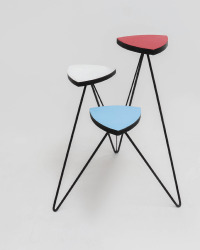
Stool - Wood - A wooden milking stool


Add to your favourites to get an alert when the auction starts.

Acquired extensive antiques knowledge through renovation works and running own antiques shop.
Catawiki Buyer Protection
Your payment’s safe with us until you receive your object.View details
Trustpilot 4.4 | 131620 reviews
Rated Excellent on Trustpilot.
Description from the seller
early 20th century wooden milking stool with a strong rural folk character.
Object Identification:
Type: Four-legged milking stool
Period: Likely mid–20th century
Style: Primitive / Folk / Vernacular rural
Seat:
Solid single plank seat
Thick and heavy
Visible shrinkage cracks
Hand-forged nail heads are visible on top
Central large peg or dowel reinforcement
The seat underside shows clear hand-tool marks likely adze-worked rather than machine-planed.
The surface suggests long functional use.
The Legs (Important Detail)
This is where it gets interesting.
traditional for stability on uneven farm floors)
Turned sections in the upper part of the legs
Tapered and wedged into the seat
Transitional folk craftsmanship (handmade)
This turning style was common in:
Scandinavian rural furniture
Alpine regions
Northern Germany
The leg angle is wide and practical — classic milking stool geometry for balance.
Fittings & Joinery:
Legs are mortised into the seat
Likely wedged from above (traditional technique)
No modern screws
Hand-forged hardware
The patina is authentic and layered:
Burnished seat top from decades of use
Darkened edges
Dirt is ingrained in wood fibers
Natural shrinkage cracks
Surface dryness consistent with age
This is not artificial distressing — the wear is structurally consistent.
The heavy seat and turned detail lean slightly toward Scandinavian or Alpine folk tradition.
early 20th century wooden milking stool with a strong rural folk character.
Object Identification:
Type: Four-legged milking stool
Period: Likely mid–20th century
Style: Primitive / Folk / Vernacular rural
Seat:
Solid single plank seat
Thick and heavy
Visible shrinkage cracks
Hand-forged nail heads are visible on top
Central large peg or dowel reinforcement
The seat underside shows clear hand-tool marks likely adze-worked rather than machine-planed.
The surface suggests long functional use.
The Legs (Important Detail)
This is where it gets interesting.
traditional for stability on uneven farm floors)
Turned sections in the upper part of the legs
Tapered and wedged into the seat
Transitional folk craftsmanship (handmade)
This turning style was common in:
Scandinavian rural furniture
Alpine regions
Northern Germany
The leg angle is wide and practical — classic milking stool geometry for balance.
Fittings & Joinery:
Legs are mortised into the seat
Likely wedged from above (traditional technique)
No modern screws
Hand-forged hardware
The patina is authentic and layered:
Burnished seat top from decades of use
Darkened edges
Dirt is ingrained in wood fibers
Natural shrinkage cracks
Surface dryness consistent with age
This is not artificial distressing — the wear is structurally consistent.
The heavy seat and turned detail lean slightly toward Scandinavian or Alpine folk tradition.