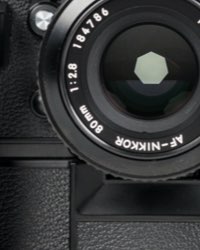
Nikon F4 Analogue camera


04
days
14
hours
54
minutes
38
seconds
Current bid
€ 114
Reserve price not met

Expert
Selected by Edwin Molenaar
Has over 15 years' experience in photography and camera building, formerly a trader.
Estimate € 250 - € 280
15 other people are watching this object
 | €114 |
|---|
Catawiki Buyer Protection
Your payment’s safe with us until you receive your object.View details
Trustpilot 4.4 | 131870 reviews
Rated Excellent on Trustpilot.
Nikon F4 35 mm film SLR with Nikon F mount, serial 2275168; physical condition: good, functional condition: tested and working.
AI-assisted summary
Description from the seller
The Nikon F4 is a professional 35mm film SLR camera introduced in 1988 by Nikon. It is a historic machine because it marks the definitive transition from fully mechanical SLRs to advanced electronic ones, while still maintaining direct and “physical” control typical of analog cameras.
The design, crafted by Giorgetto Giugiaro, is immediately recognizable: sharp lines, integrated grip and the characteristic front red badge. It is a solid camera, built for professional use, with a sense of robustness and very high reliability.
One of the most important aspects of the F4 is the introduction of autofocus into the Nikon professional system. While not as fast as later generations, it represents a huge step forward compared to pure manual focusing, opening the door to a new way of working.
The interface is a unique blend of tradition and innovation: unlike later, more “digital” models, the F4 retains physical dials for shutter speeds, exposure compensation and modes, making the experience very intuitive and direct. It is a camera that you use “with your hands,” without relying too much on menus.
The Nikon F4 is a professional 35mm film SLR camera introduced in 1988 by Nikon. It is a historic machine because it marks the definitive transition from fully mechanical SLRs to advanced electronic ones, while still maintaining direct and “physical” control typical of analog cameras.
The design, crafted by Giorgetto Giugiaro, is immediately recognizable: sharp lines, integrated grip and the characteristic front red badge. It is a solid camera, built for professional use, with a sense of robustness and very high reliability.
One of the most important aspects of the F4 is the introduction of autofocus into the Nikon professional system. While not as fast as later generations, it represents a huge step forward compared to pure manual focusing, opening the door to a new way of working.
The interface is a unique blend of tradition and innovation: unlike later, more “digital” models, the F4 retains physical dials for shutter speeds, exposure compensation and modes, making the experience very intuitive and direct. It is a camera that you use “with your hands,” without relying too much on menus.
Details
Era
1900-2000
Brand
Nikon
Model/type nr
F4
Physical condition
Good
Functional condition
Tested and working
Lens Mount Type
Nikon F
Film type
35mm
Serial number
2275168
Estimated period
1980-1990
Sold by