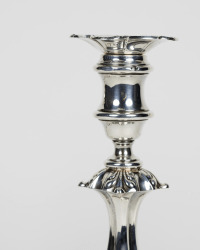
Tea strainer - .800 silver - Silver tea strainer 86 g 800


Has over 30 years of experience in archaeology and is an appraiser specialising in archaeological objects.
Catawiki Buyer Protection
Your payment’s safe with us until you receive your object.View details
Trustpilot 4.4 | 135164 reviews
Rated Excellent on Trustpilot.
Silver teasieve in 800 silver, weighing 86 g and measuring 9.4 × 15.5 × 2.5 cm, made in Germany and dating to 1850–1900, in good condition with minor signs of age; features a solid decorative rim in a neoclassical Louis XVI style with floral festoons and a solid backmarked edge, including marks resembling fleur-de-lis, an acorn motif, and a partially worn crown, linked to Hanauer silversmiths.
Description from the seller
For sale is an exceptionally beautiful and strikingly solidly crafted tea strainer made of genuine silver. The piece was produced in the late 19th or early 20th century in the Neoclassical Louis-seize style of Historicism, and captivates with its masterful artisanal execution.
Notably, the detailed, plastic relief work of the surrounding rim stands out. In contrast to the more commonly found pierced rims, the decorative edge here is left completely solid. It runs around the piece and is adorned with finely worked floral festoons (flower garlands), elegant ribbons, and classical, antiquing decorative medallions. The shapely handle continues this floral relief decoration harmoniously and gives the object excellent visual and tactile value. The embossed rim shows a clean, completely intact perforation pattern. An exquisite collectible piece for lovers of demanding antique table culture.
Marking & Provenance The tea strainer is stamped on the back of the rim in several places, conspicuously. The high-resolution macro photographs reveal a fascinating combination of historical marks:
• A stylized lily (Fleur-de-lis) in the center
• A plastically formed pinecone, inspired by Augsburg's famous historic city mark on the right side
• Another mark, which is sadly heavily rubbed (upper half of a crown) on the left side
This deliberately chosen arrangement of historically incongruent marks clearly identifies the piece as a Spitzenprodukt of the famous Hanau silverware manufactories around the turn of the century (such as Schleissner, Neresheimer, etc.). These master workshops were internationally renowned for reviving magnificent historical stylistic periods in perfect quality. To emphasize the antique character, they adorned their works with these artistic pseudo-marks (“fantasy stamps”).
Condition The object is in excellent, undamaged and unrestored original condition. The delicate chisellings and relief structures are razor-sharply preserved and have not been flattened over generations. There are no dents, cracks, deformations, or old solder joints. In the deeper reliefs there is a fine, authentic silver patina that beautifully emphasizes the three-dimensional effect of the decoration.
For sale is an exceptionally beautiful and strikingly solidly crafted tea strainer made of genuine silver. The piece was produced in the late 19th or early 20th century in the Neoclassical Louis-seize style of Historicism, and captivates with its masterful artisanal execution.
Notably, the detailed, plastic relief work of the surrounding rim stands out. In contrast to the more commonly found pierced rims, the decorative edge here is left completely solid. It runs around the piece and is adorned with finely worked floral festoons (flower garlands), elegant ribbons, and classical, antiquing decorative medallions. The shapely handle continues this floral relief decoration harmoniously and gives the object excellent visual and tactile value. The embossed rim shows a clean, completely intact perforation pattern. An exquisite collectible piece for lovers of demanding antique table culture.
Marking & Provenance The tea strainer is stamped on the back of the rim in several places, conspicuously. The high-resolution macro photographs reveal a fascinating combination of historical marks:
• A stylized lily (Fleur-de-lis) in the center
• A plastically formed pinecone, inspired by Augsburg's famous historic city mark on the right side
• Another mark, which is sadly heavily rubbed (upper half of a crown) on the left side
This deliberately chosen arrangement of historically incongruent marks clearly identifies the piece as a Spitzenprodukt of the famous Hanau silverware manufactories around the turn of the century (such as Schleissner, Neresheimer, etc.). These master workshops were internationally renowned for reviving magnificent historical stylistic periods in perfect quality. To emphasize the antique character, they adorned their works with these artistic pseudo-marks (“fantasy stamps”).
Condition The object is in excellent, undamaged and unrestored original condition. The delicate chisellings and relief structures are razor-sharply preserved and have not been flattened over generations. There are no dents, cracks, deformations, or old solder joints. In the deeper reliefs there is a fine, authentic silver patina that beautifully emphasizes the three-dimensional effect of the decoration.