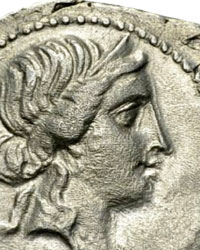
Thrace, Ainos Tetradrachm Circa 415/4-413/2 BC

Starting bid
€ 1

Add to your favourites to get an alert when the auction starts.

Carmen Vera Gutiérrez
Expert
Selected by Carmen Vera Gutiérrez

Experienced antique appraiser specialising in Spanish coins with deep knowledge of ancient currency.

Estimate  € 3,900 - € 4,300
Catawiki Buyer Protection

Your payment’s safe with us until you receive your object.View details

Trustpilot 4.4 | 136828 reviews

Rated Excellent on Trustpilot.

Description from the seller

THRACE, Ainos. Circa 415/4-413/2 BC. AR Tetradrachm. Head of Hermes right, wearing petasos / Goat standing right; ivy branch to right; all within incuse square.
Ainos came rather late to currency production, striking its first tetradrachms only after the expulsion of the Persians from northern Greece following Xerxes’ defeat at Salamis. Its first period ended with the Athenian coinage decree of 449 BC, but the mint was in operation again by circa 435 BC, tapering off rapidly until disappearing with the conquest of the city by Philip of Macedon in 342 BC. Its uniform types throughout its history were Hermes and the goat, the latter the symbol of the pasture land that provided what prosperity Ainos had. Hermes was the patron deity of Ainos, dating from the time of the Trojan War. According to a poem by Kallimachos, the sculptor Epeios, who constructed the Trojan Horse, also made a wooden statue (ξοανον) of Hermes, which was washed out to sea and recovered by fishermen by the Hebros river. The fishermen, thinking it just a piece of driftwood, tried to burn it in their bonfire. When it failed to burn they took fright and threw it back into the sea, which promptly cast it back again. The natives accepted it as a relic of the gods, and erected the sanctuary of Hermes Perpheraios (the Wanderer) at the future site of Ainos. The later coins of Ainos, with their splendid facing head of Hermes, showcase some of the finest numismatic art of the Greek world. Nevertheless, Ainos never became an important city or trading center. The climate might have had something to do with it; according to Athaneus, Ainos had two seasons, eight months of cold and four months of winter. At least the goats liked it.

Weight: 16,55 gr
Diameter: 25,2 mm

Condition: Very Fine

Seller's Story

Founded in 2021, we specialize in sourcing and selling high-quality collectible coins, banknotes, and numismatic objects. With a strong focus on authenticity, transparency, and customer satisfaction, we offer carefully selected pieces for both experienced collectors and novice enthusiasts. Each offered item is described accurately, carefully packed, and handled with professional attention. We place great importance on clear communication, fast shipping, and a reliable and pleasant shopping experience.
Translated by Google Translate

THRACE, Ainos. Circa 415/4-413/2 BC. AR Tetradrachm. Head of Hermes right, wearing petasos / Goat standing right; ivy branch to right; all within incuse square.
Ainos came rather late to currency production, striking its first tetradrachms only after the expulsion of the Persians from northern Greece following Xerxes’ defeat at Salamis. Its first period ended with the Athenian coinage decree of 449 BC, but the mint was in operation again by circa 435 BC, tapering off rapidly until disappearing with the conquest of the city by Philip of Macedon in 342 BC. Its uniform types throughout its history were Hermes and the goat, the latter the symbol of the pasture land that provided what prosperity Ainos had. Hermes was the patron deity of Ainos, dating from the time of the Trojan War. According to a poem by Kallimachos, the sculptor Epeios, who constructed the Trojan Horse, also made a wooden statue (ξοανον) of Hermes, which was washed out to sea and recovered by fishermen by the Hebros river. The fishermen, thinking it just a piece of driftwood, tried to burn it in their bonfire. When it failed to burn they took fright and threw it back into the sea, which promptly cast it back again. The natives accepted it as a relic of the gods, and erected the sanctuary of Hermes Perpheraios (the Wanderer) at the future site of Ainos. The later coins of Ainos, with their splendid facing head of Hermes, showcase some of the finest numismatic art of the Greek world. Nevertheless, Ainos never became an important city or trading center. The climate might have had something to do with it; according to Athaneus, Ainos had two seasons, eight months of cold and four months of winter. At least the goats liked it.

Weight: 16,55 gr
Diameter: 25,2 mm

Condition: Very Fine

Seller's Story

Founded in 2021, we specialize in sourcing and selling high-quality collectible coins, banknotes, and numismatic objects. With a strong focus on authenticity, transparency, and customer satisfaction, we offer carefully selected pieces for both experienced collectors and novice enthusiasts. Each offered item is described accurately, carefully packed, and handled with professional attention. We place great importance on clear communication, fast shipping, and a reliable and pleasant shopping experience.
Translated by Google Translate

Details

Era
Before 1400
Weight
16.55 g
Culture/region
Thrace, Ainos
Year/period and variation
Circa 415/4-413/2 BC
Number of items
1
Denomination
Tetradrachm
Metal
AR
Condition
Ungraded
Sold by
The NetherlandsVerified
81
Objects sold
pro

Similar objects

For you in

Ancient Coins