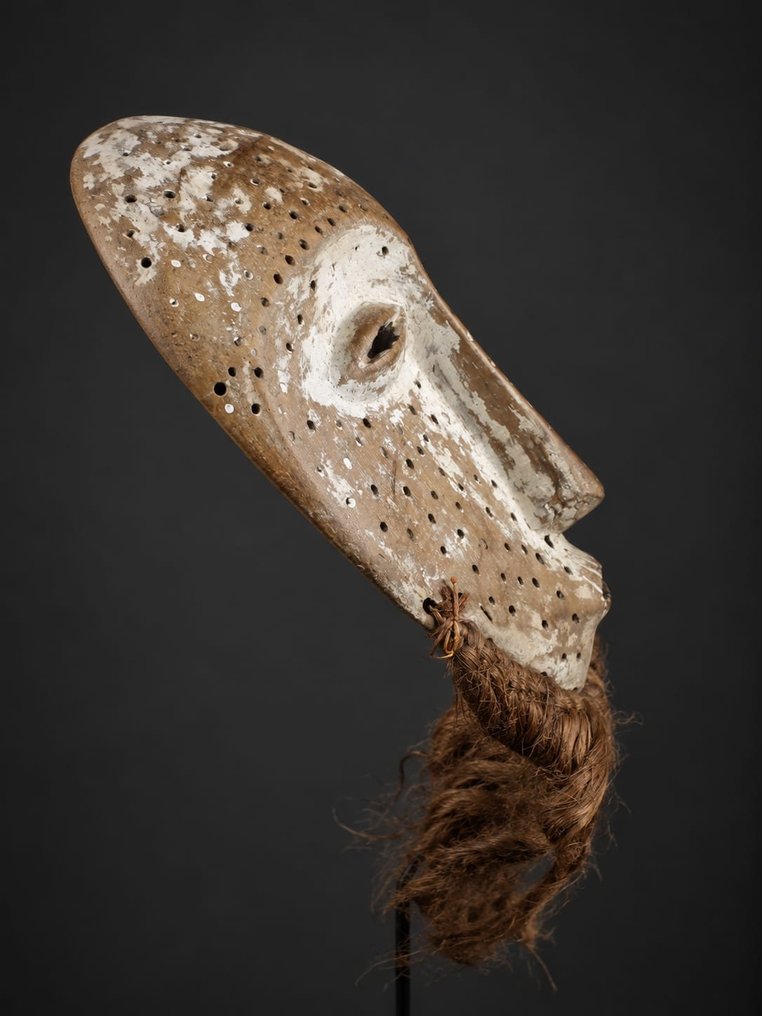
Lega mask - DR Congo



04
days
05
hours
11
minutes
49
seconds
Starting bid
€ 1
Reserve price not met

Expert
Selected by Dimitri André
Holds a postgraduate degree in African studies and 15 years experience in African art.
Estimate € 170 - € 200
No bids placed
Catawiki Buyer Protection
Your payment’s safe with us until you receive your object.View details
Trustpilot 4.4 | 144916 reviews
Rated Excellent on Trustpilot.
Description from the seller
Origin. Democratic Republic of the Congo
Tribe name. Balega
Material. Wood
Size. 28 cm
Shipping method. Colissimo in 24–48 hours
This mask belongs to the traditional art of the Lega (or Rega), a people who live mainly in the eastern part of the Democratic Republic of the Congo. The masks of this ethnic group play a central role in the Bwami initiation society, an institution that shapes the group’s social, moral, and political life.
Here is a detailed description of this mask:
1. Shape and Materials
Oval, streamlined shape: The mask has an overall oval, convex structure, with the soft, clean lines typical of Lega aesthetics.
Wood and patina: Carved from wood, it displays a beautiful aged patina combining warm brown tones.
White pigments (pembe): The face is partially covered with kaolin or white pigments, especially around the eyes and on the forehead—a distinctive feature symbolizing wisdom, purity, and the spirit world.
2. Facial Features
The eyes: Horizontal slit-shaped, finely carved and highlighted with white patina, they give the gaze an introspective and serene expression.
The nose: Slender, straight, and elongated, it vertically structures the face, extending from the forehead to the base.
The mouth: Slightly open, small, and delicately incised with tiny vertical notches reminiscent of a row of teeth.
3. Adornments and Distinctive Features
Perforations (scarifications): The mask’s surface is dotted with numerous small circular holes, regularly drilled across the forehead and cheeks. Among the Lega, these perforations often evoke bodily scarification or serve symbolic and practical functions connected with Bwami rituals.
Vegetable-fiber beard: The lower part of the mask is richly adorned with a long, shaggy beard made of braided plant fibers (raffia or hemp), framing the chin and enhancing the object’s venerable, grounded appearance.
The rear cavity: The back of the mask (visible in the last image) shows marks left by adze carving, revealing the sculptor’s raw handwork.
Cultural significance
This type of mask was generally not worn over the face during dances, but rather displayed on the forehead, handled by hand, or placed on altars and hung along palisade structures during Bwami initiation ceremonies. It symbolizes the ideals of wisdom, dignity, and moral elevation sought by initiates.
Details
Number of objects
1
Country of Origin
DR Congo
Material
Wood
Sold with stand
No
Condition
Good condition
Title of artwork
Lega mask
Height
28 cm
Authenticity
Original/official
Sold by
