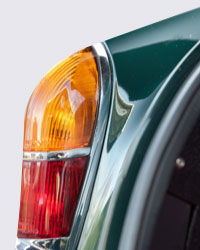
Jaguar - 240 - 1968


Add to your favourites to get an alert when the auction starts.

Thirty years' experience with classic cars, specialising in Italian cars and Porsche.
Catawiki Buyer Protection
Your payment’s safe with us until you receive your object.View details
Trustpilot 4.4 | 139803 reviews
Rated Excellent on Trustpilot.
Description from the seller
Jaguar 240 Overdrive 1968
• Manual with overdrive
• Only 3 owners from new
• History and documentation available
• Notable history thanks to a prominent role in the opening of the Gouwe Aqueduct in 1981 with historical photos
• Engine rebuilt
• 6-cylinder engine with 133 hp and twin SU carburetors
• Solid chassis
• Damage-free bodywork
• Ideal wedding car
HISTORY/DOCUMENTATION
This Jaguar 240 was delivered in 1968 in the United Kingdom, as is the case with the majority. In 1977 the car came to the Netherlands, where the second owner held it for no less than 45 years (1976-2021) and accumulated many reliability trips. The third owner has owned the car since 2021 but due to health issues has only been able to drive 94 miles. In 2021 the car was technically sound. At present the car starts and runs but will need a service (including fluids and filters replacement).
The car has extensive history and documentation such as invoices, old registration papers and APK reports. Also included are a workshop manual and a 2021 appraisals report (€34,000). Reportedly, the odometer is original. Of particular note is the prominent place the car took at the ceremonial opening of the Gouwe Aqueduct in Gouda in 1981, for which historical photos are available. The official opening of the Gouwe Aqueduct on 6 October 1981 was a national highlight for one of the most complex hydraulic engineering projects of the 1970s.
This enormous structure, at the time the world’s widest aqueduct with a span of over 47 meters, finally resolved the notorious daily bottleneck of 70,000 vehicles on the A12. At this solemn opening, several prominent figures attended, including the Minister of Traffic and Water Management Henk Zeevalking, who performed the opening act by unveiling a Rijkswaterstaat flag. Also present were prominent figures such as the Mayor of Gouda and politician Ed Nijpels.
EXTERIOR
The car is finished in stylish Old English White. The Jaguar has never been fully restored and still retains some of its original paint. The bodywork is damage-free, with patina and some signs of use, but neat for its age.
Chrome and rubbers have been refreshed in the past. The chassis is in solid condition (see our extensive photo report). There is visibly no welding on the car. The wheels are equipped with chromed hubcaps and trim rings. The tires are Vredestein.
INTERIOR
The interior is finished in attractive burgundy red artificial leather (skai) upholstery and is largely original and in good condition with some signs of use. The upholstery on the seats, bench and door panels is neat without major damage. The burl wood trim could be improved. The gauges are complete and, as far as known, functional. An optional radio is present.
TECHNICAL
The engine was rebuilt approximately 1,600 miles ago and prepared for unleaded petrol. Additionally, the brakes and suspension were refurbished. In 2021 the car was in good running order, shifting and braking. Since then the car has stood still, so some maintenance is advised.
The car starts and runs, but it is recommended to replace fluids, replace filters and perform a safety check.
The Jaguar 240 was powered by a 2.5-liter (2,483 cc) DOHC inline-six XK engine that, thanks to twin SU HD6 carburetors and a cylinder head derived from the E-Type, delivered 133 hp and 202 Nm of torque. This power was transmitted via rear-wheel drive and a four-speed manual gearbox (optionally with overdrive or automatic) for a top speed of 170 km/h and a 0-100 km/h time of just under 12 seconds.
The chassis featured servo-assisted Dunlop disc brakes at all four corners, independent front suspension, a live rear axle and a modern 12-volt electrical system with an alternator, while the road-ready weight was reduced to about 1,440 kg thanks to slimmer bumpers.
GENERAL
The Jaguar 240 was a compact, luxury sports saloon produced from September 1967 to April 1969. The car served as the direct, more streamlined badging of its legendary predecessor, the Jaguar Mark II (2.4 liter), and was eventually succeeded by the iconic Jaguar XJ6 in 1969. In total, 4,446 units rolled off the assembly line.
An interesting tidbit is that the Jaguar 240, although marketed as a cheaper ‘end of production’ model with simplifications such as vinyl Ambla upholstery and the absence of the distinctive wooden picnic tables, was actually more powerful (133 hp) and faster than its predecessor thanks to a new E-Type cylinder head and twin SU carburetors. In addition, this model is visually recognizable by its noticeably narrower bumpers.
Seller's Story
Jaguar 240 Overdrive 1968
• Manual with overdrive
• Only 3 owners from new
• History and documentation available
• Notable history thanks to a prominent role in the opening of the Gouwe Aqueduct in 1981 with historical photos
• Engine rebuilt
• 6-cylinder engine with 133 hp and twin SU carburetors
• Solid chassis
• Damage-free bodywork
• Ideal wedding car
HISTORY/DOCUMENTATION
This Jaguar 240 was delivered in 1968 in the United Kingdom, as is the case with the majority. In 1977 the car came to the Netherlands, where the second owner held it for no less than 45 years (1976-2021) and accumulated many reliability trips. The third owner has owned the car since 2021 but due to health issues has only been able to drive 94 miles. In 2021 the car was technically sound. At present the car starts and runs but will need a service (including fluids and filters replacement).
The car has extensive history and documentation such as invoices, old registration papers and APK reports. Also included are a workshop manual and a 2021 appraisals report (€34,000). Reportedly, the odometer is original. Of particular note is the prominent place the car took at the ceremonial opening of the Gouwe Aqueduct in Gouda in 1981, for which historical photos are available. The official opening of the Gouwe Aqueduct on 6 October 1981 was a national highlight for one of the most complex hydraulic engineering projects of the 1970s.
This enormous structure, at the time the world’s widest aqueduct with a span of over 47 meters, finally resolved the notorious daily bottleneck of 70,000 vehicles on the A12. At this solemn opening, several prominent figures attended, including the Minister of Traffic and Water Management Henk Zeevalking, who performed the opening act by unveiling a Rijkswaterstaat flag. Also present were prominent figures such as the Mayor of Gouda and politician Ed Nijpels.
EXTERIOR
The car is finished in stylish Old English White. The Jaguar has never been fully restored and still retains some of its original paint. The bodywork is damage-free, with patina and some signs of use, but neat for its age.
Chrome and rubbers have been refreshed in the past. The chassis is in solid condition (see our extensive photo report). There is visibly no welding on the car. The wheels are equipped with chromed hubcaps and trim rings. The tires are Vredestein.
INTERIOR
The interior is finished in attractive burgundy red artificial leather (skai) upholstery and is largely original and in good condition with some signs of use. The upholstery on the seats, bench and door panels is neat without major damage. The burl wood trim could be improved. The gauges are complete and, as far as known, functional. An optional radio is present.
TECHNICAL
The engine was rebuilt approximately 1,600 miles ago and prepared for unleaded petrol. Additionally, the brakes and suspension were refurbished. In 2021 the car was in good running order, shifting and braking. Since then the car has stood still, so some maintenance is advised.
The car starts and runs, but it is recommended to replace fluids, replace filters and perform a safety check.
The Jaguar 240 was powered by a 2.5-liter (2,483 cc) DOHC inline-six XK engine that, thanks to twin SU HD6 carburetors and a cylinder head derived from the E-Type, delivered 133 hp and 202 Nm of torque. This power was transmitted via rear-wheel drive and a four-speed manual gearbox (optionally with overdrive or automatic) for a top speed of 170 km/h and a 0-100 km/h time of just under 12 seconds.
The chassis featured servo-assisted Dunlop disc brakes at all four corners, independent front suspension, a live rear axle and a modern 12-volt electrical system with an alternator, while the road-ready weight was reduced to about 1,440 kg thanks to slimmer bumpers.
GENERAL
The Jaguar 240 was a compact, luxury sports saloon produced from September 1967 to April 1969. The car served as the direct, more streamlined badging of its legendary predecessor, the Jaguar Mark II (2.4 liter), and was eventually succeeded by the iconic Jaguar XJ6 in 1969. In total, 4,446 units rolled off the assembly line.
An interesting tidbit is that the Jaguar 240, although marketed as a cheaper ‘end of production’ model with simplifications such as vinyl Ambla upholstery and the absence of the distinctive wooden picnic tables, was actually more powerful (133 hp) and faster than its predecessor thanks to a new E-Type cylinder head and twin SU carburetors. In addition, this model is visually recognizable by its noticeably narrower bumpers.
Seller's Story
Details
Vehicle registration
We can help buyers register their vehicle through our trusted external partner. The process is straightforward and can be completed after purchase. Vehicle registration remains the buyer's responsibility.
Disclaimer
Catawiki always aims to offer you the best possible buying experience. Our experts virtually review and select every vehicle in line with our submission guidelines and we require our sellers to provide the most accurate description of the vehicle. However, providing a fully detailed analysis of the vehicle is extremely difficult, and close to impossible. To guide you, we ask our sellers to provide information about the vehicle’s condition. Please consider that most vehicles for sale are classic vehicles and they often already have a whole life behind them, meaning that even a condition 1 or 2 vehicle might need maintenance to be ready for the road. It is advised to carefully read our submission guidelines that further describe details about the condition grades and types to manage your expectations. Cars are sold “as is”, meaning as described and in the condition they are in at the time of the sale and without any representation, warranty or assumption of liability of any kind as to the condition by Catawiki or by the seller. The condition of this item is the opinion of the seller and may differ from yours, your local garage, or the dealer’s opinion. This does not automatically mean the car does not conform to its description. Before bidding, please check your local legislation regarding vehicle registration. Neither the seller nor Catawiki is responsible for the registration of the vehicle in your country and will not accept a cancellation for your failure to register the vehicle. We also recommend that, if possible, you arrange a viewing with the seller before placing a bid.