Mask - Dan - Côte d'Ivoire



05
days
18
hours
54
minutes
53
seconds
Current bid
€ 75
Reserve price not met

Expert
Selected by Dimitri André
Holds a postgraduate degree in African studies and 15 years experience in African art.
Estimate € 1,700 - € 2,000
 | €75 |
|---|
Catawiki Buyer Protection
Your payment’s safe with us until you receive your object.View details
Trustpilot 4.4 | 142376 reviews
Rated Excellent on Trustpilot.
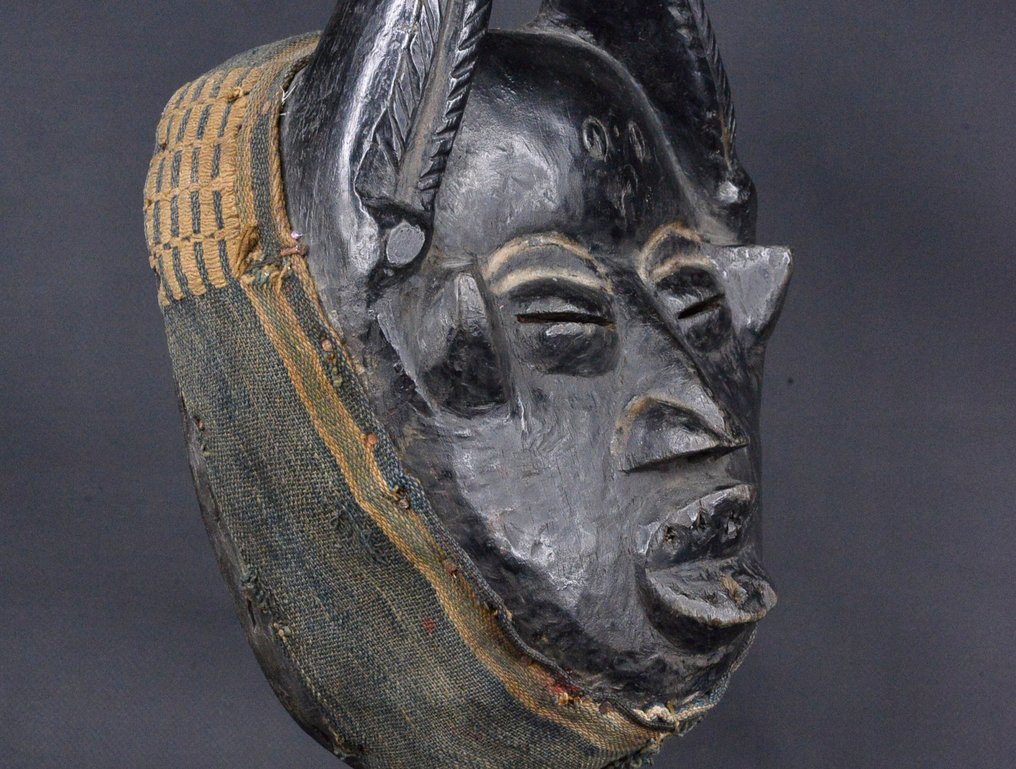
Dan-Guéré mask in wood from Côte d’Ivoire, provenance Vente Millon 07/04/2022, sold with stand, authentic original object embodying Dan–Wè culture.
AI-assisted summary
Description from the seller
Côte d'Ivoire
Dan
Bois et tissus
Height: 260mm
Width: 175mm
Depth: 110mm
Dan-Guéré (Wè) — horn projection dance mask
Côte d’Ivoire / Liberia — Dan-Guéré cultural area
The examination of the different views allows us to attribute a Dan-Guéré / Wè mask to the forest-cultural area extending from the west of Côte d’Ivoire to Liberia.
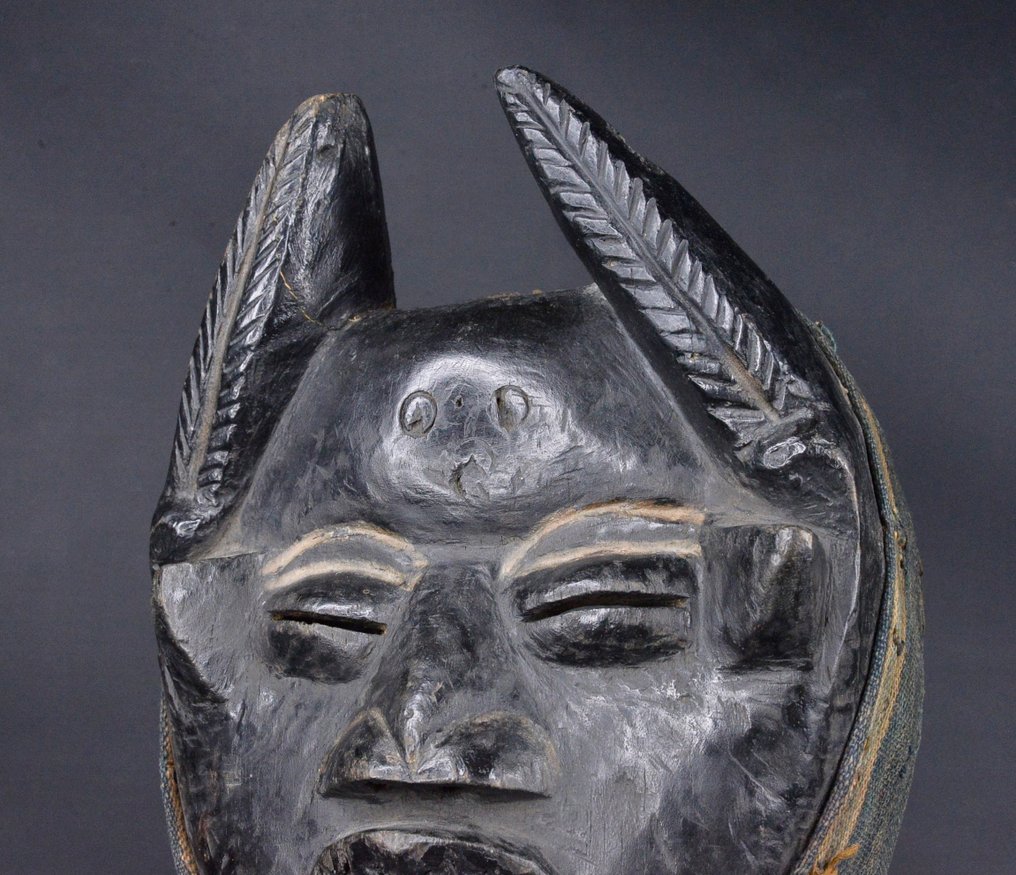
The mask morphology is highly characteristic: a human face that is strongly stylized, narrow slit eyes, a powerful nose, a widely open mouth showing the teeth, widely developed lateral ears and above all two large vertical projections on the crown of the forehead, treated as horn-like elements. The textile surround is part of the mask’s design.
This attribution finds a particularly interesting parallel in Christie’s documentation, which published a mask explicitly identified as Dan/Guéré, with an open mouth and teeth, eyes placed beneath horn projections and textile elements.
Geographical origin
West of Côte d’Ivoire / northeast Liberia.
The Dan area extends from the forest regions of northeast Liberia to northwest Côte d’Ivoire. The Musée du Quai Branly emphasizes this cross-border cultural continuity and the importance of mask traditions in this region.
The Wè/Guéré belongs to the same regional complex and maintains close stylistic relations with the Dan. The National Museum of African Art indeed describes Wè masks in direct relation to their Dan, Bassa, Guéré and Wobé neighbors.
Ethnicity / culture
Dan-Guéré (Wè)
The designation Dan-Guéré is preferable here to a simple attribution of “Dan,” as the mask displays a plastic vocabulary that belongs to the Dan–Wè/Guéré complex.
European collections show that stylistic borders between these populations must be approached with caution. The Musée du Quai Branly directly documents Dan masks from Côte d’Ivoire and Liberia, but also Wè/Guéré works belonging to the same cultural environment.
Type of object
Dance mask / anthropomorphic ritual mask with horn projections
This is a facial mask intended to be integrated into a dance ensemble and costume.
It is preferable not to assign it a precise performance name based solely on morphology. Among the Dan, identity and function of a mask also depend on its name, its spirit, its accessories and the ceremonial context; the Musée du Quai Branly explicitly emphasizes that form alone is not enough to determine the exact use of an individual mask.
Artistic and stylistic description
The face is built around strong frontality and a remarkable contrast between relatively flat surfaces and highly projected volumes.
In particular one distinguishes:
• a wide, rounded forehead;
• powerful brow ridges;
• horizontal slit eyes;
• a strongly projecting nose;
• highly contoured cheeks;
• a widely open mouth;
• carved teeth visible in the oral opening;
• large lateral ears.
The upper part is dominated by two long vertical projections, whose edges are outlined with fine diagonal incisions. They give the mask a very distinctive silhouette and constitute one of its main plastic elements.
The face is surrounded by a woven textile, held on the sides and under the chin. This arrangement is consistent with West Ivorian masks that linked the sculpted face to textile, fiber and other attached materials.
The treatment of the mouth merits particular attention: the very wide opening and the presence of sculpted teeth closely align this piece with the Wè/Guéré mask vocabulary documented in collections. The Met notably preserves Guéré masks characterized by a composite construction and a highly expressive facial treatment.
Materials and technique
Carved wood, pigments and textile.
The face was carved from the wood and then carefully modeled and incised. The details of the upper projections are highlighted by fine geometric engraving.
The peripheral textile is integrated into the object and participates in its design as a dance mask.
The British Museum collections document Dan masks in wood associated with woven or sewn fibers, while the Quai Branly Museum also presents Dan masks composed of wood and textile or fibrous materials.
Symbolism
In Dan and Wè traditions, the mask is the visible manifestation of a spiritual power associated with the forest world.
The Quai Branly Museum explains that, among the Dan, each mask theoretically has a unique identity and is considered the incarnation of a particular spirit. The mask is therefore not merely a portrait or decorative representation.
The deliberately strong expression of this example — open mouth, visible teeth, horn-like elements and accentuated volumes — participates in this transformation of the human face into a supernatural entity.
Function / ritual use
Dan and Wè masks were used in various social and ceremonial contexts.
Documentation from the National Museum of African Art indicates that Wè masks and those of their Dan, Bassa, Guéré and Wobé neighbors could be involved in settling conflicts, conveying moral messages and ceremonies related to power and war.
For the Dan, the Quai Branly Museum documents several mask categories related to initiation, entertainment, competition or social control.
For this reason, I would present the piece as a Dan-Guéré ritual dance mask, without asserting that it was used in a specific rite.
Cultural context
One of the major aspects of Dan and Wè art is the importance given to the mask as an agent being, not merely a sculpture.
The Quai Branly Museum explains that masks can be involved in community security, youth education, competitions, judicial and political decisions, or entertainment. Their appearance, costume, dance and accompanying elements together contribute to their identity.
This concept explains the great formal diversity of the corpus and the presence of very naturalistic masks alongside much more geometric, aggressive or hybrid creations.
Comparisons with museum pieces and documented collections
Musée du quai Branly – Jacques Chirac, Paris
Dan anthropomorphic mask, Côte d’Ivoire/Liberia, inv. 70.2017.66.25
This is a major European reference for the Dan attribution. The mask features an oval construction, naturalistic facial modeling, scarifications and large lateral ears. The museum notice also explains the criteria allowing some Dan masks from the northern Dan area to be linked to Mano and Tura populations.
Musée du quai Branly – Jacques Chirac, Paris
Wè mask, Côte d’Ivoire, inv. 73.1967.5.1
This piece, now documented as a Wè mask with an articulated jaw, is particularly useful for placing the present example within the Wè/Guéré corpus and for comparing the combined use of wood, textile, fibers and attached elements.
Royal Museum for Central Africa / AfricaMuseum, Tervuren, Belgium
Tervuren’s collections include a substantial set of Dan and Wobé masks, with pieces collected in Côte d’Ivoire and registered notably under inventories EO.1969.59.1036, EO.1976.38.44 and EO.1976.38.50. This institutional presence is particularly important for situating the mask in the Dan–Wè continuum of western Côte d’Ivoire.
Tervuren also preserves a Dan mask documented by its scientific department, whose large orbits and formal structure illustrate the diversity of Dan mask types.
British Museum, London
The British Museum houses several Dan masks from Côte d’Ivoire and Liberia, notably a wooden mask attributed to the Dan from Liberia, as well as another Dan wooden and fiber mask from Côte d’Ivoire. These pieces confirm the stylistic and material continuity of the Dan corpus on both sides of the border.
European reference particularly close: Christie’s Paris
A Dan/Guéré mask published by Christie’s shows an open mouth with teeth and horn projections above the eyes, with fibers and pigments. This comparison is particularly interesting for the present piece, even though it is a sales catalog entry and not a public collection.
Bibliography / sources
• Musée du quai Branly – Jacques Chirac, Dan anthropomorphic mask, Côte d’Ivoire/Liberia, inv. 70.2017.66.25.
• Musée du quai Branly – Jacques Chirac, documentation on Dan masks and their cultural context.
• AfricaMuseum, Tervuren, collection base: Dan and Wobé masks of Côte d’Ivoire.
• British Museum, Dan mask collections from Côte d’Ivoire and Liberia.
• Metropolitan Museum of Art, Guéré/Wè masks and documentation of West Ivorian arts.
• Eberhard Fischer & Hans Himmelheber, The Arts of the Dan in West Africa, Museum Rietberg, Zürich. The Rietberg Museum is a fundamental bibliographic reference on Dan art.
• Marie-Noël Verger-Fèvre, “Masks in the Dan country of Côte d’Ivoire,” in Arts of Côte d’Ivoire, Barbier-Mueller Museum, Geneva.
• Christie’s Paris, Dan/Guéré mask, Côte d’Ivoire, morphological comparison with horn projections.
Repair to the right ear.
Provenance :
Millon sale of 07/04/2022
Private collection
Objects are shipped with tracking number.
Delivery in France by Chronopost in 1 to 2 days. Delivery in the European Union by Chronopost International in 3 to 5 days. Delivery by Colissimo International for the rest of Europe and for the whole world.
We speak english.
Seller's Story
Passionate about World Arts and more specifically about African Art, we buy from collectors, former officials, military, health workers, public works staff who have worked in Africa and also in Côte d'Ivoire, from antique dealers and traders who roam across West Africa to find quality objects.
It is with pride that we present works that, beyond their power to beautify spaces, invite our collectors to resonate with the richness and depth of human expression through the most authentic art.
At Arts Ethniques Gallery, we have the privilege of offering our visitors an exclusive selection of artworks, all unique and original. Each piece presented is the outcome of a demanding artistic approach, driven by a singular vision and mastered craftsmanship, all elements that guarantee authenticity and value.
The works we offer are not industrial reproductions. They are individual creations, crafted with sensitivity and precision, each bearing its own story, identity and presence. Originality is the very foundation of our commitment to excellence. Thus, every mask and every statue in our collection is the subject of a rigorous selection, in order to preserve their rarity and singularity.
Acquiring a work from Arts Ethniques Gallery means owning a truly unique piece: a creation that embodies both talent, cultural memory and the expressive force of African art. It is also a lasting investment in a work whose artistic and emotional value transcends time.
We guarantee that every work leaving our gallery is an authentic piece, without replicas, bearing witness to the creativity, heritage and passion of the African artists who shaped them.
We invite you to participate in our gallery’s auctions with confidence. Each presented work is an original, unique and irreplaceable creation, selected with the greatest rigor to guarantee its authenticity and artistic value.
Whether you wish to enrich a personal collection or introduce an exceptional artwork into your space, Arts Ethniques Gallery offers a safe, transparent and professional setting to acquire remarkable pieces.
Art auctions are a privileged moment to discover rare works, capable of becoming the heart of a collection. Acquiring a work at our sales is not just buying an object: it is investing in a creation whose aesthetic value and cultural reach reinforce over time.
The pieces presented by Arts Ethniques Gallery testify not only to the talent and vision of the artists but also possess the ability to transform spaces and enrich the gaze of those who behold them.
Participating in our auctions is taking part in a singular experience, where the passion for art meets the rigors of collecting. Bidding on a work from Arts Ethniques Gallery goes beyond a simple transaction: it is a gesture of commitment and appreciation for art in its most authentic form.
We invite you to bid with passion and to join us in this adventure dedicated to discovery, transmission and celebration of art.
Perhaps your next heart piece is already waiting for you."
Translated by Google TranslateCôte d'Ivoire
Dan
Bois et tissus
Height: 260mm
Width: 175mm
Depth: 110mm
Dan-Guéré (Wè) — horn projection dance mask
Côte d’Ivoire / Liberia — Dan-Guéré cultural area
The examination of the different views allows us to attribute a Dan-Guéré / Wè mask to the forest-cultural area extending from the west of Côte d’Ivoire to Liberia.
The mask morphology is highly characteristic: a human face that is strongly stylized, narrow slit eyes, a powerful nose, a widely open mouth showing the teeth, widely developed lateral ears and above all two large vertical projections on the crown of the forehead, treated as horn-like elements. The textile surround is part of the mask’s design.
This attribution finds a particularly interesting parallel in Christie’s documentation, which published a mask explicitly identified as Dan/Guéré, with an open mouth and teeth, eyes placed beneath horn projections and textile elements.
Geographical origin
West of Côte d’Ivoire / northeast Liberia.
The Dan area extends from the forest regions of northeast Liberia to northwest Côte d’Ivoire. The Musée du Quai Branly emphasizes this cross-border cultural continuity and the importance of mask traditions in this region.
The Wè/Guéré belongs to the same regional complex and maintains close stylistic relations with the Dan. The National Museum of African Art indeed describes Wè masks in direct relation to their Dan, Bassa, Guéré and Wobé neighbors.
Ethnicity / culture
Dan-Guéré (Wè)
The designation Dan-Guéré is preferable here to a simple attribution of “Dan,” as the mask displays a plastic vocabulary that belongs to the Dan–Wè/Guéré complex.
European collections show that stylistic borders between these populations must be approached with caution. The Musée du Quai Branly directly documents Dan masks from Côte d’Ivoire and Liberia, but also Wè/Guéré works belonging to the same cultural environment.
Type of object
Dance mask / anthropomorphic ritual mask with horn projections
This is a facial mask intended to be integrated into a dance ensemble and costume.
It is preferable not to assign it a precise performance name based solely on morphology. Among the Dan, identity and function of a mask also depend on its name, its spirit, its accessories and the ceremonial context; the Musée du Quai Branly explicitly emphasizes that form alone is not enough to determine the exact use of an individual mask.
Artistic and stylistic description
The face is built around strong frontality and a remarkable contrast between relatively flat surfaces and highly projected volumes.
In particular one distinguishes:
• a wide, rounded forehead;
• powerful brow ridges;
• horizontal slit eyes;
• a strongly projecting nose;
• highly contoured cheeks;
• a widely open mouth;
• carved teeth visible in the oral opening;
• large lateral ears.
The upper part is dominated by two long vertical projections, whose edges are outlined with fine diagonal incisions. They give the mask a very distinctive silhouette and constitute one of its main plastic elements.
The face is surrounded by a woven textile, held on the sides and under the chin. This arrangement is consistent with West Ivorian masks that linked the sculpted face to textile, fiber and other attached materials.
The treatment of the mouth merits particular attention: the very wide opening and the presence of sculpted teeth closely align this piece with the Wè/Guéré mask vocabulary documented in collections. The Met notably preserves Guéré masks characterized by a composite construction and a highly expressive facial treatment.
Materials and technique
Carved wood, pigments and textile.
The face was carved from the wood and then carefully modeled and incised. The details of the upper projections are highlighted by fine geometric engraving.
The peripheral textile is integrated into the object and participates in its design as a dance mask.
The British Museum collections document Dan masks in wood associated with woven or sewn fibers, while the Quai Branly Museum also presents Dan masks composed of wood and textile or fibrous materials.
Symbolism
In Dan and Wè traditions, the mask is the visible manifestation of a spiritual power associated with the forest world.
The Quai Branly Museum explains that, among the Dan, each mask theoretically has a unique identity and is considered the incarnation of a particular spirit. The mask is therefore not merely a portrait or decorative representation.
The deliberately strong expression of this example — open mouth, visible teeth, horn-like elements and accentuated volumes — participates in this transformation of the human face into a supernatural entity.
Function / ritual use
Dan and Wè masks were used in various social and ceremonial contexts.
Documentation from the National Museum of African Art indicates that Wè masks and those of their Dan, Bassa, Guéré and Wobé neighbors could be involved in settling conflicts, conveying moral messages and ceremonies related to power and war.
For the Dan, the Quai Branly Museum documents several mask categories related to initiation, entertainment, competition or social control.
For this reason, I would present the piece as a Dan-Guéré ritual dance mask, without asserting that it was used in a specific rite.
Cultural context
One of the major aspects of Dan and Wè art is the importance given to the mask as an agent being, not merely a sculpture.
The Quai Branly Museum explains that masks can be involved in community security, youth education, competitions, judicial and political decisions, or entertainment. Their appearance, costume, dance and accompanying elements together contribute to their identity.
This concept explains the great formal diversity of the corpus and the presence of very naturalistic masks alongside much more geometric, aggressive or hybrid creations.
Comparisons with museum pieces and documented collections
Musée du quai Branly – Jacques Chirac, Paris
Dan anthropomorphic mask, Côte d’Ivoire/Liberia, inv. 70.2017.66.25
This is a major European reference for the Dan attribution. The mask features an oval construction, naturalistic facial modeling, scarifications and large lateral ears. The museum notice also explains the criteria allowing some Dan masks from the northern Dan area to be linked to Mano and Tura populations.
Musée du quai Branly – Jacques Chirac, Paris
Wè mask, Côte d’Ivoire, inv. 73.1967.5.1
This piece, now documented as a Wè mask with an articulated jaw, is particularly useful for placing the present example within the Wè/Guéré corpus and for comparing the combined use of wood, textile, fibers and attached elements.
Royal Museum for Central Africa / AfricaMuseum, Tervuren, Belgium
Tervuren’s collections include a substantial set of Dan and Wobé masks, with pieces collected in Côte d’Ivoire and registered notably under inventories EO.1969.59.1036, EO.1976.38.44 and EO.1976.38.50. This institutional presence is particularly important for situating the mask in the Dan–Wè continuum of western Côte d’Ivoire.
Tervuren also preserves a Dan mask documented by its scientific department, whose large orbits and formal structure illustrate the diversity of Dan mask types.
British Museum, London
The British Museum houses several Dan masks from Côte d’Ivoire and Liberia, notably a wooden mask attributed to the Dan from Liberia, as well as another Dan wooden and fiber mask from Côte d’Ivoire. These pieces confirm the stylistic and material continuity of the Dan corpus on both sides of the border.
European reference particularly close: Christie’s Paris
A Dan/Guéré mask published by Christie’s shows an open mouth with teeth and horn projections above the eyes, with fibers and pigments. This comparison is particularly interesting for the present piece, even though it is a sales catalog entry and not a public collection.
Bibliography / sources
• Musée du quai Branly – Jacques Chirac, Dan anthropomorphic mask, Côte d’Ivoire/Liberia, inv. 70.2017.66.25.
• Musée du quai Branly – Jacques Chirac, documentation on Dan masks and their cultural context.
• AfricaMuseum, Tervuren, collection base: Dan and Wobé masks of Côte d’Ivoire.
• British Museum, Dan mask collections from Côte d’Ivoire and Liberia.
• Metropolitan Museum of Art, Guéré/Wè masks and documentation of West Ivorian arts.
• Eberhard Fischer & Hans Himmelheber, The Arts of the Dan in West Africa, Museum Rietberg, Zürich. The Rietberg Museum is a fundamental bibliographic reference on Dan art.
• Marie-Noël Verger-Fèvre, “Masks in the Dan country of Côte d’Ivoire,” in Arts of Côte d’Ivoire, Barbier-Mueller Museum, Geneva.
• Christie’s Paris, Dan/Guéré mask, Côte d’Ivoire, morphological comparison with horn projections.
Repair to the right ear.
Provenance :
Millon sale of 07/04/2022
Private collection
Objects are shipped with tracking number.
Delivery in France by Chronopost in 1 to 2 days. Delivery in the European Union by Chronopost International in 3 to 5 days. Delivery by Colissimo International for the rest of Europe and for the whole world.
We speak english.
Seller's Story
Passionate about World Arts and more specifically about African Art, we buy from collectors, former officials, military, health workers, public works staff who have worked in Africa and also in Côte d'Ivoire, from antique dealers and traders who roam across West Africa to find quality objects.
It is with pride that we present works that, beyond their power to beautify spaces, invite our collectors to resonate with the richness and depth of human expression through the most authentic art.
At Arts Ethniques Gallery, we have the privilege of offering our visitors an exclusive selection of artworks, all unique and original. Each piece presented is the outcome of a demanding artistic approach, driven by a singular vision and mastered craftsmanship, all elements that guarantee authenticity and value.
The works we offer are not industrial reproductions. They are individual creations, crafted with sensitivity and precision, each bearing its own story, identity and presence. Originality is the very foundation of our commitment to excellence. Thus, every mask and every statue in our collection is the subject of a rigorous selection, in order to preserve their rarity and singularity.
Acquiring a work from Arts Ethniques Gallery means owning a truly unique piece: a creation that embodies both talent, cultural memory and the expressive force of African art. It is also a lasting investment in a work whose artistic and emotional value transcends time.
We guarantee that every work leaving our gallery is an authentic piece, without replicas, bearing witness to the creativity, heritage and passion of the African artists who shaped them.
We invite you to participate in our gallery’s auctions with confidence. Each presented work is an original, unique and irreplaceable creation, selected with the greatest rigor to guarantee its authenticity and artistic value.
Whether you wish to enrich a personal collection or introduce an exceptional artwork into your space, Arts Ethniques Gallery offers a safe, transparent and professional setting to acquire remarkable pieces.
Art auctions are a privileged moment to discover rare works, capable of becoming the heart of a collection. Acquiring a work at our sales is not just buying an object: it is investing in a creation whose aesthetic value and cultural reach reinforce over time.
The pieces presented by Arts Ethniques Gallery testify not only to the talent and vision of the artists but also possess the ability to transform spaces and enrich the gaze of those who behold them.
Participating in our auctions is taking part in a singular experience, where the passion for art meets the rigors of collecting. Bidding on a work from Arts Ethniques Gallery goes beyond a simple transaction: it is a gesture of commitment and appreciation for art in its most authentic form.
We invite you to bid with passion and to join us in this adventure dedicated to discovery, transmission and celebration of art.
Perhaps your next heart piece is already waiting for you."
Translated by Google TranslateDetails
Indigenous object name
Mask
Ethnic group/ culture
Dan
Country of Origin
Côte d'Ivoire
Material
Wood
Sold with stand
Yes
Condition
Fair condition
Authenticity
Original/official
Sold by
