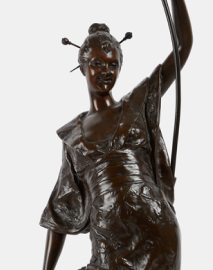
Sculpture, Ercole e Lica - 27 cm - Alabaster


03
days
03
hours
56
minutes
47
seconds

 | €35 | |
|---|---|---|
| €30 | |
| €25 | |
Catawiki Buyer Protection
Your payment’s safe with us until you receive your object.View details
Trustpilot 4.4 | 144679 reviews
Rated Excellent on Trustpilot.
The unsigned alabaster sculpture *Ercole e Lica*, in an antique style and originating from Italy, depicts Hercules holding Lichas by the foot, ready to throw him.
AI-assisted summary
Description from the seller
Hercules is a very famous hero of Greek mythology, remembered in history for his legendary strength. One day he is traveling with his wife Deianira to reach Ceice, a friend of theirs. Along the way they must cross a river. Here they meet Nessus, a centaur (a mythical creature with the body of a horse and the torso of a man) who offers to accompany the woman. Nessus falls in love with Deianira and tries to seize her, but Hercules stops him. Nessus, before dying, gives the woman drops of his blood, telling her that she could use it to prepare a potion that would make Hercules fall in love with her forever (in reality it is a ruse and it is a lethal poison).
Later, Hercules falls in love with Iole and when Deianira learns of it, she decides to prepare the potion with the centaur’s blood. Once ready, she pours it on a cloak of Hercules and asks Lica, their faithful servant, to bring it to the husband.
Hercules wears it and thus the poison reaches his skin, making it burn and driving him insane with pain. No longer able to control himself, he grabs Lica and hurls him far away, sending him crashing into the sea, where he turns into a rock.
When Deianira discovers that Nessus’s blood was actually poison, the pain is too strong and she dies. Hercules, in an attempt to escape the torture, throws himself into the flames, but is saved by the goddess Athena who carries him to Olympus, where he becomes immortal.
The sculpture represents the Greek hero Hercules, who, in a moment of madness caused by pain, is about to fling away the servant Lica, who had brought him—unbeknownst to him—a poisoned cloak. Hercules will become immortal.
Hercules is depicted at the moment of maximal power, sculpted as he seizes Lica by the ankle, ready to throw him.
A sculpture in alabaster, which, by uniting dramatic physical tension with perfect formal balance, together with the right dimensions, makes this piece a timeless enchanting masterpiece of craftsmanship. He is not afraid to stay alone, at an entrance, on a bookshelf, in an Old or modern setting, the myth of Hercules remains forever immortal.
Shipping to be arranged for destinations outside the continent.
Details
Era
1900-2000
Country of origin
Italy
Style
Antique
Material
Alabaster
Title of artwork
Ercole e Lica
Signature
Not signed
Condition
Good condition
Height
27 cm
Width
14.5 cm
Depth
7.5 cm
Weight
900 g
Sold by