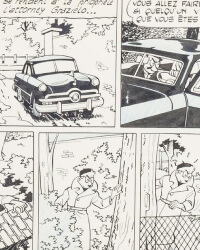
Kyōji Ogata (緒方恭二) - 27 Original page - Pole Position for Murder - Complete chapter


06
days
04
hours
16
minutes
24
seconds

 | €75 |
|---|
Catawiki Buyer Protection
Your payment’s safe with us until you receive your object.View details
Trustpilot 4.4 | 143727 reviews
Rated Excellent on Trustpilot.
Kyōji Ogata drew 27 original manga pages forming a complete chapter in the Pole Position for Murder series, titled Complete chapter, published by Group Zero, measuring 25.7 × 36.4 cm and in excellent condition.
AI-assisted summary
Description from the seller
“Satsujin no Pole Position” (殺人のポールポジション) — “Pole Position for Murder”
Complete chapter comprising 27 original manga pages
Story by Takayuki Miki (三木孝祐)
Including two-colour and black-and-white pages, with screentone on selected sheets
Bringing together all 27 original pages of “Pole Position for Murder,” this lot offers the opportunity to encounter Kyōji Ogata’s work as a complete narrative rather than an isolated image. Created for Shisetsu 38 Bunsho—loosely translated as “Private 38th Precinct”—the chapter belongs to Ogata’s collaboration with writer Takayuki Miki. The series has subsequently been made available in Japan in a four-volume digital edition published by Group Zero. You can purchase the cover illustration of this chapter on a separate auction.
The illustrated sheets reveal a striking range of visual registers, from densely observed workshop interiors and conversational exchanges to spectacular scenes of automotive destruction. A racing car disintegrates before a crowded grandstand; elsewhere, an explosion sends wreckage through a field of radiating lines, followed by views of burning debris and figures standing above a rocky precipice. Against these large-scale set pieces, the quieter investigative page establishes an altogether different rhythm, using changes of viewpoint, facial expression and gesture to sustain the exchange between characters.
Ogata’s handling of contrast gives these pages much of their force. In the two-colour racing sequence, red-orange accents intensify the explosion and its aftermath, working against the black drawing and pale areas of the sheet. The limited palette does not simply decorate the scene: it reinforces the outward thrust of the impact and distinguishes the heat of the wreckage from the surrounding mechanical forms. Oversized sound effects cut across the panel boundaries, becoming an active part of the composition rather than a separate layer of text.
The black-and-white explosion page achieves comparable intensity through different means. Dense hatching, tonal patterns, dark masses and scattered white accents create a turbulent field of smoke and airborne fragments. The dominant upper panel delivers the initial spectacle, while the smaller panels below shift attention between the burning wreck and the figures overlooking it. This movement from expansive destruction to human scale gives the action both spatial clarity and dramatic consequence.
The workshop page provides an effective counterpoint. Architectural framing, layered textures and carefully placed vehicles establish a credible working environment before the sequence moves into closer views of the speakers. The sunglass-wearing investigator’s notebook, listening posture and final thoughtful gesture turn exposition into a succession of readable actions. The page demonstrates the less conspicuous but equally important craft that underpins an action manga: controlling pace when the spectacle gives way to inquiry.
As a complete chapter - minus the illustration cover - , the lot allows a collector to follow these shifts of tempo across the original sheets, examining the relationship between dramatic highlights and the connective passages that make them effective. Its mixture of two-colour work, black-and-white drawing and selectively applied screentone further broadens its interest, preserving different approaches to atmosphere, surface and emphasis within a single narrative unit. The photographed pages also retain visible white interventions, pasted dialogue elements and marginal numbering, offering material evidence of the working pages’ preparation for reproduction.
Details
Item
Original page
Number of objects
27
Series
Pole Position for Murder
Condition
Excellent condition
Publisher
Group Zero
Artist
Kyōji Ogata (緒方恭二)
Title of artwork
Complete chapter
Width
25.7 cm
Height
36.4 cm
Sold by