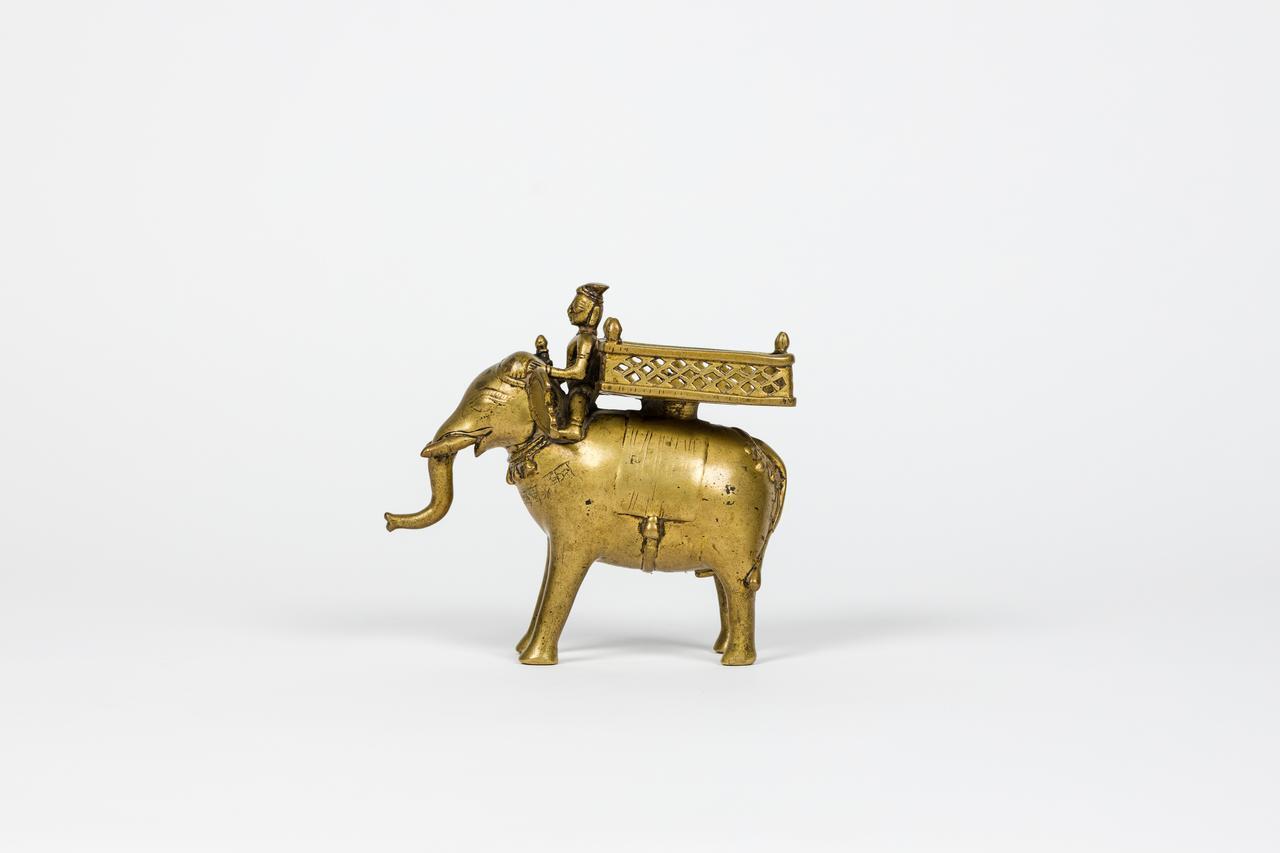
Perfume vase - Patinated bronze - Bronze kohl pot


04
days
11
hours
39
minutes
35
seconds

No bids placed
Catawiki Buyer Protection
Your payment’s safe with us until you receive your object.View details
Trustpilot 4.4 | 144879 reviews
Rated Excellent on Trustpilot.
This patinated bronze kohl pot from Turkmenistan combines Seljuk-inspired aesthetics with Qajar Baroque forms.
AI-assisted summary
Description from the seller
This khôl pot in dark patinated bronze is characterized by a complex architecture on several registers. It rests on four straight feet ending in slightly flared bases. In the center, the globular body is flanked by several projecting tenons. The elongated neck supports a wide vertical polylobed cartouche, which is finely engraved with a calligraphic inscription in its upper part and interlaced floral motifs below. A flat circular lip crowns the top of this object measuring 11.5 cm. This blend of geometric forms and chiselled ornamentation well illustrates the reinterpretation of Seljuk aesthetics, joined to the Baroque Qajar shapes that have attracted the eye of collectors, J. Naus, customs inspector in Iran in the early 20th century.
Former Joseph Naus collection (1849-1920), often designated by the initial J. Naus, was a high official and diplomat who played a central, but very controversial, role in the history of Iran (then called the Persian Empire) in the early 20th century. Joseph Naus (1849-1920) was a Belgian high official recruited by the Shah of Persia in 1898 to clean up the Empire’s finances. While he brilliantly reorganized the customs to the point of becoming minister, his tariff reforms, regarded as favorable to foreign powers, earned him the hatred of Iranian merchants and the clergy. The situation exploded in 1905 because of a blunder: a photo of him dressed as a mollah at a masquerade ball began to circulate. Perceived as a grave blasphemy, the incident lit the fuse and forced him to flee the country in 1907. Alongside his tumultuous political career, his many years in Persia allowed him to assemble a very fine collection of Oriental antiquities.
Details
Era
1400-1900
Bronze type
Patinated bronze
Specific region of origin
Perse
Title additional information
Bronze kohl pot
Country of origin
Turkmenistan
Material
Bronze
Style
Antique
Condition
Good condition - used with small signs of aging & blemishes
Height
11.5 cm
Width
7 cm
Depth
7 cm
Estimated period
1800-1850, 1850-1900
Sold by