Pablo Palazuelo - Sigilla


| €200 | ||
|---|---|---|
| €170 | ||
| €150 | ||
Catawiki Buyer Protection
Your payment’s safe with us until you receive your object.View details
Trustpilot 4.4 | 122028 reviews
Rated Excellent on Trustpilot.
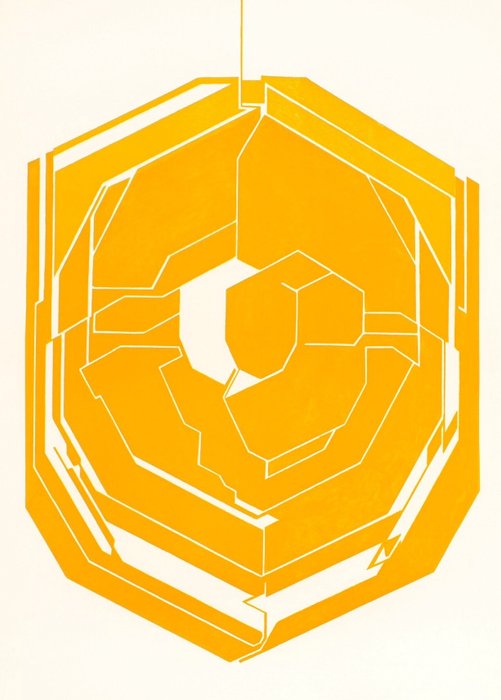
Pablo Palazuelo's lithograph Sigilla (1980) from the Emblema series, limited edition of 3000, signed on the plate, printed on Arches paper, 80 × 58 cm, in excellent condition, Spain origin, abstract style, published by Maeght and printed by Arte París, COA included.
Description from the seller
Lithograph by Pablo Palazuelo (* 1927 † 2003, Madrid) titled “Sigilla”
This work belongs to the 'Emblema' series, created by Palazuelo in 1980.
Signed directly on the surface by the artist.
Edited by Maeght. Printed by Arte París. *Sold Out Edition*.
Made on high-quality Arches paper, with its characteristic watermark.
Includes Certificate of Authenticity (COA).
Last units
Dimensions: 80 x 58 cm
Year: 1980
Edition: 3000 copies.
Condition: Excellent (this work has never been framed or exhibited, and has always been kept in a professional art folder, thus remaining in perfect condition).
Provenance: Private Collection.
The item will be carefully handled and packaged in a reinforced cardboard box. The shipment will be certified with a tracking number.
The shipment will also include transport insurance for the final value of the work with full reimbursement in case of loss or damage, at no cost to the buyer.
Pablo Palazuelo studied architecture in Madrid and at the Royal Institute of British Architects in Oxford. Since 1939, he dedicated himself exclusively to painting. After briefly developing a neo-Cubist style inspired by Picasso and Braque, he became interested in the work of sculptors like Naum Gabo and Anton Pevsner, and in the paintings of Paul Klee, which had a profound influence on him.
His early abstract drawings were based on the observation of natural structures, such as snow crystals, microscopic examinations of cells, or aerial photographs; the search for geometric structures and their mathematical proportions would characterize Palazuelo's work throughout his entire career.
In 1948, he settled in the Spanish Pavilion at the University City of Paris, where he met Chillida.
His first solo exhibition took place at the Maeght Gallery in Paris in 1955. Subsequently, he exhibited at major European and American museums, such as the Guggenheim in New York, the Carnegie International in Pittsburgh, and the Museum of Modern Art in the City of Paris.
In 1954, he began developing a sculptural facet that reached its peak in the 1970s. Over time, his geometry gained more dynamism and flexibility, and his rhythm became faster: the fragmentation produced on the surface creates a network of straight and broken lines and gives rise to a crystallization structure.
In 1969, he returned to Spain, where he established his definitive studio. He was awarded the Gold Medal of Fine Arts in 1982. In 2004, he received the Velázquez Prize from the Spanish Ministry of Culture.
Seller's Story
Lithograph by Pablo Palazuelo (* 1927 † 2003, Madrid) titled “Sigilla”
This work belongs to the 'Emblema' series, created by Palazuelo in 1980.
Signed directly on the surface by the artist.
Edited by Maeght. Printed by Arte París. *Sold Out Edition*.
Made on high-quality Arches paper, with its characteristic watermark.
Includes Certificate of Authenticity (COA).
Last units
Dimensions: 80 x 58 cm
Year: 1980
Edition: 3000 copies.
Condition: Excellent (this work has never been framed or exhibited, and has always been kept in a professional art folder, thus remaining in perfect condition).
Provenance: Private Collection.
The item will be carefully handled and packaged in a reinforced cardboard box. The shipment will be certified with a tracking number.
The shipment will also include transport insurance for the final value of the work with full reimbursement in case of loss or damage, at no cost to the buyer.
Pablo Palazuelo studied architecture in Madrid and at the Royal Institute of British Architects in Oxford. Since 1939, he dedicated himself exclusively to painting. After briefly developing a neo-Cubist style inspired by Picasso and Braque, he became interested in the work of sculptors like Naum Gabo and Anton Pevsner, and in the paintings of Paul Klee, which had a profound influence on him.
His early abstract drawings were based on the observation of natural structures, such as snow crystals, microscopic examinations of cells, or aerial photographs; the search for geometric structures and their mathematical proportions would characterize Palazuelo's work throughout his entire career.
In 1948, he settled in the Spanish Pavilion at the University City of Paris, where he met Chillida.
His first solo exhibition took place at the Maeght Gallery in Paris in 1955. Subsequently, he exhibited at major European and American museums, such as the Guggenheim in New York, the Carnegie International in Pittsburgh, and the Museum of Modern Art in the City of Paris.
In 1954, he began developing a sculptural facet that reached its peak in the 1970s. Over time, his geometry gained more dynamism and flexibility, and his rhythm became faster: the fragmentation produced on the surface creates a network of straight and broken lines and gives rise to a crystallization structure.
In 1969, he returned to Spain, where he established his definitive studio. He was awarded the Gold Medal of Fine Arts in 1982. In 2004, he received the Velázquez Prize from the Spanish Ministry of Culture.