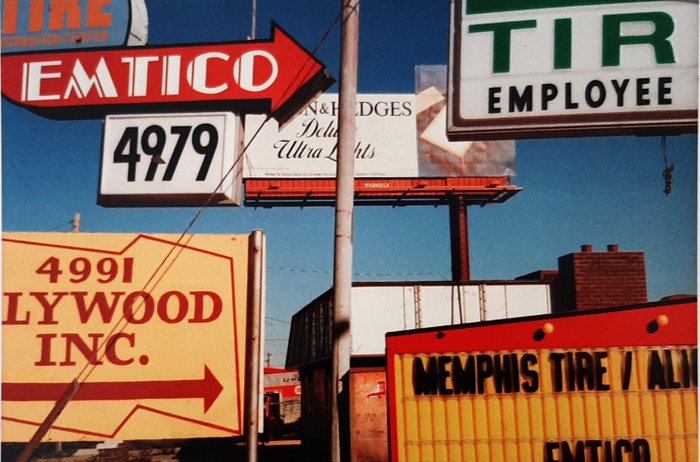
William Eggleston - The Democratic Forest, 1983

00
days
12
hours
54
minutes
19
seconds
Current bid
€ 57
No reserve price
26 other people are watching this object
nlBidder 3466 €57
nlBidder 5411 €50
nlBidder 3466 €50

Catawiki Buyer Protection

Your payment’s safe with us until you receive your object.View details

Trustpilot 4.4 | 121798 reviews

Rated Excellent on Trustpilot.

Description from the seller

Subscribers of the art magazine received this photograph and all others from the series as a noble print from STEIDL Verlag. For each issue, paper, format, and printing process were coordinated with the photographer. This resulted in a high-quality collection of the best contemporary photography in a precious edition.

Thomas Weski about the work of the legendary
US Americans, which as a milestone of the
artistic color photography is considered
The 'most hated exhibition of the year' — this is how a critic in 1976 retrospectively described the solo exhibition of color photographs by William Eggleston at the Museum of Modern Art in New York. The artist, born in Memphis in 1939, used an expensive manufacturing process from advertising for his prints, which allowed him to control the coloring so individually that it influenced perception. The exhibition's curator had sharply described Eggleston as the 'inventor of color photography' to characterize his use of color, which until then had been associated only with painting. Until this exhibition, color photography was reserved for advertising and photojournalism, and the famous photographer Walker Evans had called it 'vulgar.' Therefore, a solo exhibition of color photographs at the Museum of Modern Art, still regarded today as the pinnacle of artistic photography, was seen as provocative.
The intense criticism was not only due to Eggleston's motives, which he found in his immediate environment and which were considered everyday and banal. The seemingly casual style of his photographs, reminiscent of family album shots, also caused offense. Today, Eggleston's exhibition is regarded as a milestone in the recognition of color photography as an artistic form of expression. Eggleston developed an artistic photography in a snapshot style because it allowed him to see everything as worthy of depiction and to express it in an accessible visual language. In doing so, the photographer deliberately sets his shots so that the cut-off objects extend the images beyond the edges to suggest other interpretations and occasionally develop a mysterious, autonomous life. The often profound atmosphere of many of his images, which deal with existential themes such as alienation and loneliness, has influenced filmmakers like Gus Van Sant and Sofia Coppola. Eggleston's concept of a 'Democratic Camera' has, however, especially shaped generations of young photographers who venerate the artist, now widely acclaimed, in a cult-like manner.

Subscribers of the art magazine received this photograph and all others from the series as a noble print from STEIDL Verlag. For each issue, paper, format, and printing process were coordinated with the photographer. This resulted in a high-quality collection of the best contemporary photography in a precious edition.

Thomas Weski about the work of the legendary
US Americans, which as a milestone of the
artistic color photography is considered
The 'most hated exhibition of the year' — this is how a critic in 1976 retrospectively described the solo exhibition of color photographs by William Eggleston at the Museum of Modern Art in New York. The artist, born in Memphis in 1939, used an expensive manufacturing process from advertising for his prints, which allowed him to control the coloring so individually that it influenced perception. The exhibition's curator had sharply described Eggleston as the 'inventor of color photography' to characterize his use of color, which until then had been associated only with painting. Until this exhibition, color photography was reserved for advertising and photojournalism, and the famous photographer Walker Evans had called it 'vulgar.' Therefore, a solo exhibition of color photographs at the Museum of Modern Art, still regarded today as the pinnacle of artistic photography, was seen as provocative.
The intense criticism was not only due to Eggleston's motives, which he found in his immediate environment and which were considered everyday and banal. The seemingly casual style of his photographs, reminiscent of family album shots, also caused offense. Today, Eggleston's exhibition is regarded as a milestone in the recognition of color photography as an artistic form of expression. Eggleston developed an artistic photography in a snapshot style because it allowed him to see everything as worthy of depiction and to express it in an accessible visual language. In doing so, the photographer deliberately sets his shots so that the cut-off objects extend the images beyond the edges to suggest other interpretations and occasionally develop a mysterious, autonomous life. The often profound atmosphere of many of his images, which deal with existential themes such as alienation and loneliness, has influenced filmmakers like Gus Van Sant and Sofia Coppola. Eggleston's concept of a 'Democratic Camera' has, however, especially shaped generations of young photographers who venerate the artist, now widely acclaimed, in a cult-like manner.

Details

Date of print
1983
Artist
William Eggleston
Sold by
Owner or reseller
Title of artwork
The Democratic Forest, 1983
Condition
Very fine
Technique
C-Print
Height
19 cm
Width
25.3 cm
Signature
Not signed
Genre
Cityscape
GermanyVerified
36
Objects sold
Private

Similar objects

For you in

Photography