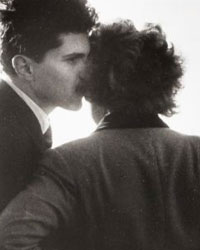
Man Ray (Emmanuel Radnitzky) - Retour à la raison, 1923


| €1 |
|---|
Catawiki Buyer Protection
Your payment’s safe with us until you receive your object.View details
Trustpilot 4.4 | 122630 reviews
Rated Excellent on Trustpilot.
Description from the seller
Man Ray (Emmanuel Radnitzky). Retour à la raison, 1923.
'Copyright 2001 Man Ray Trust, Paris / VG Bild-Kunst, Bonn' on the bottom back. Total dimensions: 36,5 x 28,2 cm on semi-gloss paper. Fine condition. Printed Lated, 2000's.
This image stems from Retour à la raison, the experimental short film Man Ray created in 1923, blending Rayographs, animated textures, and the torso of Kiki of Montparnasse into one of the earliest Dadaist cinematic works. In this frame translated to paper, the body becomes a luminous surface: flowing lines of light, shifting shadows, and a sculptural interplay of black and white that turns the human form into pure optical rhythm.
The photograph distills one of Man Ray’s most radical ideas —that an image does not need to describe in order to reveal. The figure becomes almost abstract, a landscape of light that continues to challenge perception a century later. It is a piece that bridges modern art history from Dada to Surrealism in a single visual gesture.
Man Ray stands as one of the foundational figures of 20th-century photography. An inventor and visionary, his influence resonates alongside Henri Cartier-Bresson, Ansel Adams, Edward Weston, Robert Capa, Elliott Erwitt, Walker Evans, Alfred Stieglitz, Diane Arbus, Cindy Sherman, Irving Penn, Robert Mapplethorpe, Richard Avedon and other artists who reshaped the medium.
A remarkable piece for collectors of modern photography, Dada experimentation, and body abstraction —a fragment of Man Ray’s creative laboratory where light, form, and perception remain in perpetual motion.
Man Ray (Emmanuel Radnitzky). Retour à la raison, 1923.
'Copyright 2001 Man Ray Trust, Paris / VG Bild-Kunst, Bonn' on the bottom back. Total dimensions: 36,5 x 28,2 cm on semi-gloss paper. Fine condition. Printed Lated, 2000's.
This image stems from Retour à la raison, the experimental short film Man Ray created in 1923, blending Rayographs, animated textures, and the torso of Kiki of Montparnasse into one of the earliest Dadaist cinematic works. In this frame translated to paper, the body becomes a luminous surface: flowing lines of light, shifting shadows, and a sculptural interplay of black and white that turns the human form into pure optical rhythm.
The photograph distills one of Man Ray’s most radical ideas —that an image does not need to describe in order to reveal. The figure becomes almost abstract, a landscape of light that continues to challenge perception a century later. It is a piece that bridges modern art history from Dada to Surrealism in a single visual gesture.
Man Ray stands as one of the foundational figures of 20th-century photography. An inventor and visionary, his influence resonates alongside Henri Cartier-Bresson, Ansel Adams, Edward Weston, Robert Capa, Elliott Erwitt, Walker Evans, Alfred Stieglitz, Diane Arbus, Cindy Sherman, Irving Penn, Robert Mapplethorpe, Richard Avedon and other artists who reshaped the medium.
A remarkable piece for collectors of modern photography, Dada experimentation, and body abstraction —a fragment of Man Ray’s creative laboratory where light, form, and perception remain in perpetual motion.